This blog is a continuation of my previous blog, Dapr - Workflow & .NET Aspire, which introduced the concepts of Prompt Chaining, Routing and Parallelization. In this blog, the focus shifts to advanced agentic patterns—including Orchestrator-Workers, Evaluator-Optimizer, and Autonomous Agent—demonstrating how these can be implemented using Dapr Workflow and the Dapr Conversation API to build scalable, stateful, and modular LLM pipelines in distributed .NET applications.
Prerequisties & Solution Structure
- Refer to the earlier blog post, Dapr - Workflow & .NET Aspire
Changes in AppHost
The OrchestratorWorkers project (a new Minimal API) has been added, and the web frontend has been updated to reference it.
// AppHost.cs
using CommunityToolkit.Aspire.Hosting.Dapr;

var builder = DistributedApplication.CreateBuilder(args);

// Diagrid Dashboard for Dapr Workflow Visualization
var diagridDashboard = builder.AddContainer("diagrid-dashboard", "ghcr.io/diagridio/diagrid-dashboard", "latest")
    .WithHttpEndpoint(8080, 8080, name: "dashboard");

// Add RedisInsight GUI for Redis data visualization
var redisInsight = builder.AddContainer("redisinsight", "redislabs/redisinsight", "latest")
    .WithHttpEndpoint(8001, 8001)
    .WithEnvironment("RI_APP_PORT", "8001")
    .WithEnvironment("RI_HOST", "0.0.0.0")
    .WithBindMount(Path.Combine(builder.AppHostDirectory, "redisinsight-data"), "/data");

// Pattern - 1. AugmentedLlm
var augmentedLlmService = builder.AddProject<Projects.AspireWithDapr_AugmentedLlm>("AugmentedLlm")
    .WithHttpHealthCheck("/health")
    .WithDaprSidecar(new DaprSidecarOptions
    {
        ResourcesPaths = ["components"],
        Config = "components/daprConfig.yaml",
        EnableApiLogging = false
    })
    .WithEnvironment("DAPR_HOST_IP", "127.0.0.1")
    .WithEnvironment("ZIPKIN_ENDPOINT", "http://localhost:9411/api/v2/spans");

// Pattern - 1.1 StatefulLlm
var statefulLlmService = builder.AddProject<Projects.AspireWithDapr_StatefulLlm>("StatefulLlm")
    .WithExternalHttpEndpoints()
    .WithHttpHealthCheck("/health")
    .WithDaprSidecar(new DaprSidecarOptions
    {
        ResourcesPaths = ["components"],
        Config = "components/daprConfig.yaml",
        EnableApiLogging = false
    })
    .WithEnvironment("DAPR_HOST_IP", "127.0.0.1")
    .WithEnvironment("ZIPKIN_ENDPOINT", "http://localhost:9411/api/v2/spans");

// Pattern - 2. PromptChaining
var promptChainingService = builder.AddProject<Projects.AspireWithDapr_PromptChaining>("PromptChaining")
    .WithExternalHttpEndpoints()
    .WithHttpHealthCheck("/health")
    .WithDaprSidecar(new DaprSidecarOptions
    {
        ResourcesPaths = ["components"],
        Config = "components/daprConfig.yaml",
        EnableApiLogging = false
    })
    .WithEnvironment("DAPR_HOST_IP", "127.0.0.1")
    .WithEnvironment("ZIPKIN_ENDPOINT", "http://localhost:9411/api/v2/spans");

// Pattern - 3. Routing
var routingService = builder.AddProject<Projects.AspireWithDapr_Routing>("Routing")
    .WithExternalHttpEndpoints()
    .WithHttpHealthCheck("/health")
    .WithDaprSidecar(new DaprSidecarOptions
    {
        ResourcesPaths = ["components"],
        Config = "components/daprConfig.yaml"
    })
    .WithEnvironment("DAPR_HOST_IP", "127.0.0.1")
    .WithEnvironment("ZIPKIN_ENDPOINT", "http://localhost:9411/api/v2/spans");

// Pattern - 4. Parallelization
var parallelizationService = builder.AddProject<Projects.AspireWithDapr_Parallelization>("Parallelization")
    .WithExternalHttpEndpoints()
    .WithHttpHealthCheck("/health")
    .WithDaprSidecar(new DaprSidecarOptions
    {
        ResourcesPaths = ["components"],
        Config = "components/daprConfig.yaml"
    })
    .WithEnvironment("DAPR_HOST_IP", "127.0.0.1")
    .WithEnvironment("ZIPKIN_ENDPOINT", "http://localhost:9411/api/v2/spans");

// Pattern - 5. OrchestratorWorkers
var orchestratorWorkersService = builder.AddProject<Projects.AspireWithDapr_OrchestratorWorkers>("OrchestratorWorkers")
    .WithExternalHttpEndpoints()
    .WithHttpHealthCheck("/health")
    .WithDaprSidecar(new DaprSidecarOptions
    {
        ResourcesPaths = ["components"],
        Config = "components/daprConfig.yaml"
    })
    .WithEnvironment("DAPR_HOST_IP", "127.0.0.1")
    .WithEnvironment("ZIPKIN_ENDPOINT", "http://localhost:9411/api/v2/spans");

// Web Frontend
builder.AddProject<Projects.AspireWithDapr_Web>("webfrontend")
    .WithExternalHttpEndpoints()
    .WithHttpHealthCheck("/health")
    .WithReference(augmentedLlmService)
    .WaitFor(augmentedLlmService)
    .WithReference(statefulLlmService)
    .WaitFor(statefulLlmService)
    .WithReference(promptChainingService)
    .WaitFor(promptChainingService)
    .WithReference(routingService)
    .WaitFor(routingService)
    .WithReference(parallelizationService)
    .WaitFor(parallelizationService)
    .WithReference(orchestratorWorkersService)
    .WithDaprSidecar(new DaprSidecarOptions
    {
        ResourcesPaths = ["components"],
        Config = "components/daprConfig.yaml"
    })
    .WithEnvironment("DAPR_HOST_IP", "127.0.0.1")
    .WithEnvironment("ZIPKIN_ENDPOINT", "http://localhost:9411/api/v2/spans");

builder.Build().Run();
Orchestrator-Workers
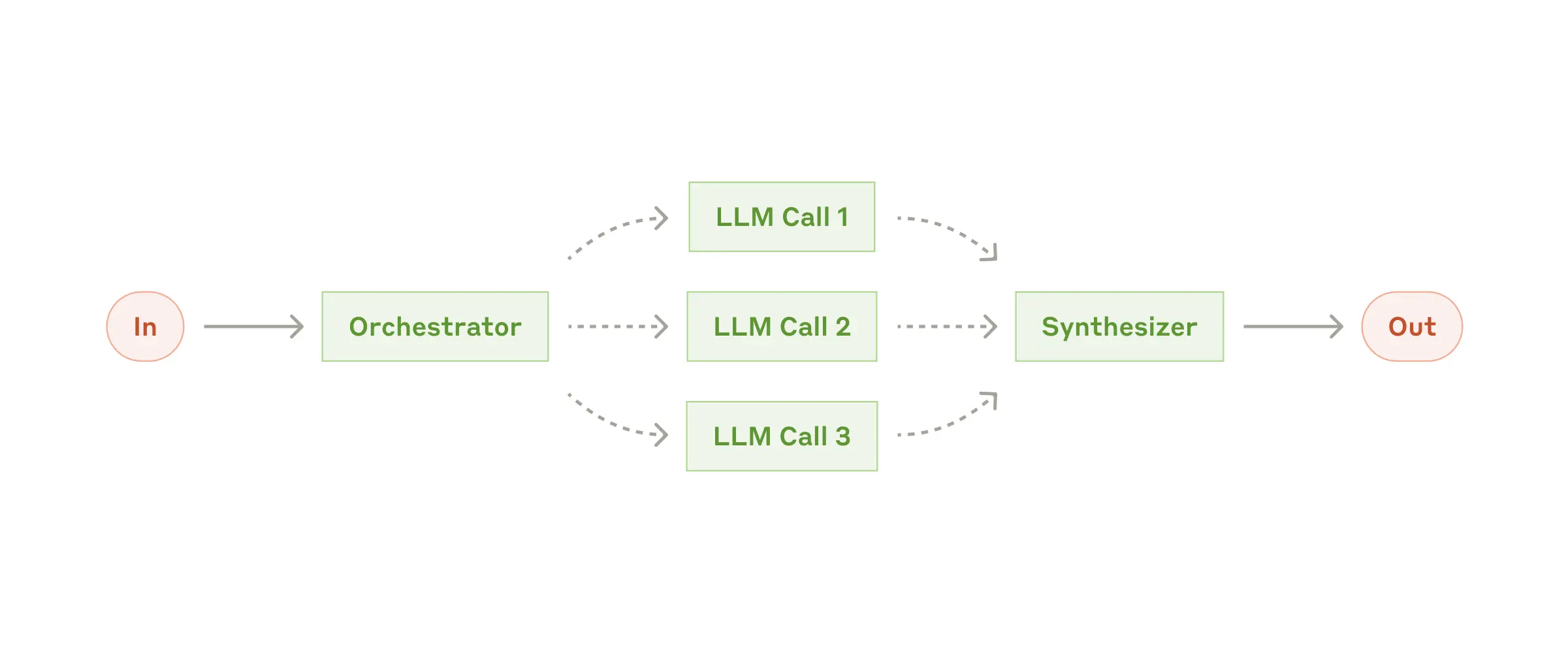
The orchestrator–workers workflow centers on a primary LLM that dynamically decomposes tasks, delegates execution to worker LLMs, and synthesizes the outcomes.
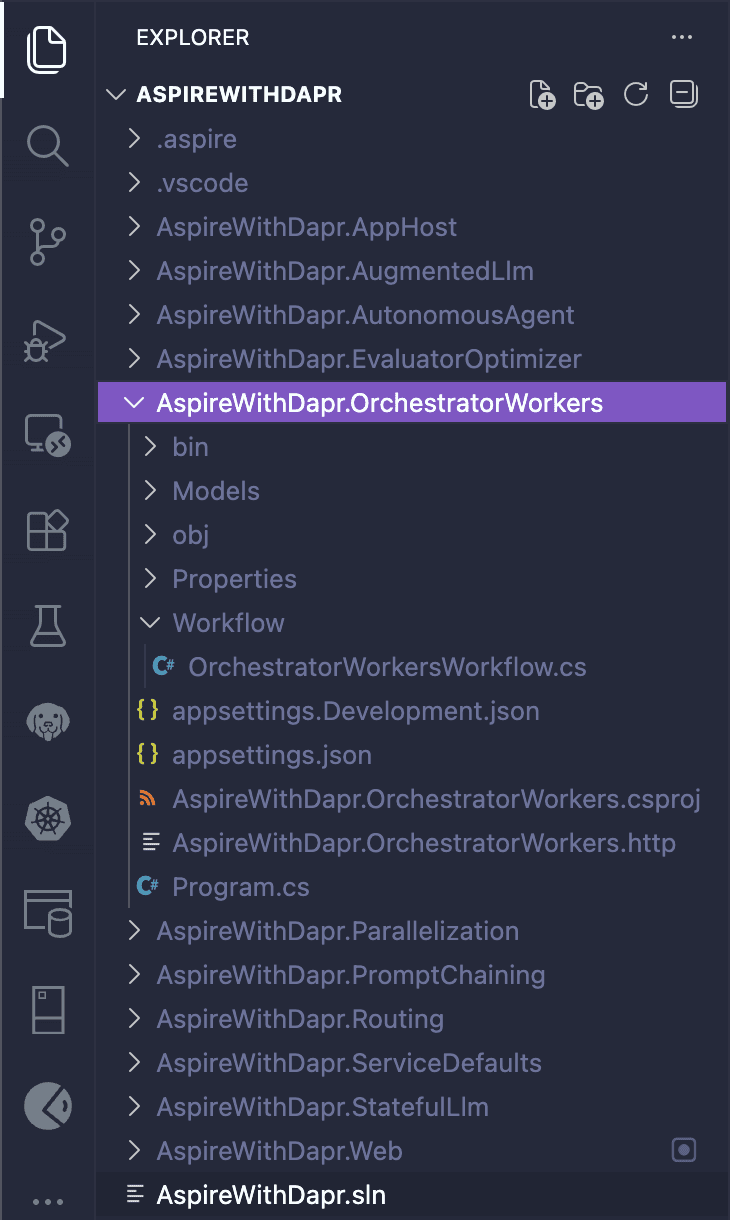
dotnet add package Dapr.AI
dotnet add package Dapr.Workflow
// LlmModels.cs
using System.ComponentModel.DataAnnotations;
namespace AspireWithDapr.OrchestratorWorkers.Models;
public record LlmRequest(
[Required] [MinLength(1)] string Prompt,
Dictionary<string, object>? Context = null,
string? Model = null,
double? Temperature = null);
public record LlmResponse(
string Response,
Dictionary<string, object>? Metadata = null);
public record OrchestratorRequest(
[Required] [MinLength(1)] string Prompt,
int WorkerCount = 3,
Dictionary<string, object>? Context = null,
string? Model = null,
double? Temperature = null);
public record Subtask(
string Id,
string Description,
string Type);
public record WorkerTask(
Subtask Subtask,
string? Model = null,
double? Temperature = null);
public record WorkerResult(
string SubtaskId,
string Output,
double Confidence);// Program.cs
#pragma warning disable DAPR_CONVERSATION
using System.ComponentModel.DataAnnotations;
using Dapr.AI.Conversation.Extensions;
using Dapr.Workflow;
using AspireWithDapr.OrchestratorWorkers.Models;
using AspireWithDapr.OrchestratorWorkers.Workflow;
var builder = WebApplication.CreateBuilder(args);
builder.AddServiceDefaults();
builder.Services.AddProblemDetails();
builder.Services.AddOpenApi();
builder.Services.AddDaprConversationClient();
builder.Services.AddDaprWorkflow(options =>
{
options.RegisterWorkflow<OrchestratorWorkersWorkflow>();
options.RegisterActivity<BreakdownActivity>();
options.RegisterActivity<WorkerActivity>();
options.RegisterActivity<AggregateActivity>();
options.RegisterActivity<LoggingActivity>();
});
var app = builder.Build();
// Initialize workflow logger with the app's logger factory
var loggerFactory = app.Services.GetRequiredService<ILoggerFactory>();
OrchestratorWorkersWorkflow.SetLogger(loggerFactory);
app.UseExceptionHandler();
if (app.Environment.IsDevelopment())
{
app.MapOpenApi();
}
app.MapGet("/", () => Results.Ok(new {
service = "Orchestrator-Workers LLM API",
version = "1.0.0",
endpoints = new[] { "/llm/query", "/llm/query/{instanceId}", "/llm/query/{instanceId}/status", "/health" },
description = "Orchestrator dynamically breaks down tasks, delegates to worker LLMs, and synthesizes results"
}))
.WithName("GetServiceInfo")
.WithTags("Info");
app.MapPost("/llm/query", async (
[Required] OrchestratorRequest request,
DaprWorkflowClient workflowClient,
ILogger<Program> logger,
CancellationToken cancellationToken) =>
{
if (string.IsNullOrWhiteSpace(request.Prompt))
{
return Results.BadRequest(new { error = "Prompt is required and cannot be empty." });
}
if (request.WorkerCount < 1 || request.WorkerCount > 10)
{
return Results.BadRequest(new { error = "WorkerCount must be between 1 and 10." });
}
try
{
logger.LogInformation("Starting Orchestrator-Workers workflow for prompt: {Prompt} with length {PromptLength} characters | Worker Count: {WorkerCount}",
request.Prompt, request.Prompt.Length, request.WorkerCount);
var instanceId = Guid.NewGuid().ToString();
await workflowClient.ScheduleNewWorkflowAsync(
nameof(OrchestratorWorkersWorkflow),
instanceId,
request);
logger.LogInformation("Workflow started with instance ID: {InstanceId}", instanceId);
return Results.Accepted($"/llm/query/{instanceId}", new {
instanceId,
status = "started"
});
}
catch (Exception ex)
{
logger.LogError(ex, "Error starting workflow");
return Results.Problem(
detail: "An error occurred while starting the workflow.",
statusCode: StatusCodes.Status500InternalServerError);
}
})
.WithName("StartOrchestratorWorkersQuery")
.WithTags("LLM")
.Produces<LlmResponse>(StatusCodes.Status202Accepted)
.Produces(StatusCodes.Status400BadRequest)
.Produces(StatusCodes.Status500InternalServerError);
app.MapGet("/llm/query/{instanceId}", async (
string instanceId,
DaprWorkflowClient workflowClient,
ILogger<Program> logger,
CancellationToken cancellationToken) =>
{
try
{
var workflowState = await workflowClient.GetWorkflowStateAsync(instanceId);
if (workflowState is null)
{
return Results.NotFound(new { error = $"Workflow instance {instanceId} not found." });
}
if (workflowState.RuntimeStatus != WorkflowRuntimeStatus.Completed)
{
return Results.Accepted($"/llm/query/{instanceId}", new
{
instanceId,
runtimeStatus = workflowState.RuntimeStatus.ToString()
});
}
var output = workflowState.ReadOutputAs<LlmResponse>();
return Results.Ok(new
{
instanceId,
runtimeStatus = workflowState.RuntimeStatus.ToString(),
result = output
});
}
catch (Exception ex)
{
logger.LogError(ex, "Error retrieving workflow state for instance {InstanceId}", instanceId);
return Results.Problem(
detail: "An error occurred while retrieving the workflow state.",
statusCode: StatusCodes.Status500InternalServerError);
}
})
.WithName("GetOrchestratorWorkersQueryResult")
.WithTags("LLM")
.Produces<LlmResponse>()
.Produces(StatusCodes.Status404NotFound)
.Produces(StatusCodes.Status500InternalServerError);
app.MapGet("/llm/query/{instanceId}/status", async (
string instanceId,
DaprWorkflowClient workflowClient,
ILogger<Program> logger,
CancellationToken cancellationToken) =>
{
try
{
var workflowState = await workflowClient.GetWorkflowStateAsync(instanceId);
if (workflowState is null)
{
return Results.NotFound(new { error = $"Workflow instance {instanceId} not found." });
}
var status = workflowState.RuntimeStatus;
return Results.Ok(new
{
instanceId,
runtimeStatus = status.ToString(),
isCompleted = status == WorkflowRuntimeStatus.Completed,
isRunning = status == WorkflowRuntimeStatus.Running,
isFailed = status == WorkflowRuntimeStatus.Failed,
isTerminated = status == WorkflowRuntimeStatus.Terminated,
isPending = status == WorkflowRuntimeStatus.Pending
});
}
catch (Exception ex)
{
logger.LogError(ex, "Error retrieving workflow status for instance {InstanceId}", instanceId);
return Results.Problem(
detail: "An error occurred while retrieving the workflow status.",
statusCode: StatusCodes.Status500InternalServerError);
}
})
.WithName("GetOrchestratorWorkersWorkflowStatus")
.WithTags("LLM")
.Produces(StatusCodes.Status200OK)
.Produces(StatusCodes.Status404NotFound)
.Produces(StatusCodes.Status500InternalServerError);
app.MapDefaultEndpoints();
app.Run();// OrchestratorWorkersWorkflow
#pragma warning disable DAPR_CONVERSATION
using Dapr.Workflow;
using Dapr.AI.Conversation;
using Dapr.AI.Conversation.ConversationRoles;
using AspireWithDapr.OrchestratorWorkers.Models;
using System.Text.Json;
namespace AspireWithDapr.OrchestratorWorkers.Workflow;
public class OrchestratorWorkersWorkflow : Workflow<OrchestratorRequest, LlmResponse>
{
private static ILogger? _logger;
public static void SetLogger(ILoggerFactory loggerFactory)
{
_logger = loggerFactory.CreateLogger<OrchestratorWorkersWorkflow>();
}
public override async Task<LlmResponse> RunAsync(
WorkflowContext context,
OrchestratorRequest request)
{
ArgumentNullException.ThrowIfNull(request);
ArgumentException.ThrowIfNullOrWhiteSpace(request.Prompt);
// Create logger if not set, using a default factory as fallback
var logger = _logger ?? LoggerFactory.Create(builder => builder.AddConsole()).CreateLogger<OrchestratorWorkersWorkflow>();
var workflowInstanceId = context.InstanceId;
// Log workflow start using activity to ensure it's captured
var promptPreview = request.Prompt.Length > 100 ? request.Prompt[..100] + "..." : request.Prompt;
await context.CallActivityAsync<bool>(
nameof(LoggingActivity),
new LogMessage($"[Workflow Start] InstanceId: {workflowInstanceId} | Prompt: \"{promptPreview}\" | Prompt Length: {request.Prompt.Length} | Worker Count: {request.WorkerCount} | Model: {request.Model ?? "llama"} | Temperature: {request.Temperature ?? 0.7}"));
// Log full initial prompt for end-to-end tracking
await context.CallActivityAsync<bool>(
nameof(LoggingActivity),
new LogMessage($"[Initial Prompt] InstanceId: {workflowInstanceId}\n---\n{request.Prompt}\n---"));
context.SetCustomStatus(new { step = "breaking_down_task" });
// Step 1: Break down main task into subtasks
await context.CallActivityAsync<bool>(
nameof(LoggingActivity),
new LogMessage($"[Step 1: Breakdown] InstanceId: {workflowInstanceId} | Worker Count: {request.WorkerCount}"));
List<Subtask>? subtasks = null;
try
{
subtasks = await context.CallActivityAsync<List<Subtask>>(
nameof(BreakdownActivity),
new BreakdownRequest(request.Prompt, request.WorkerCount, request.Model, request.Temperature));
await context.CallActivityAsync<bool>(
nameof(LoggingActivity),
new LogMessage($"[Step 1: Breakdown Complete] InstanceId: {workflowInstanceId} | Subtasks Generated: {subtasks?.Count ?? 0}"));
}
catch (Exception ex)
{
logger.LogError(ex,
"[Step 1: Breakdown Failed] InstanceId: {InstanceId} | Error: {Error}",
workflowInstanceId,
ex.Message);
throw;
}
if (subtasks is null || subtasks.Count == 0)
{
logger.LogWarning(
"[Workflow Early Exit] InstanceId: {InstanceId} | Reason: No subtasks generated",
workflowInstanceId);
context.SetCustomStatus(new { step = "completed", warning = "no_subtasks_generated" });
return new LlmResponse(
"Unable to break down the task into subtasks.",
new Dictionary<string, object>
{
["workers_used"] = 0,
["workflow_type"] = "orchestrator_workers"
});
}
if (subtasks.Count > 0)
{
logger.LogDebug(
"[Step 1: Breakdown Output] InstanceId: {InstanceId} | Subtasks: {Subtasks}",
workflowInstanceId,
JsonSerializer.Serialize(subtasks.Select(s => new { s.Id, s.Type, DescriptionLength = s.Description.Length })));
}
context.SetCustomStatus(new { step = "distributing_to_workers", subtask_count = subtasks.Count });
// Step 2: Distribute subtasks to worker activities
await context.CallActivityAsync<bool>(
nameof(LoggingActivity),
new LogMessage($"[Step 2: DistributeToWorkers] InstanceId: {workflowInstanceId} | Subtask Count: {subtasks.Count}"));
List<WorkerResult>? workerResults = null;
try
{
var workerTasks = subtasks.Select(subtask =>
context.CallActivityAsync<WorkerResult>(
nameof(WorkerActivity),
new WorkerTask(subtask, request.Model, request.Temperature)));
var results = await Task.WhenAll(workerTasks);
workerResults = results.ToList();
await context.CallActivityAsync<bool>(
nameof(LoggingActivity),
new LogMessage($"[Step 2: DistributeToWorkers Complete] InstanceId: {workflowInstanceId} | Worker Results Count: {workerResults.Count}"));
}
catch (Exception ex)
{
logger.LogError(ex,
"[Step 2: DistributeToWorkers Failed] InstanceId: {InstanceId} | Error: {Error}",
workflowInstanceId,
ex.Message);
throw;
}
if (workerResults is null || workerResults.Count == 0)
{
logger.LogWarning(
"[Workflow Early Exit] InstanceId: {InstanceId} | Reason: No worker results",
workflowInstanceId);
context.SetCustomStatus(new { step = "completed", warning = "no_worker_results" });
return new LlmResponse(
"Worker execution completed but no results were generated.",
new Dictionary<string, object>
{
["workers_used"] = subtasks.Count,
["results_count"] = 0,
["workflow_type"] = "orchestrator_workers"
});
}
if (workerResults.Count > 0)
{
logger.LogDebug(
"[Step 2: DistributeToWorkers Output] InstanceId: {InstanceId} | Worker Results: {Results}",
workflowInstanceId,
JsonSerializer.Serialize(workerResults.Select(r => new
{
r.SubtaskId,
OutputLength = r.Output?.Length ?? 0,
r.Confidence
})));
}
context.SetCustomStatus(new { step = "aggregating_results" });
// Step 3: Aggregate worker results
await context.CallActivityAsync<bool>(
nameof(LoggingActivity),
new LogMessage($"[Step 3: Aggregate] InstanceId: {workflowInstanceId} | Worker Results Count: {workerResults.Count} | Original Prompt: \"{promptPreview}\""));
LlmResponse? aggregated = null;
try
{
aggregated = await context.CallActivityAsync<LlmResponse>(
nameof(AggregateActivity),
new AggregateRequest(
request.Prompt,
workerResults,
subtasks,
request.Model,
request.Temperature));
var aggregatedPreview = aggregated?.Response?.Length > 150 ? aggregated.Response[..150] + "..." : aggregated?.Response;
await context.CallActivityAsync<bool>(
nameof(LoggingActivity),
new LogMessage($"[Step 3: Aggregate Complete] InstanceId: {workflowInstanceId} | Aggregated: \"{aggregatedPreview}\" | Aggregated Length: {aggregated?.Response?.Length ?? 0}"));
// Log full aggregated response after completion
if (aggregated?.Response != null)
{
await context.CallActivityAsync<bool>(
nameof(LoggingActivity),
new LogMessage($"[Aggregated Response After Step 3] InstanceId: {workflowInstanceId}\n---\n{aggregated.Response}\n---"));
}
}
catch (Exception ex)
{
logger.LogError(ex,
"[Step 3: Aggregate Failed] InstanceId: {InstanceId} | Error: {Error}",
workflowInstanceId,
ex.Message);
throw;
}
logger.LogDebug(
"[Step 3: Aggregate Output] InstanceId: {InstanceId} | Aggregated Preview: {Preview}",
workflowInstanceId,
aggregated?.Response?.Length > 200 ? aggregated.Response[..200] + "..." : aggregated?.Response);
context.SetCustomStatus(new { step = "completed" });
// Enhance metadata with orchestrator-workers information
var baseMetadata = aggregated?.Metadata ?? new Dictionary<string, object>();
var enhancedMetadata = new Dictionary<string, object>(baseMetadata)
{
["workers_used"] = subtasks.Count,
["subtasks"] = subtasks.Select(s => s.Type).ToList(),
["workflow_type"] = "orchestrator_workers"
};
var finalResponse = aggregated! with { Metadata = enhancedMetadata };
await context.CallActivityAsync<bool>(
nameof(LoggingActivity),
new LogMessage($"[Workflow Complete] InstanceId: {workflowInstanceId} | Total Steps: 3 | Workers: {subtasks.Count} | Final Response Length: {finalResponse.Response?.Length ?? 0}"));
if (finalResponse.Metadata != null)
{
logger.LogDebug(
"[Workflow Final Metadata] InstanceId: {InstanceId} | Metadata: {Metadata}",
workflowInstanceId,
JsonSerializer.Serialize(finalResponse.Metadata));
}
if (finalResponse is null)
{
logger.LogError(
"[Workflow Error] InstanceId: {InstanceId} | Final response is null",
workflowInstanceId);
throw new InvalidOperationException("Workflow completed but final response is null.");
}
return finalResponse;
}
}
// Logging activity to ensure workflow logs are captured
public class LoggingActivity(ILogger<LoggingActivity> logger) : WorkflowActivity<LogMessage, bool>
{
public override Task<bool> RunAsync(WorkflowActivityContext context, LogMessage message)
{
try
{
switch (message.Level.ToLower())
{
case "error":
logger.LogError("[Workflow] {Message}", message.Message);
break;
case "warning":
logger.LogWarning("[Workflow] {Message}", message.Message);
break;
case "debug":
logger.LogDebug("[Workflow] {Message}", message.Message);
break;
default:
logger.LogInformation("[Workflow] {Message}", message.Message);
break;
}
return Task.FromResult(true);
}
catch (Exception ex)
{
logger.LogError(ex, "[LoggingActivity] Error logging message: {Message}", message.Message);
return Task.FromResult(false);
}
}
}
public record LogMessage(string Message, string Level = "Information");
// Activity to break down main task into subtasks
public class BreakdownActivity(
DaprConversationClient conversationClient,
ILogger<BreakdownActivity> logger) : WorkflowActivity<BreakdownRequest, List<Subtask>>
{
public override async Task<List<Subtask>> RunAsync(
WorkflowActivityContext context,
BreakdownRequest request)
{
ArgumentNullException.ThrowIfNull(conversationClient);
ArgumentNullException.ThrowIfNull(request);
ArgumentException.ThrowIfNullOrWhiteSpace(request.Prompt);
var activityName = nameof(BreakdownActivity);
var startTime = DateTime.UtcNow;
var componentName = request.Model ?? "llama";
var promptPreview = request.Prompt.Length > 100 ? request.Prompt[..100] + "..." : request.Prompt;
logger.LogInformation(
"[{Activity} Start] Prompt: \"{Prompt}\" | Prompt Length: {PromptLength} | Worker Count: {WorkerCount} | Model: {Model} | Temperature: {Temperature}",
activityName,
promptPreview,
request.Prompt.Length,
request.WorkerCount,
componentName,
request.Temperature ?? 0.5);
logger.LogDebug(
"[{Activity} Input] Full Request: {Request}",
activityName,
JsonSerializer.Serialize(new
{
PromptLength = request.Prompt.Length,
PromptPreview = request.Prompt.Length > 200 ? request.Prompt[..200] + "..." : request.Prompt,
request.WorkerCount,
request.Model,
request.Temperature
}));
var breakdownPrompt = $"""
Break down this task into {request.WorkerCount} specialized subtasks:
"{request.Prompt}"
Return each subtask on a new line in the format: "ID|Description|Type"
Types can be: research, analysis, synthesis, validation, creative
Example format:
task1|Research the topic thoroughly|research
task2|Analyze the findings|analysis
""";
var conversationInput = new ConversationInput(
[
new UserMessage
{
Content = [new MessageContent(breakdownPrompt)]
}
]);
var conversationOptions = new ConversationOptions(componentName)
{
Temperature = request.Temperature ?? 0.5
};
logger.LogDebug(
"[{Activity}] Calling LLM conversation API with component: {Component}",
activityName,
componentName);
var response = await conversationClient.ConverseAsync(
[conversationInput],
conversationOptions,
CancellationToken.None);
if (response?.Outputs is null || response.Outputs.Count == 0)
{
logger.LogError(
"[{Activity} Error] LLM returned no outputs. Response: {Response}",
activityName,
response != null ? JsonSerializer.Serialize(response) : "null");
throw new InvalidOperationException("LLM returned no outputs for task breakdown.");
}
logger.LogDebug(
"[{Activity}] Received {OutputCount} output(s) from LLM",
activityName,
response.Outputs.Count);
var responseText = string.Empty;
var choiceCount = 0;
foreach (var output in response.Outputs)
{
if (output?.Choices is null) continue;
foreach (var choice in output.Choices)
{
var content = choice.Message?.Content ?? string.Empty;
responseText += content;
choiceCount++;
}
}
if (string.IsNullOrWhiteSpace(responseText))
{
logger.LogError(
"[{Activity} Error] LLM returned empty response. Outputs Count: {OutputCount}, Choices Processed: {ChoiceCount}",
activityName,
response.Outputs.Count,
choiceCount);
throw new InvalidOperationException("LLM returned empty response for task breakdown.");
}
// Parse subtasks from response
var subtasks = new List<Subtask>();
var lines = responseText.Split('\n', StringSplitOptions.RemoveEmptyEntries);
foreach (var line in lines)
{
var trimmedLine = line.Trim();
if (string.IsNullOrWhiteSpace(trimmedLine)) continue;
var parts = trimmedLine.Split('|', 3);
if (parts.Length >= 3)
{
var id = parts[0].Trim();
var description = parts[1].Trim();
var type = parts[2].Trim();
if (!string.IsNullOrWhiteSpace(id) && !string.IsNullOrWhiteSpace(description))
{
subtasks.Add(new Subtask(id, description, type));
}
}
}
// Ensure we have at least the requested number of subtasks
while (subtasks.Count < request.WorkerCount && subtasks.Count < 10) // Cap at 10 to avoid infinite loop
{
var index = subtasks.Count + 1;
subtasks.Add(new Subtask(
$"task{index}",
$"{request.Prompt} (Subtask {index})",
"general"));
}
// Limit to requested worker count
subtasks = subtasks.Take(request.WorkerCount).ToList();
var duration = (DateTime.UtcNow - startTime).TotalMilliseconds;
logger.LogInformation(
"[{Activity} Complete] Duration: {Duration}ms | Subtasks Generated: {Count} | Choices: {ChoiceCount} | ConversationId: {ConversationId}",
activityName,
duration,
subtasks.Count,
choiceCount,
response.ConversationId ?? "none");
logger.LogDebug(
"[{Activity} Output] Subtasks: {Subtasks}",
activityName,
JsonSerializer.Serialize(subtasks.Select(s => new { s.Id, s.Type, DescriptionLength = s.Description.Length })));
return subtasks;
}
}
// Activity to execute worker task (combines research and analysis)
public class WorkerActivity(
DaprConversationClient conversationClient,
ILogger<WorkerActivity> logger) : WorkflowActivity<WorkerTask, WorkerResult>
{
public override async Task<WorkerResult> RunAsync(
WorkflowActivityContext context,
WorkerTask input)
{
ArgumentNullException.ThrowIfNull(conversationClient);
ArgumentNullException.ThrowIfNull(input);
ArgumentNullException.ThrowIfNull(input.Subtask);
var activityName = nameof(WorkerActivity);
var startTime = DateTime.UtcNow;
var componentName = input.Model ?? "llama";
logger.LogInformation(
"[{Activity} Start] Subtask ID: {SubtaskId} | Type: {Type} | Description: \"{Description}\" | Model: {Model}",
activityName,
input.Subtask.Id,
input.Subtask.Type,
input.Subtask.Description.Length > 100 ? input.Subtask.Description[..100] + "..." : input.Subtask.Description,
componentName);
// Step 1: Worker-specific research
string? research = null;
try
{
var researchPrompt = $"""
As a {input.Subtask.Type} specialist, research this subtask:
"{input.Subtask.Description}"
Provide comprehensive research notes.
""";
var researchInput = new ConversationInput(
[
new UserMessage
{
Content = [new MessageContent(researchPrompt)]
}
]);
var researchOptions = new ConversationOptions(componentName)
{
Temperature = input.Temperature ?? 0.6
};
logger.LogDebug(
"[{Activity}] Calling LLM for research with component: {Component}",
activityName,
componentName);
var researchResponse = await conversationClient.ConverseAsync(
[researchInput],
researchOptions,
CancellationToken.None);
if (researchResponse?.Outputs != null && researchResponse.Outputs.Count > 0)
{
foreach (var output in researchResponse.Outputs)
{
if (output?.Choices is null) continue;
foreach (var choice in output.Choices)
{
research += choice.Message?.Content ?? string.Empty;
}
}
}
if (string.IsNullOrWhiteSpace(research))
{
research = "No research data available.";
}
logger.LogDebug(
"[{Activity}] Research Complete | Research Length: {Length}",
activityName,
research?.Length ?? 0);
}
catch (Exception ex)
{
logger.LogWarning(ex,
"[{Activity}] Research failed, continuing without research | Subtask ID: {SubtaskId}",
activityName,
input.Subtask.Id);
research = "No research data available.";
}
// Step 2: Worker-specific analysis
LlmResponse? analysis = null;
try
{
var analysisPrompt = $"Analyze: {input.Subtask.Description}\n\nResearch: {research}";
var analysisInput = new ConversationInput(
[
new UserMessage
{
Content = [new MessageContent(analysisPrompt)]
}
]);
var analysisOptions = new ConversationOptions(componentName)
{
Temperature = input.Temperature ?? 0.7
};
logger.LogDebug(
"[{Activity}] Calling LLM for analysis with component: {Component}",
activityName,
componentName);
var analysisResponse = await conversationClient.ConverseAsync(
[analysisInput],
analysisOptions,
CancellationToken.None);
if (analysisResponse?.Outputs is null || analysisResponse.Outputs.Count == 0)
{
logger.LogError(
"[{Activity} Error] LLM returned no outputs for analysis. Response: {Response}",
activityName,
analysisResponse != null ? JsonSerializer.Serialize(analysisResponse) : "null");
throw new InvalidOperationException("LLM returned no outputs for specialized analysis.");
}
var responseText = string.Empty;
var choiceCount = 0;
foreach (var output in analysisResponse.Outputs)
{
if (output?.Choices is null) continue;
foreach (var choice in output.Choices)
{
var content = choice.Message?.Content ?? string.Empty;
responseText += content;
choiceCount++;
}
}
if (string.IsNullOrWhiteSpace(responseText))
{
logger.LogError(
"[{Activity} Error] LLM returned empty response for analysis. Outputs Count: {OutputCount}, Choices Processed: {ChoiceCount}",
activityName,
analysisResponse.Outputs.Count,
choiceCount);
throw new InvalidOperationException("LLM returned empty response for specialized analysis.");
}
analysis = new LlmResponse(
responseText,
new Dictionary<string, object>
{
["model"] = componentName,
["temperature"] = input.Temperature ?? 0.7,
["timestamp"] = DateTime.UtcNow,
["conversationId"] = analysisResponse.ConversationId ?? string.Empty,
["type"] = input.Subtask.Type,
["confidence"] = 0.85
});
logger.LogDebug(
"[{Activity}] Analysis Complete | Analysis Length: {Length}",
activityName,
analysis?.Response?.Length ?? 0);
}
catch (Exception ex)
{
logger.LogError(ex,
"[{Activity}] Analysis failed | Subtask ID: {SubtaskId}",
activityName,
input.Subtask.Id);
throw;
}
var duration = (DateTime.UtcNow - startTime).TotalMilliseconds;
var confidence = analysis?.Metadata?.TryGetValue("confidence", out var confObj) == true && confObj is double conf
? conf
: 0.85; // Default confidence
var result = new WorkerResult(
input.Subtask.Id,
analysis?.Response ?? "No output generated",
confidence);
logger.LogInformation(
"[{Activity} Complete] Duration: {Duration}ms | Subtask ID: {SubtaskId} | Output Length: {OutputLength} | Confidence: {Confidence}",
activityName,
duration,
input.Subtask.Id,
result.Output?.Length ?? 0,
result.Confidence);
return result;
}
}
// Activity to aggregate worker results
public class AggregateActivity(
DaprConversationClient conversationClient,
ILogger<AggregateActivity> logger) : WorkflowActivity<AggregateRequest, LlmResponse>
{
public override async Task<LlmResponse> RunAsync(
WorkflowActivityContext context,
AggregateRequest request)
{
ArgumentNullException.ThrowIfNull(conversationClient);
ArgumentNullException.ThrowIfNull(request);
ArgumentNullException.ThrowIfNull(request.WorkerResults);
ArgumentNullException.ThrowIfNull(request.Subtasks);
var activityName = nameof(AggregateActivity);
var startTime = DateTime.UtcNow;
var componentName = request.Model ?? "llama";
var promptPreview = request.OriginalPrompt.Length > 100 ? request.OriginalPrompt[..100] + "..." : request.OriginalPrompt;
logger.LogInformation(
"[{Activity} Start] Original Prompt: \"{Prompt}\" | Original Prompt Length: {PromptLength} | Worker Results Count: {ResultsCount} | Subtasks Count: {SubtasksCount} | Model: {Model} | Temperature: {Temperature}",
activityName,
promptPreview,
request.OriginalPrompt.Length,
request.WorkerResults.Count,
request.Subtasks.Count,
componentName,
request.Temperature ?? 0.6);
logger.LogDebug(
"[{Activity} Input] Original Prompt: {Prompt} | Worker Results: {Results} | Subtasks: {Subtasks}",
activityName,
request.OriginalPrompt,
JsonSerializer.Serialize(request.WorkerResults.Select(r => new { r.SubtaskId, OutputLength = r.Output?.Length ?? 0, r.Confidence })),
JsonSerializer.Serialize(request.Subtasks.Select(s => new { s.Id, s.Type })));
var resultsText = string.Join("\n\n",
request.WorkerResults.Select((r, i) =>
{
var subtask = request.Subtasks.FirstOrDefault(s => s.Id == r.SubtaskId) ?? request.Subtasks[i];
return $"[Worker {i + 1} - {subtask.Type}]\nSubtask: {subtask.Description}\n\nOutput:\n{r.Output}";
}));
var aggregatePrompt = $"""
Original task: {request.OriginalPrompt}
Worker results from specialized subtasks:
{resultsText}
Synthesize all worker contributions into a comprehensive final answer.
Requirements:
1. Acknowledge each worker's contribution
2. Integrate insights from all subtasks
3. Create a unified, well-structured response
4. Maintain coherence and flow
5. Highlight how different perspectives contribute to the final answer
Synthesized Answer:
""";
var conversationInput = new ConversationInput(
[
new UserMessage
{
Content = [new MessageContent(aggregatePrompt)]
}
]);
var conversationOptions = new ConversationOptions(componentName)
{
Temperature = request.Temperature ?? 0.6
};
logger.LogDebug(
"[{Activity}] Calling LLM conversation API with component: {Component}",
activityName,
componentName);
var response = await conversationClient.ConverseAsync(
[conversationInput],
conversationOptions,
CancellationToken.None);
if (response?.Outputs is null || response.Outputs.Count == 0)
{
logger.LogError(
"[{Activity} Error] LLM returned no outputs. Response: {Response}",
activityName,
response != null ? JsonSerializer.Serialize(response) : "null");
throw new InvalidOperationException("LLM returned no outputs for aggregation.");
}
logger.LogDebug(
"[{Activity}] Received {OutputCount} output(s) from LLM",
activityName,
response.Outputs.Count);
var responseText = string.Empty;
var choiceCount = 0;
foreach (var output in response.Outputs)
{
if (output?.Choices is null) continue;
foreach (var choice in output.Choices)
{
var content = choice.Message?.Content ?? string.Empty;
responseText += content;
choiceCount++;
}
}
if (string.IsNullOrWhiteSpace(responseText))
{
logger.LogError(
"[{Activity} Error] LLM returned empty response. Outputs Count: {OutputCount}, Choices Processed: {ChoiceCount}",
activityName,
response.Outputs.Count,
choiceCount);
throw new InvalidOperationException("LLM returned empty aggregation.");
}
var duration = (DateTime.UtcNow - startTime).TotalMilliseconds;
var metadata = new Dictionary<string, object>
{
["model"] = componentName,
["temperature"] = request.Temperature ?? 0.6,
["timestamp"] = DateTime.UtcNow,
["conversationId"] = response.ConversationId ?? string.Empty,
["workers_aggregated"] = request.WorkerResults.Count,
["aggregation_method"] = "orchestrator_synthesis"
};
var result = new LlmResponse(responseText, metadata);
var aggregatedPreview = responseText.Length > 150 ? responseText[..150] + "..." : responseText;
logger.LogInformation(
"[{Activity} Complete] Duration: {Duration}ms | Aggregated: \"{Aggregated}\" | Aggregated Length: {AggregatedLength} | Choices: {ChoiceCount} | ConversationId: {ConversationId} | Workers: {WorkersCount}",
activityName,
duration,
aggregatedPreview,
responseText.Length,
choiceCount,
response.ConversationId ?? "none",
request.WorkerResults.Count);
logger.LogDebug(
"[{Activity} Output] Aggregated Preview: {Preview} | Metadata: {Metadata}",
activityName,
responseText.Length > 300 ? responseText[..300] + "..." : responseText,
JsonSerializer.Serialize(metadata));
return result;
}
}
// Request/Response models for activities
public record BreakdownRequest(
string Prompt,
int WorkerCount,
string? Model = null,
double? Temperature = null);
public record AggregateRequest(
string OriginalPrompt,
List<WorkerResult> WorkerResults,
List<Subtask> Subtasks,
string? Model = null,
double? Temperature = null);If you walk through the code, you will see that it implements a Dapr Workflow based on the Orchestrator-Workers pattern. This pattern breaks down a complex task into subtasks, distributes them to parallel workers, and aggregates the results into a unified response.
The workflow consists of three main steps (activities):
- Breakdown – Calls the LLM to decompose the user prompt into WorkerCount specialized subtasks. Each subtask has an ID, description, and type (research/analysis/synthesis/validation/creative).
- Worker – Executes a subtask in two phases: (1) Research – gathers information for the subtask, (2) Analysis – analyzes findings and produces output. Returns a WorkerResult with confidence score. Multiple workers run in parallel based on WorkerCount user input.
- Aggregate – Synthesizes all worker outputs into a unified final response.
Aspire, Diagrid, Redis Insight UIs (or dashbaords)
To run the application, execute the following command.
aspire run 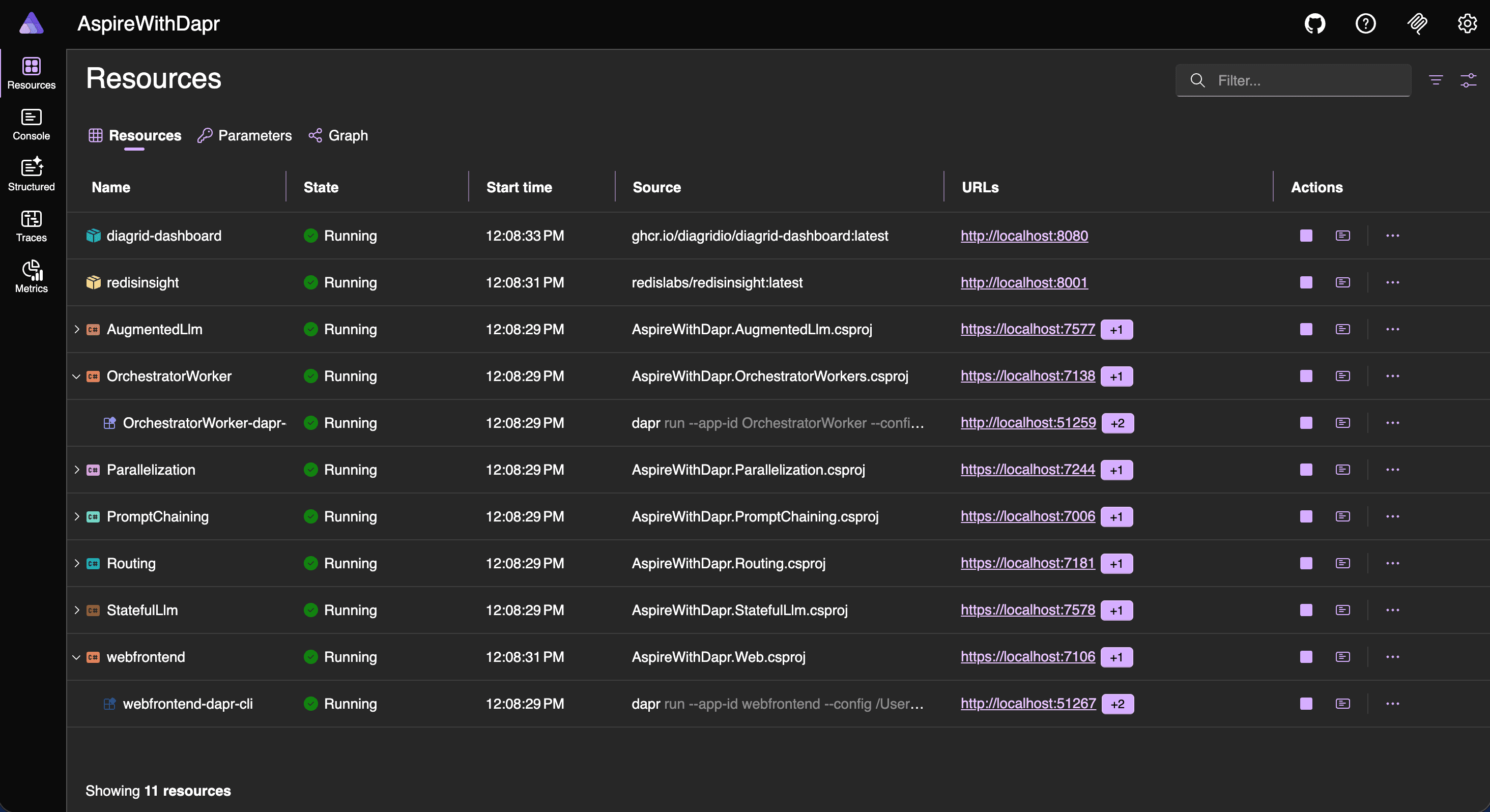
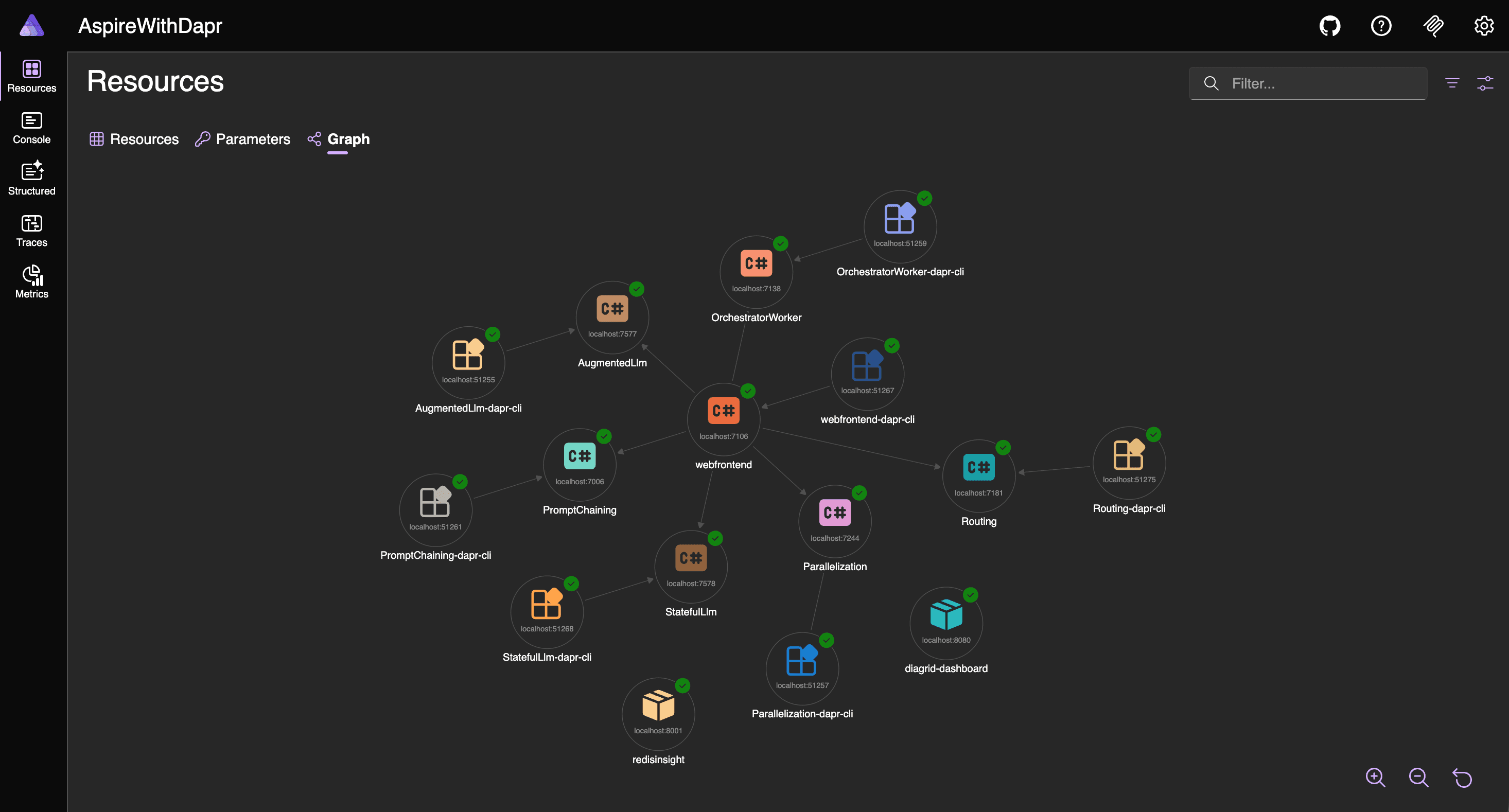
Let’s run the web application
Run the web application from the Aspire Dashboard. Once it launches, select Orchestrator Workers (Task Breakdown) as the service type. You can then start a conversation and observe the application’s behavior. Using the Diagrid Dashboard, you can inspect the underlying workflow state and review historical execution data.
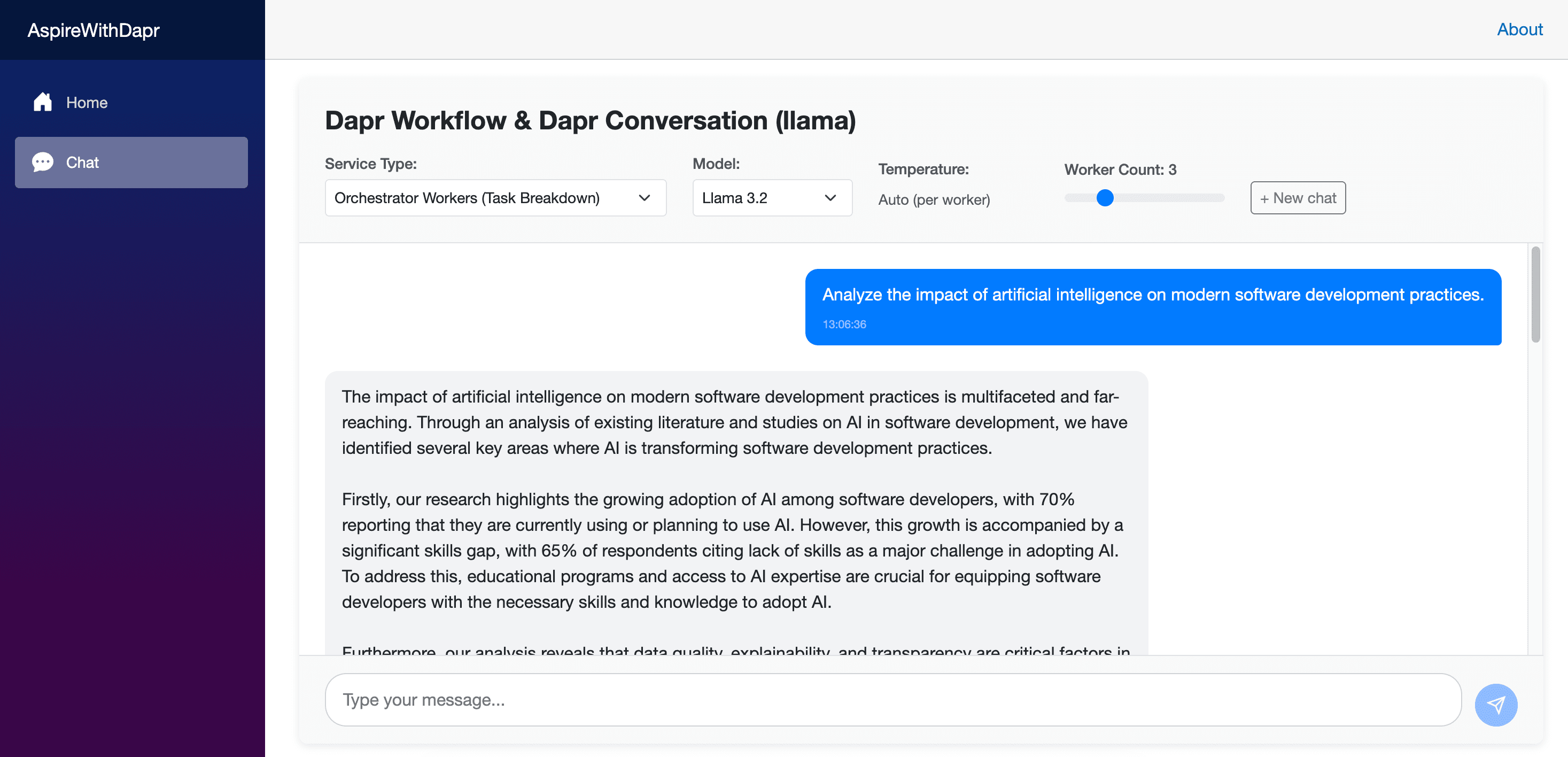
Now, let’s start structuring a new Minimal API for the Evaluator-Optimizer pattern.
Evaluator-Optimizer
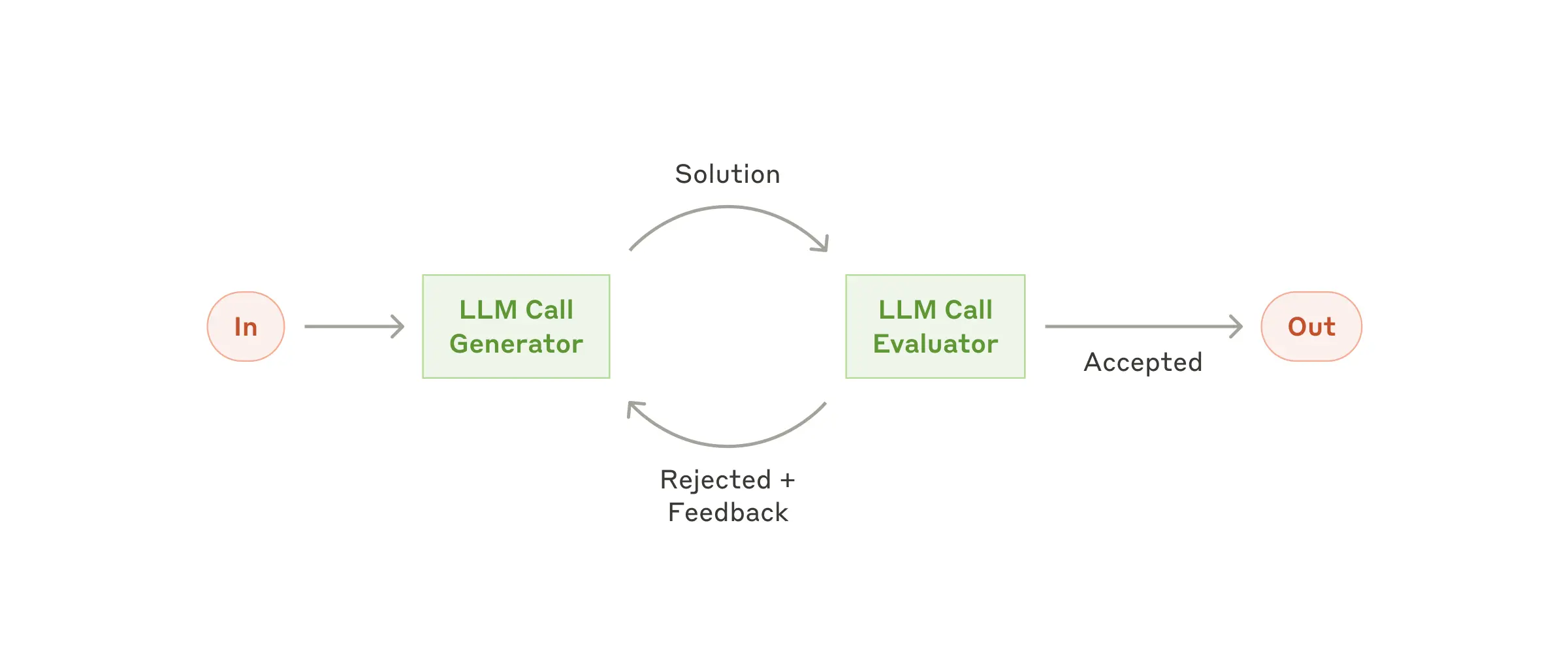
The evaluator–optimizer workflow pairs a response-generating LLM with an evaluating LLM that provides feedback in a loop to drive iterative improvement.
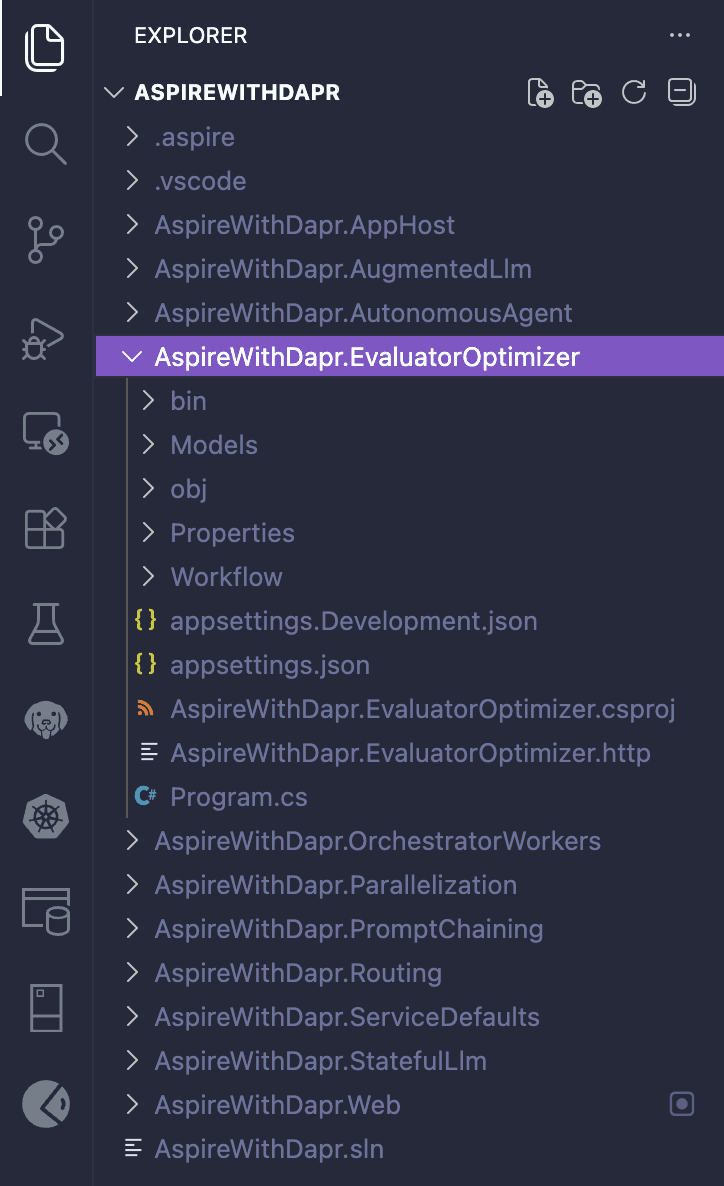
dotnet add package Dapr.AI
dotnet add package Dapr.Workflow
// LlmModels.cs
using System.ComponentModel.DataAnnotations;
namespace AspireWithDapr.EvaluatorOptimizer.Models;
public record LlmRequest(
[Required] [MinLength(1)] string Prompt,
Dictionary<string, object>? Context = null,
string? Model = null,
double? Temperature = null);
public record LlmResponse(
string Response,
Dictionary<string, object>? Metadata = null);
public record EvaluatorRequest(
[Required] [MinLength(1)] string Prompt,
int MaxIterations = 3,
double QualityThreshold = 0.8,
Dictionary<string, object>? Context = null,
string? Model = null,
double? Temperature = null);
public record EvaluationResult(
double Score,
List<string> Improvements,
string Feedback);// Program.cs
#pragma warning disable DAPR_CONVERSATION
using System.ComponentModel.DataAnnotations;
using Dapr.AI.Conversation.Extensions;
using Dapr.Workflow;
using AspireWithDapr.EvaluatorOptimizer.Models;
using AspireWithDapr.EvaluatorOptimizer.Workflow;
var builder = WebApplication.CreateBuilder(args);
builder.AddServiceDefaults();
builder.Services.AddProblemDetails();
builder.Services.AddOpenApi();
builder.Services.AddDaprConversationClient();
builder.Services.AddDaprWorkflow(options =>
{
options.RegisterWorkflow<EvaluatorOptimizerWorkflow>();
options.RegisterActivity<CallLlmActivity>();
options.RegisterActivity<EvaluateActivity>();
options.RegisterActivity<OptimizePromptActivity>();
options.RegisterActivity<LoggingActivity>();
});
var app = builder.Build();
// Initialize workflow logger with the app's logger factory
var loggerFactory = app.Services.GetRequiredService<ILoggerFactory>();
EvaluatorOptimizerWorkflow.SetLogger(loggerFactory);
app.UseExceptionHandler();
if (app.Environment.IsDevelopment())
{
app.MapOpenApi();
}
app.MapGet("/", () => Results.Ok(new {
service = "Evaluator-Optimizer LLM API",
version = "1.0.0",
endpoints = new[] { "/llm/query", "/llm/query/{instanceId}", "/llm/query/{instanceId}/status", "/health" },
description = "Iteratively generates, evaluates, and optimizes responses until quality threshold is met"
}))
.WithName("GetServiceInfo")
.WithTags("Info");
app.MapPost("/llm/query", async (
[Required] EvaluatorRequest request,
DaprWorkflowClient workflowClient,
ILogger<Program> logger,
CancellationToken cancellationToken) =>
{
if (string.IsNullOrWhiteSpace(request.Prompt))
{
return Results.BadRequest(new { error = "Prompt is required and cannot be empty." });
}
if (request.MaxIterations < 1 || request.MaxIterations > 10)
{
return Results.BadRequest(new { error = "MaxIterations must be between 1 and 10." });
}
if (request.QualityThreshold < 0.0 || request.QualityThreshold > 1.0)
{
return Results.BadRequest(new { error = "QualityThreshold must be between 0.0 and 1.0." });
}
try
{
logger.LogInformation("Starting Evaluator-Optimizer workflow for prompt: {Prompt} with length {PromptLength} characters | Max Iterations: {MaxIterations} | Quality Threshold: {QualityThreshold}",
request.Prompt, request.Prompt.Length, request.MaxIterations, request.QualityThreshold);
var instanceId = Guid.NewGuid().ToString();
await workflowClient.ScheduleNewWorkflowAsync(
nameof(EvaluatorOptimizerWorkflow),
instanceId,
request);
logger.LogInformation("Workflow started with instance ID: {InstanceId}", instanceId);
return Results.Accepted($"/llm/query/{instanceId}", new {
instanceId,
status = "started"
});
}
catch (Exception ex)
{
logger.LogError(ex, "Error starting workflow");
return Results.Problem(
detail: "An error occurred while starting the workflow.",
statusCode: StatusCodes.Status500InternalServerError);
}
})
.WithName("StartEvaluatorOptimizerQuery")
.WithTags("LLM")
.Produces<LlmResponse>(StatusCodes.Status202Accepted)
.Produces(StatusCodes.Status400BadRequest)
.Produces(StatusCodes.Status500InternalServerError);
app.MapGet("/llm/query/{instanceId}", async (
string instanceId,
DaprWorkflowClient workflowClient,
ILogger<Program> logger,
CancellationToken cancellationToken) =>
{
try
{
var workflowState = await workflowClient.GetWorkflowStateAsync(instanceId);
if (workflowState is null)
{
return Results.NotFound(new { error = $"Workflow instance {instanceId} not found." });
}
if (workflowState.RuntimeStatus != WorkflowRuntimeStatus.Completed)
{
return Results.Accepted($"/llm/query/{instanceId}", new
{
instanceId,
runtimeStatus = workflowState.RuntimeStatus.ToString()
});
}
var output = workflowState.ReadOutputAs<LlmResponse>();
return Results.Ok(new
{
instanceId,
runtimeStatus = workflowState.RuntimeStatus.ToString(),
result = output
});
}
catch (Exception ex)
{
logger.LogError(ex, "Error retrieving workflow state for instance {InstanceId}", instanceId);
return Results.Problem(
detail: "An error occurred while retrieving the workflow state.",
statusCode: StatusCodes.Status500InternalServerError);
}
})
.WithName("GetEvaluatorOptimizerQueryResult")
.WithTags("LLM")
.Produces<LlmResponse>()
.Produces(StatusCodes.Status404NotFound)
.Produces(StatusCodes.Status500InternalServerError);
app.MapGet("/llm/query/{instanceId}/status", async (
string instanceId,
DaprWorkflowClient workflowClient,
ILogger<Program> logger,
CancellationToken cancellationToken) =>
{
try
{
var workflowState = await workflowClient.GetWorkflowStateAsync(instanceId);
if (workflowState is null)
{
return Results.NotFound(new { error = $"Workflow instance {instanceId} not found." });
}
var status = workflowState.RuntimeStatus;
return Results.Ok(new
{
instanceId,
runtimeStatus = status.ToString(),
isCompleted = status == WorkflowRuntimeStatus.Completed,
isRunning = status == WorkflowRuntimeStatus.Running,
isFailed = status == WorkflowRuntimeStatus.Failed,
isTerminated = status == WorkflowRuntimeStatus.Terminated,
isPending = status == WorkflowRuntimeStatus.Pending
});
}
catch (Exception ex)
{
logger.LogError(ex, "Error retrieving workflow status for instance {InstanceId}", instanceId);
return Results.Problem(
detail: "An error occurred while retrieving the workflow status.",
statusCode: StatusCodes.Status500InternalServerError);
}
})
.WithName("GetEvaluatorOptimizerWorkflowStatus")
.WithTags("LLM")
.Produces(StatusCodes.Status200OK)
.Produces(StatusCodes.Status404NotFound)
.Produces(StatusCodes.Status500InternalServerError);
app.MapDefaultEndpoints();
app.Run();// EvaluatorOptimizerWorkflow.cs
#pragma warning disable DAPR_CONVERSATION
using Dapr.Workflow;
using Dapr.AI.Conversation;
using Dapr.AI.Conversation.ConversationRoles;
using AspireWithDapr.EvaluatorOptimizer.Models;
using System.Text.Json;
namespace AspireWithDapr.EvaluatorOptimizer.Workflow;
public class EvaluatorOptimizerWorkflow : Workflow<EvaluatorRequest, LlmResponse>
{
private static ILogger? _logger;
public static void SetLogger(ILoggerFactory loggerFactory)
{
_logger = loggerFactory.CreateLogger<EvaluatorOptimizerWorkflow>();
}
public override async Task<LlmResponse> RunAsync(
WorkflowContext context,
EvaluatorRequest request)
{
ArgumentNullException.ThrowIfNull(request);
ArgumentException.ThrowIfNullOrWhiteSpace(request.Prompt);
// Create logger if not set, using a default factory as fallback
var logger = _logger ?? LoggerFactory.Create(builder => builder.AddConsole()).CreateLogger<EvaluatorOptimizerWorkflow>();
var workflowInstanceId = context.InstanceId;
// Log workflow start using activity to ensure it's captured
var promptPreview = request.Prompt.Length > 100 ? request.Prompt[..100] + "..." : request.Prompt;
await context.CallActivityAsync<bool>(
nameof(LoggingActivity),
new LogMessage($"[Workflow Start] InstanceId: {workflowInstanceId} | Prompt: \"{promptPreview}\" | Prompt Length: {request.Prompt.Length} | Max Iterations: {request.MaxIterations} | Quality Threshold: {request.QualityThreshold} | Model: {request.Model ?? "llama"} | Temperature: {request.Temperature ?? 0.7}"));
// Log full initial prompt for end-to-end tracking
await context.CallActivityAsync<bool>(
nameof(LoggingActivity),
new LogMessage($"[Initial Prompt] InstanceId: {workflowInstanceId}\n---\n{request.Prompt}\n---"));
var iteration = 0;
LlmResponse? bestResponse = null;
var bestScore = 0.0;
var currentPrompt = request.Prompt;
while (iteration < request.MaxIterations)
{
context.SetCustomStatus(new {
step = $"iteration_{iteration + 1}",
current_prompt_length = currentPrompt.Length,
best_score = bestScore
});
// Step 1: Generate response
await context.CallActivityAsync<bool>(
nameof(LoggingActivity),
new LogMessage($"[Iteration {iteration + 1}: Generate] InstanceId: {workflowInstanceId} | Prompt: \"{(currentPrompt.Length > 100 ? currentPrompt[..100] + "..." : currentPrompt)}\" | Prompt Length: {currentPrompt.Length}"));
LlmResponse? response = null;
try
{
response = await context.CallActivityAsync<LlmResponse>(
nameof(CallLlmActivity),
new LlmRequest(currentPrompt, request.Context, request.Model, request.Temperature));
await context.CallActivityAsync<bool>(
nameof(LoggingActivity),
new LogMessage($"[Iteration {iteration + 1}: Generate Complete] InstanceId: {workflowInstanceId} | Response Length: {response?.Response?.Length ?? 0}"));
// Log full response after generation
if (response?.Response != null)
{
await context.CallActivityAsync<bool>(
nameof(LoggingActivity),
new LogMessage($"[Response After Iteration {iteration + 1}] InstanceId: {workflowInstanceId}\n---\n{response.Response}\n---"));
}
}
catch (Exception ex)
{
logger.LogError(ex,
"[Iteration {Iteration}: Generate Failed] InstanceId: {InstanceId} | Error: {Error}",
iteration + 1,
workflowInstanceId,
ex.Message);
throw;
}
if (response == null)
{
logger.LogWarning(
"[Iteration {Iteration}: Generate Failed] InstanceId: {InstanceId} | Reason: Null response",
iteration + 1,
workflowInstanceId);
iteration++;
continue;
}
context.SetCustomStatus(new { step = $"evaluating_iteration_{iteration + 1}" });
// Step 2: Evaluate response
await context.CallActivityAsync<bool>(
nameof(LoggingActivity),
new LogMessage($"[Iteration {iteration + 1}: Evaluate] InstanceId: {workflowInstanceId} | Response Length: {response.Response?.Length ?? 0}"));
EvaluationResult? evaluation = null;
try
{
evaluation = await context.CallActivityAsync<EvaluationResult>(
nameof(EvaluateActivity),
new EvaluateRequest(request.Prompt, response.Response ?? string.Empty, request.Model, request.Temperature));
await context.CallActivityAsync<bool>(
nameof(LoggingActivity),
new LogMessage($"[Iteration {iteration + 1}: Evaluate Complete] InstanceId: {workflowInstanceId} | Score: {evaluation?.Score ?? 0.0} | Improvements Count: {evaluation?.Improvements?.Count ?? 0}"));
}
catch (Exception ex)
{
logger.LogError(ex,
"[Iteration {Iteration}: Evaluate Failed] InstanceId: {InstanceId} | Error: {Error}",
iteration + 1,
workflowInstanceId,
ex.Message);
throw;
}
if (evaluation == null)
{
logger.LogWarning(
"[Iteration {Iteration}: Evaluate Failed] InstanceId: {InstanceId} | Reason: Null evaluation",
iteration + 1,
workflowInstanceId);
iteration++;
continue;
}
context.SetCustomStatus(new {
step = $"iteration_{iteration + 1}_score",
score = evaluation.Score,
best_score = bestScore
});
// Track best response
if (evaluation.Score > bestScore)
{
bestScore = evaluation.Score;
bestResponse = response;
logger.LogInformation(
"[Iteration {Iteration}: New Best] InstanceId: {InstanceId} | Score: {Score}",
iteration + 1,
workflowInstanceId,
evaluation.Score);
}
// Check if quality threshold met
if (evaluation.Score >= request.QualityThreshold)
{
logger.LogInformation(
"[Workflow Early Exit] InstanceId: {InstanceId} | Reason: Quality threshold met | Score: {Score} | Threshold: {Threshold} | Iterations: {Iterations}",
workflowInstanceId,
evaluation.Score,
request.QualityThreshold,
iteration + 1);
context.SetCustomStatus(new {
step = "completed",
iterations = iteration + 1,
final_score = evaluation.Score,
threshold_met = true
});
// Enhance metadata with iteration information
var enhancedMetadata = new Dictionary<string, object>(bestResponse?.Metadata ?? new Dictionary<string, object>())
{
["iterations"] = iteration + 1,
["final_score"] = evaluation.Score,
["quality_threshold"] = request.QualityThreshold,
["threshold_met"] = true,
["workflow_type"] = "evaluator_optimizer"
};
await context.CallActivityAsync<bool>(
nameof(LoggingActivity),
new LogMessage($"[Workflow Complete] InstanceId: {workflowInstanceId} | Total Iterations: {iteration + 1} | Final Score: {evaluation.Score} | Threshold Met: true | Final Response Length: {bestResponse?.Response?.Length ?? 0}"));
return bestResponse! with { Metadata = enhancedMetadata };
}
// Optimize prompt for next iteration
if (iteration < request.MaxIterations - 1)
{
context.SetCustomStatus(new { step = $"optimizing_iteration_{iteration + 1}" });
await context.CallActivityAsync<bool>(
nameof(LoggingActivity),
new LogMessage($"[Iteration {iteration + 1}: Optimize] InstanceId: {workflowInstanceId} | Current Score: {evaluation.Score} | Improvements: {evaluation.Improvements?.Count ?? 0}"));
try
{
var optimizedPrompt = await context.CallActivityAsync<string>(
nameof(OptimizePromptActivity),
new OptimizePromptRequest(
request.Prompt,
currentPrompt,
response.Response ?? string.Empty,
evaluation,
request.Model,
request.Temperature));
currentPrompt = optimizedPrompt;
await context.CallActivityAsync<bool>(
nameof(LoggingActivity),
new LogMessage($"[Iteration {iteration + 1}: Optimize Complete] InstanceId: {workflowInstanceId} | Optimized Prompt Length: {currentPrompt.Length}"));
// Log full optimized prompt
await context.CallActivityAsync<bool>(
nameof(LoggingActivity),
new LogMessage($"[Optimized Prompt After Iteration {iteration + 1}] InstanceId: {workflowInstanceId}\n---\n{currentPrompt}\n---"));
}
catch (Exception ex)
{
logger.LogError(ex,
"[Iteration {Iteration}: Optimize Failed] InstanceId: {InstanceId} | Error: {Error}",
iteration + 1,
workflowInstanceId,
ex.Message);
// Continue with current prompt if optimization fails
}
}
iteration++;
}
logger.LogInformation(
"[Workflow Complete] InstanceId: {InstanceId} | Reason: Max iterations reached | Iterations: {Iterations} | Best Score: {BestScore} | Threshold: {Threshold}",
workflowInstanceId,
iteration,
bestScore,
request.QualityThreshold);
context.SetCustomStatus(new {
step = "completed_max_iterations",
final_score = bestScore,
iterations = iteration,
threshold_met = bestScore >= request.QualityThreshold
});
// Enhance metadata with iteration information
var finalMetadata = new Dictionary<string, object>(bestResponse?.Metadata ?? new Dictionary<string, object>())
{
["iterations"] = iteration,
["final_score"] = bestScore,
["quality_threshold"] = request.QualityThreshold,
["threshold_met"] = bestScore >= request.QualityThreshold,
["workflow_type"] = "evaluator_optimizer"
};
await context.CallActivityAsync<bool>(
nameof(LoggingActivity),
new LogMessage($"[Workflow Complete] InstanceId: {workflowInstanceId} | Total Iterations: {iteration} | Best Score: {bestScore} | Threshold Met: {bestScore >= request.QualityThreshold} | Final Response Length: {bestResponse?.Response?.Length ?? 0}"));
if (bestResponse == null)
{
logger.LogError(
"[Workflow Error] InstanceId: {InstanceId} | No valid response generated after all iterations",
workflowInstanceId);
return new LlmResponse(
"Failed to generate satisfactory response after all iterations.",
finalMetadata);
}
if (bestResponse.Metadata != null)
{
logger.LogDebug(
"[Workflow Final Metadata] InstanceId: {InstanceId} | Metadata: {Metadata}",
workflowInstanceId,
JsonSerializer.Serialize(finalMetadata));
}
return bestResponse with { Metadata = finalMetadata };
}
}
// Logging activity to ensure workflow logs are captured
public class LoggingActivity(ILogger<LoggingActivity> logger) : WorkflowActivity<LogMessage, bool>
{
public override Task<bool> RunAsync(WorkflowActivityContext context, LogMessage message)
{
try
{
switch (message.Level.ToLower())
{
case "error":
logger.LogError("[Workflow] {Message}", message.Message);
break;
case "warning":
logger.LogWarning("[Workflow] {Message}", message.Message);
break;
case "debug":
logger.LogDebug("[Workflow] {Message}", message.Message);
break;
default:
logger.LogInformation("[Workflow] {Message}", message.Message);
break;
}
return Task.FromResult(true);
}
catch (Exception ex)
{
logger.LogError(ex, "[LoggingActivity] Error logging message: {Message}", message.Message);
return Task.FromResult(false);
}
}
}
public record LogMessage(string Message, string Level = "Information");
// Activity to call LLM (reusing pattern from AugmentedLlm)
public class CallLlmActivity(
DaprConversationClient conversationClient,
ILogger<CallLlmActivity> logger) : WorkflowActivity<LlmRequest, LlmResponse>
{
public override async Task<LlmResponse> RunAsync(
WorkflowActivityContext context,
LlmRequest request)
{
ArgumentNullException.ThrowIfNull(conversationClient);
ArgumentNullException.ThrowIfNull(request);
ArgumentException.ThrowIfNullOrWhiteSpace(request.Prompt);
var activityName = nameof(CallLlmActivity);
var startTime = DateTime.UtcNow;
var componentName = request.Model ?? "llama";
var promptPreview = request.Prompt.Length > 150 ? request.Prompt[..150] + "..." : request.Prompt;
logger.LogInformation(
"[{Activity} Start] Model: {Model} | Temperature: {Temperature} | Prompt: \"{Prompt}\" | Prompt Length: {PromptLength}",
activityName,
componentName,
request.Temperature ?? 0.7,
promptPreview,
request.Prompt.Length);
logger.LogDebug(
"[{Activity} Input] Full Request: {Request}",
activityName,
JsonSerializer.Serialize(new
{
request.Model,
request.Temperature,
PromptLength = request.Prompt.Length,
PromptPreview = request.Prompt.Length > 200 ? request.Prompt[..200] + "..." : request.Prompt,
ContextKeys = request.Context?.Keys.ToArray() ?? Array.Empty<string>()
}));
var conversationInput = new ConversationInput(
[
new UserMessage
{
Content = [new MessageContent(request.Prompt)]
}
]);
var conversationOptions = new ConversationOptions(componentName)
{
Temperature = request.Temperature ?? 0.7
};
logger.LogDebug(
"[{Activity}] Calling LLM conversation API with component: {Component}",
activityName,
componentName);
var response = await conversationClient.ConverseAsync(
[conversationInput],
conversationOptions,
CancellationToken.None);
if (response?.Outputs is null || response.Outputs.Count == 0)
{
logger.LogError(
"[{Activity} Error] LLM returned no outputs. Response: {Response}",
activityName,
response != null ? JsonSerializer.Serialize(response) : "null");
throw new InvalidOperationException("LLM returned no outputs.");
}
logger.LogDebug(
"[{Activity}] Received {OutputCount} output(s) from LLM",
activityName,
response.Outputs.Count);
var responseText = string.Empty;
var choiceCount = 0;
foreach (var output in response.Outputs)
{
if (output?.Choices is null) continue;
foreach (var choice in output.Choices)
{
var content = choice.Message?.Content ?? string.Empty;
responseText += content;
choiceCount++;
}
}
if (string.IsNullOrWhiteSpace(responseText))
{
logger.LogError(
"[{Activity} Error] LLM returned empty response. Outputs Count: {OutputCount}, Choices Processed: {ChoiceCount}",
activityName,
response.Outputs.Count,
choiceCount);
throw new InvalidOperationException("LLM returned empty response.");
}
var duration = (DateTime.UtcNow - startTime).TotalMilliseconds;
var result = new LlmResponse(
responseText,
new Dictionary<string, object>
{
["model"] = componentName,
["temperature"] = request.Temperature ?? 0.7,
["timestamp"] = DateTime.UtcNow,
["conversationId"] = response.ConversationId ?? string.Empty
});
logger.LogInformation(
"[{Activity} Complete] Duration: {Duration}ms | Response Length: {ResponseLength} | Choices: {ChoiceCount} | ConversationId: {ConversationId}",
activityName,
duration,
responseText.Length,
choiceCount,
response.ConversationId ?? "none");
logger.LogDebug(
"[{Activity} Output] Response Preview: {Preview} | Metadata: {Metadata}",
activityName,
responseText.Length > 300 ? responseText[..300] + "..." : responseText,
JsonSerializer.Serialize(result.Metadata));
return result;
}
}
// Activity to evaluate response quality
public class EvaluateActivity(
DaprConversationClient conversationClient,
ILogger<EvaluateActivity> logger) : WorkflowActivity<EvaluateRequest, EvaluationResult>
{
public override async Task<EvaluationResult> RunAsync(
WorkflowActivityContext context,
EvaluateRequest request)
{
ArgumentNullException.ThrowIfNull(conversationClient);
ArgumentNullException.ThrowIfNull(request);
ArgumentException.ThrowIfNullOrWhiteSpace(request.OriginalPrompt);
ArgumentException.ThrowIfNullOrWhiteSpace(request.Response);
var activityName = nameof(EvaluateActivity);
var startTime = DateTime.UtcNow;
var componentName = request.Model ?? "llama";
var promptPreview = request.OriginalPrompt.Length > 100 ? request.OriginalPrompt[..100] + "..." : request.OriginalPrompt;
var responsePreview = request.Response.Length > 100 ? request.Response[..100] + "..." : request.Response;
logger.LogInformation(
"[{Activity} Start] Original Prompt: \"{Prompt}\" | Prompt Length: {PromptLength} | Response Length: {ResponseLength} | Model: {Model} | Temperature: {Temperature}",
activityName,
promptPreview,
request.OriginalPrompt.Length,
request.Response.Length,
componentName,
request.Temperature ?? 0.4);
logger.LogDebug(
"[{Activity} Input] Original Prompt: {Prompt} | Response Preview: {ResponsePreview}",
activityName,
request.OriginalPrompt,
request.Response.Length > 200 ? request.Response[..200] + "..." : request.Response);
var evaluationPrompt = $"""
Original prompt: {request.OriginalPrompt}
Generated response: {request.Response}
Evaluate this response (score 0.0 to 1.0) based on:
1. Relevance to original prompt
2. Completeness
3. Clarity
4. Accuracy
Provide:
1. Score (just the number)
2. List of improvements (one per line)
3. Brief feedback
Format:
SCORE: [score]
IMPROVEMENTS:
[improvement1]
[improvement2]
...
FEEDBACK: [feedback]
""";
var conversationInput = new ConversationInput(
[
new UserMessage
{
Content = [new MessageContent(evaluationPrompt)]
}
]);
var conversationOptions = new ConversationOptions(componentName)
{
Temperature = request.Temperature ?? 0.4
};
logger.LogDebug(
"[{Activity}] Calling LLM conversation API with component: {Component}",
activityName,
componentName);
var response = await conversationClient.ConverseAsync(
[conversationInput],
conversationOptions,
CancellationToken.None);
if (response?.Outputs is null || response.Outputs.Count == 0)
{
logger.LogError(
"[{Activity} Error] LLM returned no outputs. Response: {Response}",
activityName,
response != null ? JsonSerializer.Serialize(response) : "null");
throw new InvalidOperationException("LLM returned no outputs for evaluation.");
}
logger.LogDebug(
"[{Activity}] Received {OutputCount} output(s) from LLM",
activityName,
response.Outputs.Count);
var responseText = string.Empty;
var choiceCount = 0;
foreach (var output in response.Outputs)
{
if (output?.Choices is null) continue;
foreach (var choice in output.Choices)
{
var content = choice.Message?.Content ?? string.Empty;
responseText += content;
choiceCount++;
}
}
if (string.IsNullOrWhiteSpace(responseText))
{
logger.LogError(
"[{Activity} Error] LLM returned empty response. Outputs Count: {OutputCount}, Choices Processed: {ChoiceCount}",
activityName,
response.Outputs.Count,
choiceCount);
throw new InvalidOperationException("LLM returned empty response for evaluation.");
}
// Parse evaluation result
var lines = responseText.Split('\n', StringSplitOptions.RemoveEmptyEntries);
var score = 0.0;
var improvements = new List<string>();
var feedback = string.Empty;
var inImprovements = false;
foreach (var line in lines)
{
var trimmedLine = line.Trim();
if (trimmedLine.StartsWith("SCORE:", StringComparison.OrdinalIgnoreCase))
{
var scoreText = trimmedLine.Replace("SCORE:", "", StringComparison.OrdinalIgnoreCase).Trim();
if (double.TryParse(scoreText, out var parsedScore))
{
score = Math.Clamp(parsedScore, 0.0, 1.0);
}
}
else if (trimmedLine.StartsWith("IMPROVEMENTS:", StringComparison.OrdinalIgnoreCase))
{
inImprovements = true;
}
else if (trimmedLine.StartsWith("FEEDBACK:", StringComparison.OrdinalIgnoreCase))
{
feedback = trimmedLine.Replace("FEEDBACK:", "", StringComparison.OrdinalIgnoreCase).Trim();
inImprovements = false;
}
else if (inImprovements && !string.IsNullOrWhiteSpace(trimmedLine))
{
improvements.Add(trimmedLine);
}
}
// If no feedback was found, use the remaining text
if (string.IsNullOrWhiteSpace(feedback) && !inImprovements)
{
var feedbackStart = responseText.IndexOf("FEEDBACK:", StringComparison.OrdinalIgnoreCase);
if (feedbackStart >= 0)
{
feedback = responseText.Substring(feedbackStart + 9).Trim();
}
}
var duration = (DateTime.UtcNow - startTime).TotalMilliseconds;
var result = new EvaluationResult(score, improvements, feedback);
logger.LogInformation(
"[{Activity} Complete] Duration: {Duration}ms | Score: {Score} | Improvements Count: {ImprovementsCount} | Choices: {ChoiceCount} | ConversationId: {ConversationId}",
activityName,
duration,
score,
improvements.Count,
choiceCount,
response.ConversationId ?? "none");
logger.LogDebug(
"[{Activity} Output] Score: {Score} | Improvements: {Improvements} | Feedback: {Feedback}",
activityName,
score,
JsonSerializer.Serialize(improvements),
feedback.Length > 200 ? feedback[..200] + "..." : feedback);
return result;
}
}
// Activity to optimize prompt for next iteration
public class OptimizePromptActivity(
DaprConversationClient conversationClient,
ILogger<OptimizePromptActivity> logger) : WorkflowActivity<OptimizePromptRequest, string>
{
public override async Task<string> RunAsync(
WorkflowActivityContext context,
OptimizePromptRequest request)
{
ArgumentNullException.ThrowIfNull(conversationClient);
ArgumentNullException.ThrowIfNull(request);
ArgumentException.ThrowIfNullOrWhiteSpace(request.OriginalPrompt);
ArgumentNullException.ThrowIfNull(request.Evaluation);
var activityName = nameof(OptimizePromptActivity);
var startTime = DateTime.UtcNow;
var componentName = request.Model ?? "llama";
var promptPreview = request.OriginalPrompt.Length > 100 ? request.OriginalPrompt[..100] + "..." : request.OriginalPrompt;
logger.LogInformation(
"[{Activity} Start] Original Prompt: \"{Prompt}\" | Current Prompt Length: {CurrentLength} | Response Length: {ResponseLength} | Score: {Score} | Improvements Count: {ImprovementsCount} | Model: {Model} | Temperature: {Temperature}",
activityName,
promptPreview,
request.CurrentPrompt.Length,
request.Response.Length,
request.Evaluation.Score,
request.Evaluation.Improvements?.Count ?? 0,
componentName,
request.Temperature ?? 0.7);
logger.LogDebug(
"[{Activity} Input] Original Prompt: {OriginalPrompt} | Current Prompt: {CurrentPrompt} | Response: {Response} | Evaluation: {Evaluation}",
activityName,
request.OriginalPrompt,
request.CurrentPrompt,
request.Response.Length > 200 ? request.Response[..200] + "..." : request.Response,
JsonSerializer.Serialize(new
{
request.Evaluation.Score,
request.Evaluation.Improvements,
FeedbackLength = request.Evaluation.Feedback?.Length ?? 0
}));
var improvementsText = request.Evaluation.Improvements != null && request.Evaluation.Improvements.Count > 0
? string.Join("\n", request.Evaluation.Improvements.Select((imp, i) => $"{i + 1}. {imp}"))
: "None specified";
var optimizationPrompt = $"""
Original goal: {request.OriginalPrompt}
Current prompt: {request.CurrentPrompt}
Generated response: {request.Response}
Evaluation score: {request.Evaluation.Score}
Improvements needed: {improvementsText}
Feedback: {request.Evaluation.Feedback}
Optimize the prompt to address the evaluation feedback.
Create a new, improved prompt that will likely generate a better response.
Focus on clarity, specificity, and addressing the noted improvements.
Optimized prompt:
""";
var conversationInput = new ConversationInput(
[
new UserMessage
{
Content = [new MessageContent(optimizationPrompt)]
}
]);
var conversationOptions = new ConversationOptions(componentName)
{
Temperature = request.Temperature ?? 0.7
};
logger.LogDebug(
"[{Activity}] Calling LLM conversation API with component: {Component}",
activityName,
componentName);
var response = await conversationClient.ConverseAsync(
[conversationInput],
conversationOptions,
CancellationToken.None);
if (response?.Outputs is null || response.Outputs.Count == 0)
{
logger.LogError(
"[{Activity} Error] LLM returned no outputs. Response: {Response}",
activityName,
response != null ? JsonSerializer.Serialize(response) : "null");
throw new InvalidOperationException("LLM returned no outputs for prompt optimization.");
}
logger.LogDebug(
"[{Activity}] Received {OutputCount} output(s) from LLM",
activityName,
response.Outputs.Count);
var responseText = string.Empty;
var choiceCount = 0;
foreach (var output in response.Outputs)
{
if (output?.Choices is null) continue;
foreach (var choice in output.Choices)
{
var content = choice.Message?.Content ?? string.Empty;
responseText += content;
choiceCount++;
}
}
if (string.IsNullOrWhiteSpace(responseText))
{
logger.LogError(
"[{Activity} Error] LLM returned empty response. Outputs Count: {OutputCount}, Choices Processed: {ChoiceCount}",
activityName,
response.Outputs.Count,
choiceCount);
throw new InvalidOperationException("LLM returned empty response for prompt optimization.");
}
var optimizedPrompt = responseText.Trim();
var duration = (DateTime.UtcNow - startTime).TotalMilliseconds;
var optimizedPreview = optimizedPrompt.Length > 150 ? optimizedPrompt[..150] + "..." : optimizedPrompt;
logger.LogInformation(
"[{Activity} Complete] Duration: {Duration}ms | Optimized Prompt: \"{OptimizedPrompt}\" | Optimized Prompt Length: {OptimizedLength} | Choices: {ChoiceCount} | ConversationId: {ConversationId}",
activityName,
duration,
optimizedPreview,
optimizedPrompt.Length,
choiceCount,
response.ConversationId ?? "none");
logger.LogDebug(
"[{Activity} Output] Optimized Prompt Preview: {Preview}",
activityName,
optimizedPrompt.Length > 300 ? optimizedPrompt[..300] + "..." : optimizedPrompt);
return optimizedPrompt;
}
}
// Request/Response models for activities
public record EvaluateRequest(
string OriginalPrompt,
string Response,
string? Model = null,
double? Temperature = null);
public record OptimizePromptRequest(
string OriginalPrompt,
string CurrentPrompt,
string Response,
EvaluationResult Evaluation,
string? Model = null,
double? Temperature = null);If you walk through the code, you will see that it implements a Dapr Workflow based on the Evaluator-Optimizer pattern. This pattern implements an iterative refinement pattern that generates LLM responses, evaluates their quality, and optimizes prompts until a quality threshold is met or max iterations are reached.
The workflow consists of three main steps (activities):
- Call LLM – Sends prompts to the LLM via
DaprConversationClientand returns the generated response with metadata (model, temperature, timestamp, conversationId). - Evaluate – Asks the LLM to score (0.0-1.0) a response based on relevance, completeness, clarity, and accuracy. Returns score, improvement suggestions, and feedback.
- Optimize Prompt – Takes the original prompt, current response, and evaluation feedback to generate an improved prompt for the next iteration.
NOTE: Before running the application, ensure that the EvaluatorOptimizer project is added to the AppHost and that the web application’s reference is updated accordingly. Refer to the code snippet below.
// AppHost.cs
// Pattern - 6. EvaluatorOptimizer
var evaluatorOptimizerService = builder.AddProject<Projects.AspireWithDapr_EvaluatorOptimizer>("EvaluatorOptimizer")
    .WithExternalHttpEndpoints()
    .WithHttpHealthCheck("/health")
    .WithDaprSidecar(new DaprSidecarOptions
    {
        ResourcesPaths = ["components"],
        Config = "components/daprConfig.yaml"
    })
    .WithEnvironment("DAPR_HOST_IP", "127.0.0.1")
    .WithEnvironment("ZIPKIN_ENDPOINT", "http://localhost:9411/api/v2/spans");
Aspire, Diagrid, Redis Insight UIs (or dashbaords)
To run the application, execute the following command.
aspire run 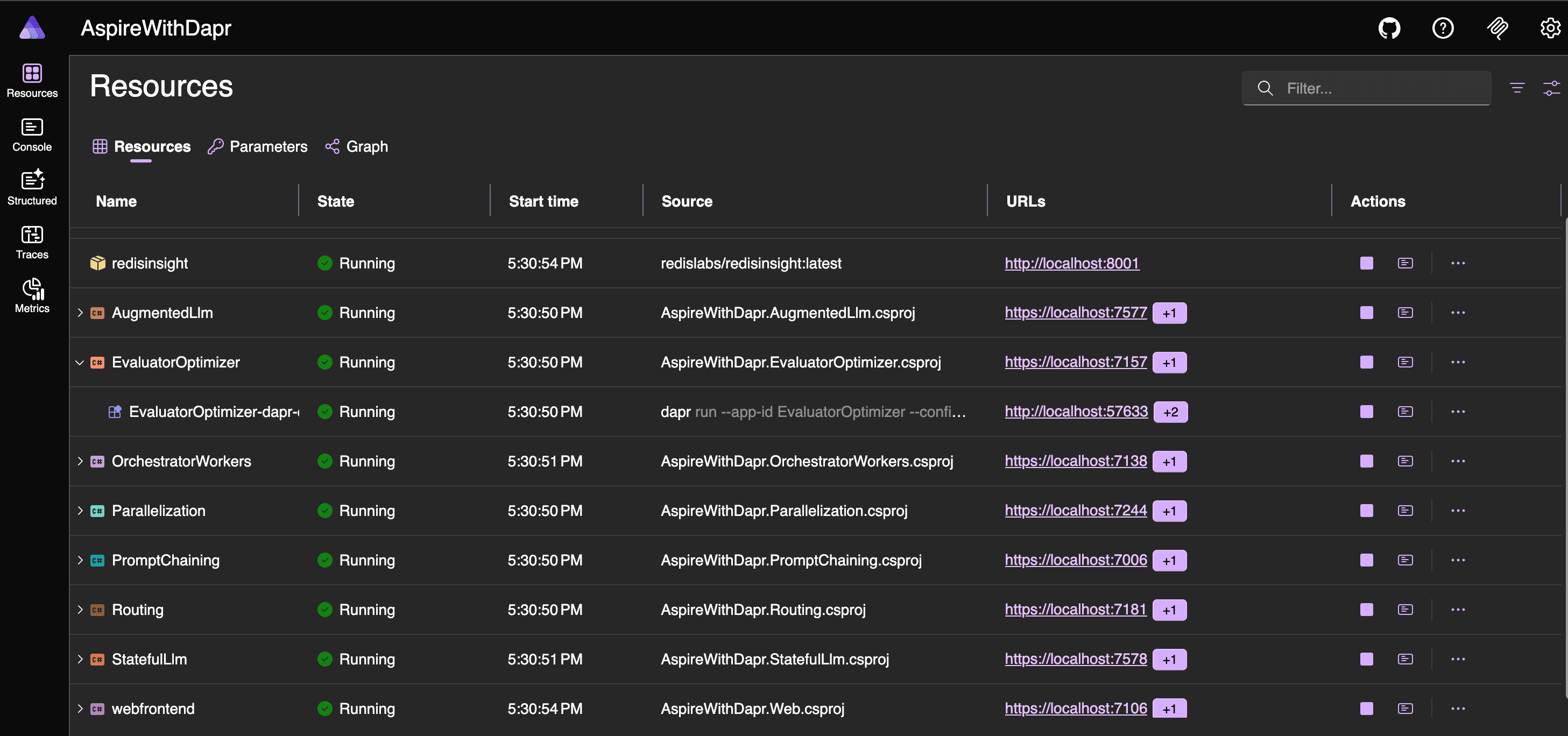
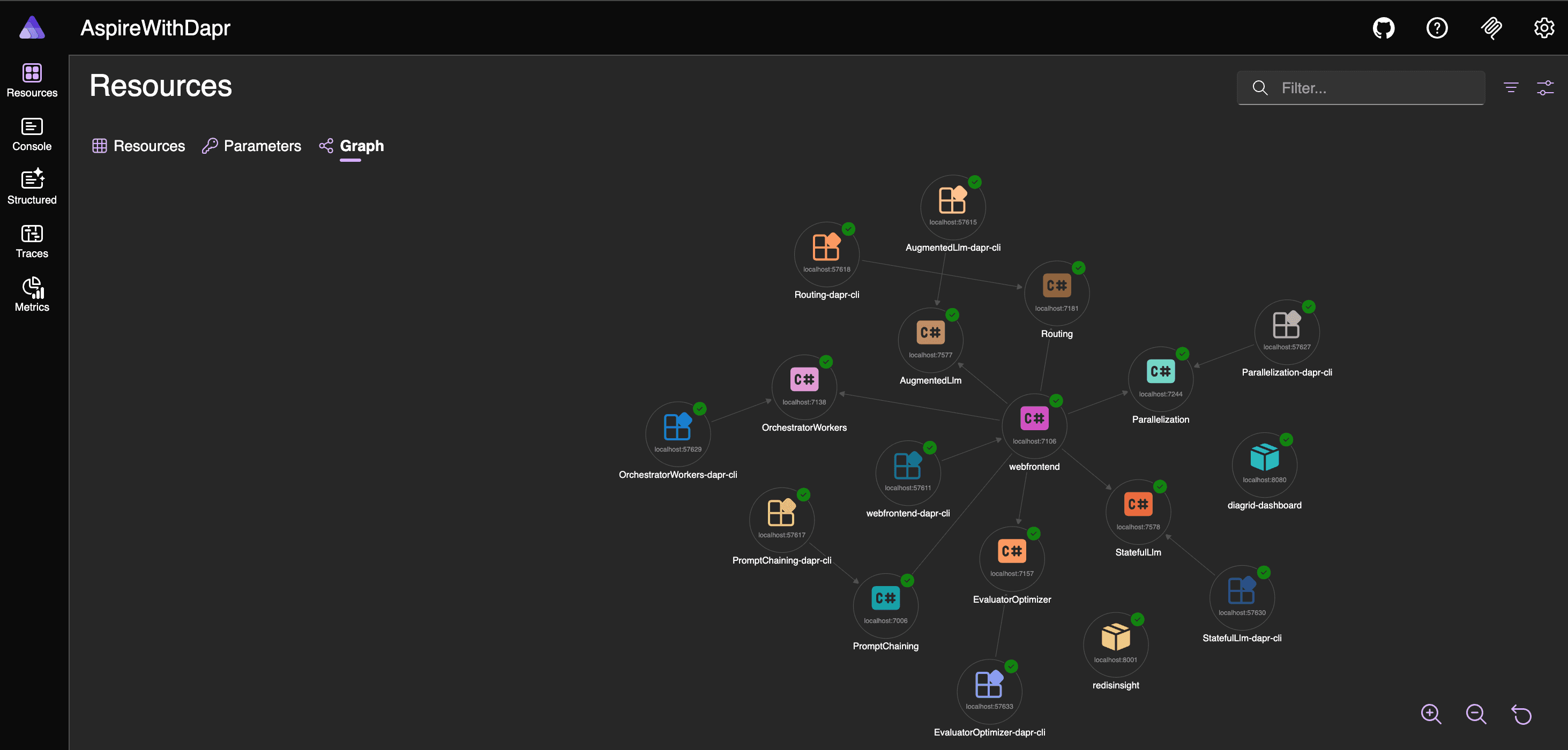
Let’s run the web application
Run the web application from the Aspire Dashboard. Once it launches, select Evaluator-Optimizer (Iterative Quality) as the service type. You can then start a conversation and observe the application’s behavior. Using the Diagrid Dashboard, you can inspect the underlying workflow state and review historical execution data.
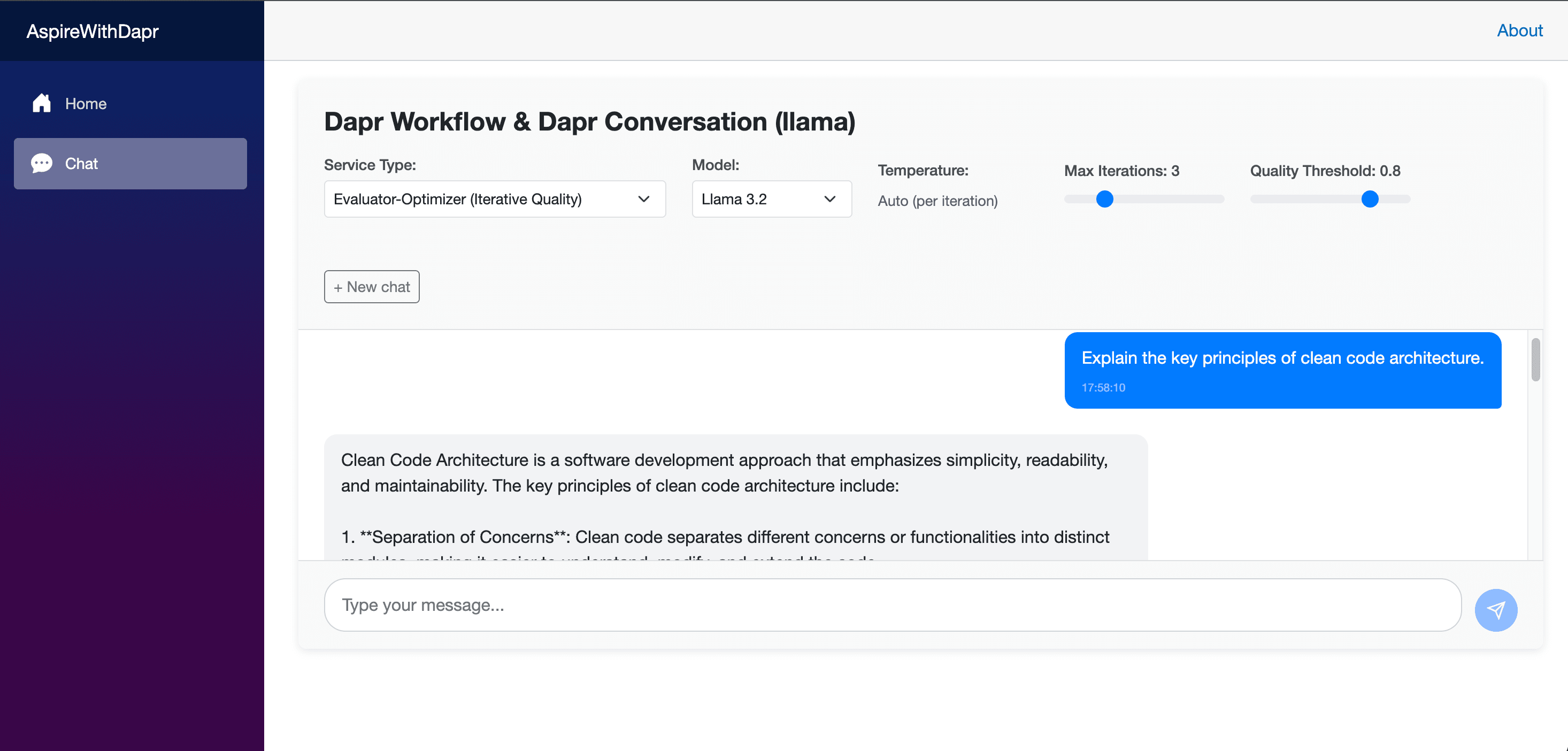
Now, let’s start structuring a new Minimal API for the Autonomous Agent pattern.
Autonomous Agent
Agents are capable of sophisticated behavior, but their underlying implementation is often simple. They usually consist of LLMs using tools in a loop informed by environmental feedback, which makes clear and thoughtful tool and documentation design critical.
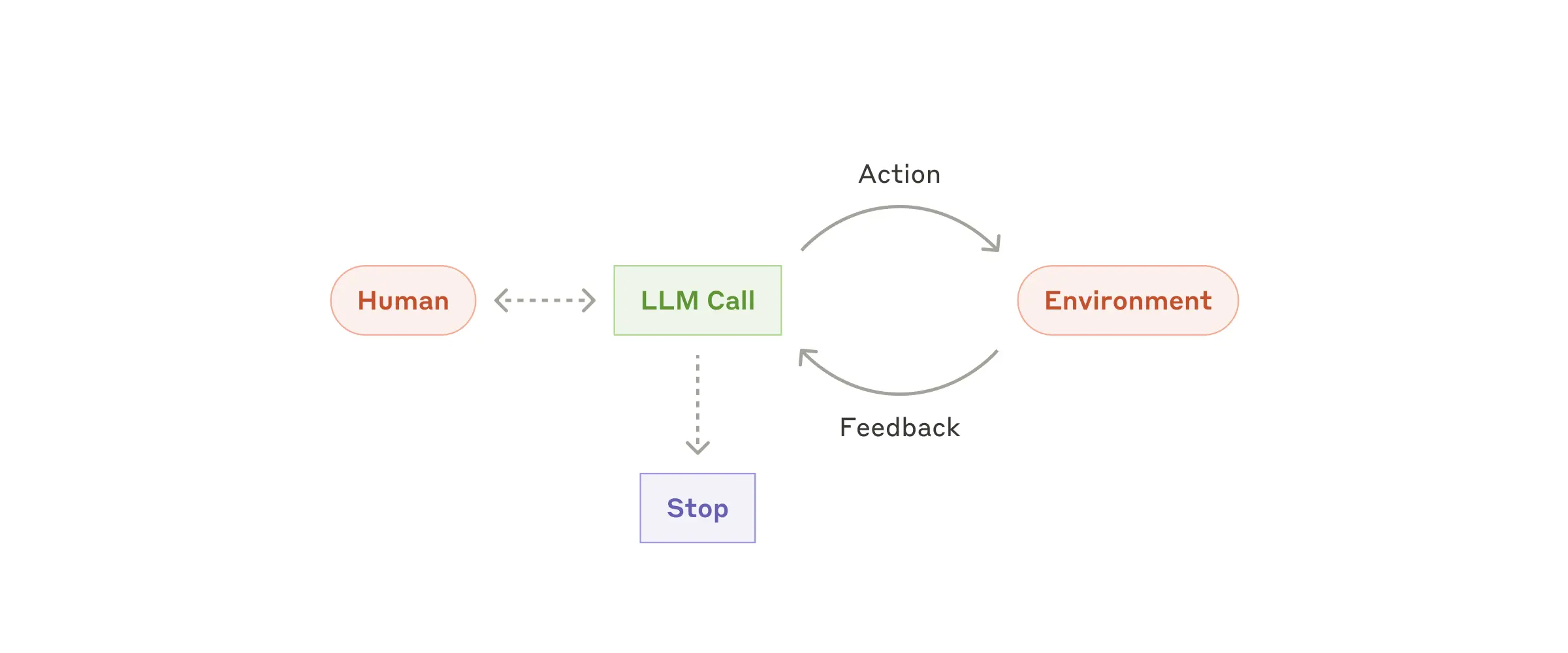
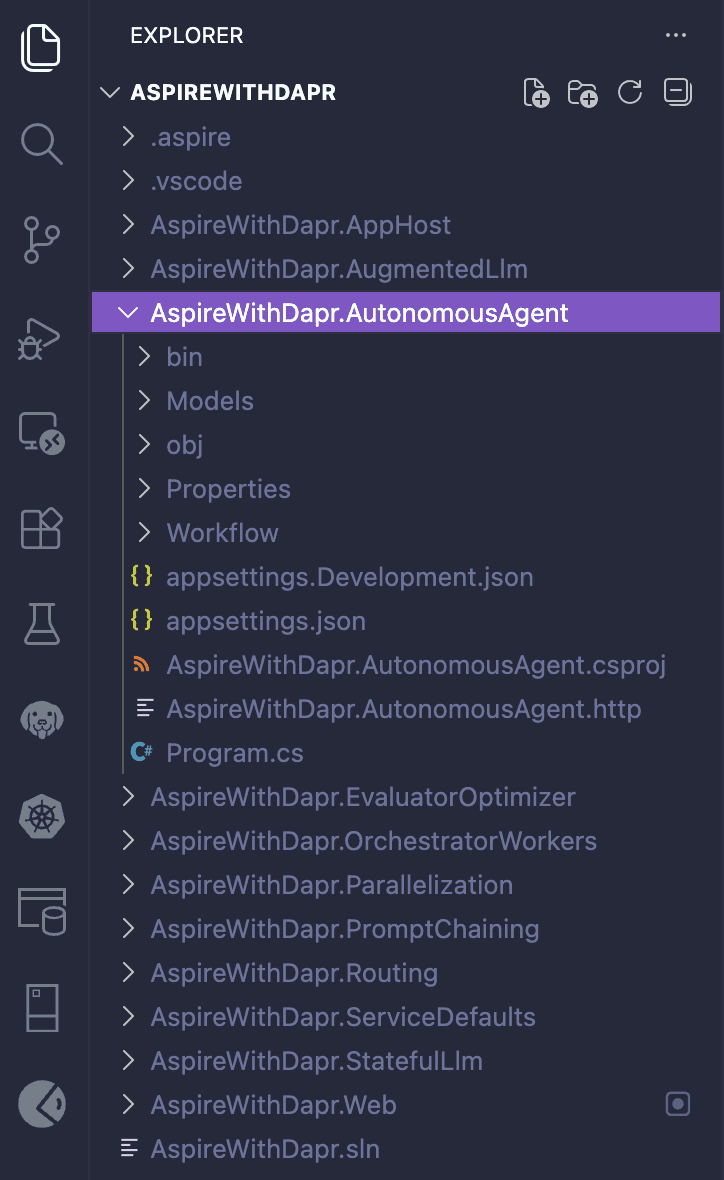
dotnet add package Dapr.AI
dotnet add package Dapr.Workflow
// LlmModels.cs
using System.ComponentModel.DataAnnotations;
namespace AspireWithDapr.AutonomousAgent.Models;
public record AgentRequest(
[Required] [MinLength(1)] string Goal,
Dictionary<string, object>? Parameters = null,
Dictionary<string, object>? Context = null,
string? Model = null,
double? Temperature = null);
public record AgentResponse(
bool Completed,
List<AgentAction> Actions,
AgentState State,
string Summary,
Dictionary<string, object>? Metadata = null);
public record AgentState(
Dictionary<string, object> Variables,
List<string> Memory,
List<AgentAction> Actions);
public record AgentDecision(
string Action,
string Reason,
double Confidence);
public record AgentAction(
string Action,
ActionResult Result,
DateTime Timestamp);
public record ActionResult(
bool Success,
string Output,
Dictionary<string, object>? Data = null);// Program.cs
#pragma warning disable DAPR_CONVERSATION
using System.ComponentModel.DataAnnotations;
using Dapr.AI.Conversation.Extensions;
using Dapr.Workflow;
using AspireWithDapr.AutonomousAgent.Models;
using AspireWithDapr.AutonomousAgent.Workflow;
var builder = WebApplication.CreateBuilder(args);
builder.AddServiceDefaults();
builder.Services.AddProblemDetails();
builder.Services.AddOpenApi();
builder.Services.AddDaprConversationClient();
builder.Services.AddDaprWorkflow(options =>
{
options.RegisterWorkflow<AutonomousAgentWorkflow>();
options.RegisterActivity<ObserveActivity>();
options.RegisterActivity<DecideActivity>();
options.RegisterActivity<ExecuteActivity>();
options.RegisterActivity<UpdateStateActivity>();
options.RegisterActivity<CheckGoalActivity>();
options.RegisterActivity<ReflectActivity>();
options.RegisterActivity<LoggingActivity>();
});
var app = builder.Build();
// Initialize workflow logger with the app's logger factory
var loggerFactory = app.Services.GetRequiredService<ILoggerFactory>();
AutonomousAgentWorkflow.SetLogger(loggerFactory);
app.UseExceptionHandler();
if (app.Environment.IsDevelopment())
{
app.MapOpenApi();
}
app.MapGet("/", () => Results.Ok(new {
service = "Autonomous Agent LLM API",
version = "1.0.0",
endpoints = new[] { "/llm/query", "/llm/query/{instanceId}", "/llm/query/{instanceId}/status", "/health" },
description = "Autonomous agent that observes, decides, and acts iteratively to achieve goals"
}))
.WithName("GetServiceInfo")
.WithTags("Info");
app.MapPost("/llm/query", async (
[Required] AgentRequest request,
DaprWorkflowClient workflowClient,
ILogger<Program> logger,
CancellationToken cancellationToken) =>
{
if (string.IsNullOrWhiteSpace(request.Goal))
{
return Results.BadRequest(new { error = "Goal is required and cannot be empty." });
}
var maxSteps = request.Parameters?.TryGetValue("maxSteps", out var maxStepsObj) == true
&& maxStepsObj is int maxStepsInt
? maxStepsInt
: request.Parameters?.TryGetValue("maxSteps", out var maxStepsStr) == true
&& int.TryParse(maxStepsStr?.ToString(), out var parsedMaxSteps)
? parsedMaxSteps
: 10;
if (maxSteps < 1 || maxSteps > 50)
{
return Results.BadRequest(new { error = "maxSteps parameter must be between 1 and 50." });
}
try
{
logger.LogInformation("Starting Autonomous Agent workflow for goal: {Goal} with length {GoalLength} characters | Max Steps: {MaxSteps}",
request.Goal, request.Goal.Length, maxSteps);
var instanceId = Guid.NewGuid().ToString();
await workflowClient.ScheduleNewWorkflowAsync(
nameof(AutonomousAgentWorkflow),
instanceId,
request);
logger.LogInformation("Workflow started with instance ID: {InstanceId}", instanceId);
return Results.Accepted($"/llm/query/{instanceId}", new {
instanceId,
status = "started"
});
}
catch (Exception ex)
{
logger.LogError(ex, "Error starting workflow");
return Results.Problem(
detail: "An error occurred while starting the workflow.",
statusCode: StatusCodes.Status500InternalServerError);
}
})
.WithName("StartAutonomousAgentQuery")
.WithTags("LLM")
.Produces<AgentResponse>(StatusCodes.Status202Accepted)
.Produces(StatusCodes.Status400BadRequest)
.Produces(StatusCodes.Status500InternalServerError);
app.MapGet("/llm/query/{instanceId}", async (
string instanceId,
DaprWorkflowClient workflowClient,
ILogger<Program> logger,
CancellationToken cancellationToken) =>
{
try
{
var workflowState = await workflowClient.GetWorkflowStateAsync(instanceId);
if (workflowState is null)
{
return Results.NotFound(new { error = $"Workflow instance {instanceId} not found." });
}
if (workflowState.RuntimeStatus != WorkflowRuntimeStatus.Completed)
{
return Results.Accepted($"/llm/query/{instanceId}", new
{
instanceId,
runtimeStatus = workflowState.RuntimeStatus.ToString()
});
}
var output = workflowState.ReadOutputAs<AgentResponse>();
return Results.Ok(new
{
instanceId,
runtimeStatus = workflowState.RuntimeStatus.ToString(),
result = output
});
}
catch (Exception ex)
{
logger.LogError(ex, "Error retrieving workflow state for instance {InstanceId}", instanceId);
return Results.Problem(
detail: "An error occurred while retrieving the workflow state.",
statusCode: StatusCodes.Status500InternalServerError);
}
})
.WithName("GetAutonomousAgentQueryResult")
.WithTags("LLM")
.Produces<AgentResponse>()
.Produces(StatusCodes.Status404NotFound)
.Produces(StatusCodes.Status500InternalServerError);
app.MapGet("/llm/query/{instanceId}/status", async (
string instanceId,
DaprWorkflowClient workflowClient,
ILogger<Program> logger,
CancellationToken cancellationToken) =>
{
try
{
var workflowState = await workflowClient.GetWorkflowStateAsync(instanceId);
if (workflowState is null)
{
return Results.NotFound(new { error = $"Workflow instance {instanceId} not found." });
}
var status = workflowState.RuntimeStatus;
return Results.Ok(new
{
instanceId,
runtimeStatus = status.ToString(),
isCompleted = status == WorkflowRuntimeStatus.Completed,
isRunning = status == WorkflowRuntimeStatus.Running,
isFailed = status == WorkflowRuntimeStatus.Failed,
isTerminated = status == WorkflowRuntimeStatus.Terminated,
isPending = status == WorkflowRuntimeStatus.Pending
});
}
catch (Exception ex)
{
logger.LogError(ex, "Error retrieving workflow status for instance {InstanceId}", instanceId);
return Results.Problem(
detail: "An error occurred while retrieving the workflow status.",
statusCode: StatusCodes.Status500InternalServerError);
}
})
.WithName("GetAutonomousAgentWorkflowStatus")
.WithTags("LLM")
.Produces(StatusCodes.Status200OK)
.Produces(StatusCodes.Status404NotFound)
.Produces(StatusCodes.Status500InternalServerError);
app.MapDefaultEndpoints();
app.Run();// AutonomousAgentWorkflow.cs
#pragma warning disable DAPR_CONVERSATION
using Dapr.Workflow;
using Dapr.AI.Conversation;
using Dapr.AI.Conversation.ConversationRoles;
using AspireWithDapr.AutonomousAgent.Models;
using System.Text.Json;
namespace AspireWithDapr.AutonomousAgent.Workflow;
public class AutonomousAgentWorkflow : Workflow<AgentRequest, AgentResponse>
{
private static ILogger? _logger;
public static void SetLogger(ILoggerFactory loggerFactory)
{
_logger = loggerFactory.CreateLogger<AutonomousAgentWorkflow>();
}
public override async Task<AgentResponse> RunAsync(
WorkflowContext context,
AgentRequest request)
{
ArgumentNullException.ThrowIfNull(request);
ArgumentException.ThrowIfNullOrWhiteSpace(request.Goal);
// Create logger if not set, using a default factory as fallback
var logger = _logger ?? LoggerFactory.Create(builder => builder.AddConsole()).CreateLogger<AutonomousAgentWorkflow>();
var workflowInstanceId = context.InstanceId;
// Extract maxSteps from parameters
var maxSteps = request.Parameters?.TryGetValue("maxSteps", out var maxStepsObj) == true
&& maxStepsObj is int maxStepsInt
? maxStepsInt
: request.Parameters?.TryGetValue("maxSteps", out var maxStepsStr) == true
&& int.TryParse(maxStepsStr?.ToString(), out var parsedMaxSteps)
? parsedMaxSteps
: 5;
// Log workflow start using activity to ensure it's captured
var goalPreview = request.Goal.Length > 100 ? request.Goal[..100] + "..." : request.Goal;
await context.CallActivityAsync<bool>(
nameof(LoggingActivity),
new LogMessage($"[Workflow Start] InstanceId: {workflowInstanceId} | Goal: \"{goalPreview}\" | Goal Length: {request.Goal.Length} | Max Steps: {maxSteps} | Model: {request.Model ?? "llama"} | Temperature: {request.Temperature ?? 0.7}"));
// Log full initial goal for end-to-end tracking
await context.CallActivityAsync<bool>(
nameof(LoggingActivity),
new LogMessage($"[Initial Goal] InstanceId: {workflowInstanceId}\n---\n{request.Goal}\n---"));
var state = new AgentState(
Variables: new Dictionary<string, object>
{
["goal"] = request.Goal,
["step"] = 0,
["started"] = DateTime.UtcNow
},
Memory: new List<string>(),
Actions: new List<AgentAction>());
var step = 0;
var completed = false;
while (step < maxSteps && !completed)
{
context.SetCustomStatus(new {
step = step + 1,
total_steps = maxSteps,
state_variables = state.Variables.Keys.Count,
actions_count = state.Actions.Count
});
// Step 1: Observe current state
await context.CallActivityAsync<bool>(
nameof(LoggingActivity),
new LogMessage($"[Step {step + 1}: Observe] InstanceId: {workflowInstanceId} | Variables Count: {state.Variables.Count} | Memory Count: {state.Memory.Count} | Actions Count: {state.Actions.Count}"));
string? observation = null;
try
{
observation = await context.CallActivityAsync<string>(
nameof(ObserveActivity),
new ObserveRequest(state, request.Goal, request.Model, request.Temperature));
await context.CallActivityAsync<bool>(
nameof(LoggingActivity),
new LogMessage($"[Step {step + 1}: Observe Complete] InstanceId: {workflowInstanceId} | Observation Length: {observation?.Length ?? 0}"));
}
catch (Exception ex)
{
logger.LogError(ex,
"[Step {Step}: Observe Failed] InstanceId: {InstanceId} | Error: {Error}",
step + 1,
workflowInstanceId,
ex.Message);
throw;
}
context.SetCustomStatus(new { step = step + 1, action = "deciding" });
// Step 2: Decide next action
await context.CallActivityAsync<bool>(
nameof(LoggingActivity),
new LogMessage($"[Step {step + 1}: Decide] InstanceId: {workflowInstanceId} | Observation: \"{(observation?.Length > 100 ? observation[..100] + "..." : observation)}\""));
AgentDecision? decision = null;
try
{
decision = await context.CallActivityAsync<AgentDecision>(
nameof(DecideActivity),
new DecideRequest(observation ?? string.Empty, state, request.Goal, request.Model, request.Temperature));
await context.CallActivityAsync<bool>(
nameof(LoggingActivity),
new LogMessage($"[Step {step + 1}: Decide Complete] InstanceId: {workflowInstanceId} | Action: {decision?.Action} | Confidence: {decision?.Confidence ?? 0.0}"));
}
catch (Exception ex)
{
logger.LogError(ex,
"[Step {Step}: Decide Failed] InstanceId: {InstanceId} | Error: {Error}",
step + 1,
workflowInstanceId,
ex.Message);
throw;
}
if (decision == null)
{
logger.LogWarning(
"[Step {Step}: Decide Failed] InstanceId: {InstanceId} | Reason: Null decision",
step + 1,
workflowInstanceId);
step++;
continue;
}
context.SetCustomStatus(new { step = step + 1, action = decision.Action });
// Step 3: Execute action
await context.CallActivityAsync<bool>(
nameof(LoggingActivity),
new LogMessage($"[Step {step + 1}: Execute] InstanceId: {workflowInstanceId} | Action: {decision.Action}"));
ActionResult? result = null;
try
{
result = await context.CallActivityAsync<ActionResult>(
nameof(ExecuteActivity),
new ExecuteRequest(decision.Action, state, request.Model, request.Temperature));
await context.CallActivityAsync<bool>(
nameof(LoggingActivity),
new LogMessage($"[Step {step + 1}: Execute Complete] InstanceId: {workflowInstanceId} | Success: {result?.Success} | Output Length: {result?.Output?.Length ?? 0}"));
}
catch (Exception ex)
{
logger.LogError(ex,
"[Step {Step}: Execute Failed] InstanceId: {InstanceId} | Error: {Error}",
step + 1,
workflowInstanceId,
ex.Message);
// Continue with failed result
result = new ActionResult(false, $"Action execution failed: {ex.Message}");
}
if (result == null)
{
result = new ActionResult(false, "Action execution returned null result");
}
// Step 4: Update state
AgentState? updatedState = null;
try
{
updatedState = await context.CallActivityAsync<AgentState>(
nameof(UpdateStateActivity),
new UpdateStateRequest(state, decision.Action, result));
state = updatedState;
}
catch (Exception ex)
{
logger.LogError(ex,
"[Step {Step}: UpdateState Failed] InstanceId: {InstanceId} | Error: {Error}",
step + 1,
workflowInstanceId,
ex.Message);
// Continue with current state if update fails
}
// Record action
var updatedActions = new List<AgentAction>(state.Actions)
{
new AgentAction(decision.Action, result, DateTime.UtcNow)
};
state = state with { Actions = updatedActions };
// Step 5: Check if goal achieved
await context.CallActivityAsync<bool>(
nameof(LoggingActivity),
new LogMessage($"[Step {step + 1}: CheckGoal] InstanceId: {workflowInstanceId} | Actions Count: {state.Actions.Count}"));
try
{
completed = await context.CallActivityAsync<bool>(
nameof(CheckGoalActivity),
new CheckGoalRequest(state, request.Goal, request.Model, request.Temperature));
await context.CallActivityAsync<bool>(
nameof(LoggingActivity),
new LogMessage($"[Step {step + 1}: CheckGoal Complete] InstanceId: {workflowInstanceId} | Completed: {completed}"));
if (completed)
{
logger.LogInformation(
"[Goal Achieved] InstanceId: {InstanceId} | Steps: {Steps} | Actions: {ActionsCount}",
workflowInstanceId,
step + 1,
state.Actions.Count);
break;
}
}
catch (Exception ex)
{
logger.LogError(ex,
"[Step {Step}: CheckGoal Failed] InstanceId: {InstanceId} | Error: {Error}",
step + 1,
workflowInstanceId,
ex.Message);
// Continue if goal check fails
}
// Step 6: Reflect periodically
if (step % 3 == 0 && step > 0)
{
await context.CallActivityAsync<bool>(
nameof(LoggingActivity),
new LogMessage($"[Step {step + 1}: Reflect] InstanceId: {workflowInstanceId} | Reflection trigger at step {step + 1}"));
try
{
var reflection = await context.CallActivityAsync<string>(
nameof(ReflectActivity),
new ReflectRequest(state, state.Actions, request.Goal, request.Model, request.Temperature));
var updatedMemory = new List<string>(state.Memory)
{
$"Reflection at step {step + 1}: {reflection}"
};
state = state with { Memory = updatedMemory };
await context.CallActivityAsync<bool>(
nameof(LoggingActivity),
new LogMessage($"[Step {step + 1}: Reflect Complete] InstanceId: {workflowInstanceId} | Reflection Length: {reflection?.Length ?? 0}"));
}
catch (Exception ex)
{
logger.LogError(ex,
"[Step {Step}: Reflect Failed] InstanceId: {InstanceId} | Error: {Error}",
step + 1,
workflowInstanceId,
ex.Message);
// Continue if reflection fails
}
}
// Wait between steps (simulate thinking/processing time)
await context.CreateTimer(TimeSpan.FromMilliseconds(500));
step++;
}
var summary = completed
? $"Goal achieved in {step} steps"
: $"Goal not achieved after {maxSteps} steps";
logger.LogInformation(
"[Workflow Complete] InstanceId: {InstanceId} | Completed: {Completed} | Steps: {Steps} | Actions: {ActionsCount}",
workflowInstanceId,
completed,
step,
state.Actions.Count);
context.SetCustomStatus(new {
completed = completed,
steps_taken = step,
actions_count = state.Actions.Count
});
var metadata = new Dictionary<string, object>
{
["steps_taken"] = step,
["actions_count"] = state.Actions.Count,
["completed"] = completed,
["workflow_type"] = "autonomous_agent"
};
await context.CallActivityAsync<bool>(
nameof(LoggingActivity),
new LogMessage($"[Workflow Complete] InstanceId: {workflowInstanceId} | Summary: {summary} | Steps: {step} | Actions: {state.Actions.Count} | Completed: {completed}"));
return new AgentResponse(
completed,
state.Actions,
state,
summary,
metadata);
}
}
// Logging activity to ensure workflow logs are captured
public class LoggingActivity(ILogger<LoggingActivity> logger) : WorkflowActivity<LogMessage, bool>
{
public override Task<bool> RunAsync(WorkflowActivityContext context, LogMessage message)
{
try
{
switch (message.Level.ToLower())
{
case "error":
logger.LogError("[Workflow] {Message}", message.Message);
break;
case "warning":
logger.LogWarning("[Workflow] {Message}", message.Message);
break;
case "debug":
logger.LogDebug("[Workflow] {Message}", message.Message);
break;
default:
logger.LogInformation("[Workflow] {Message}", message.Message);
break;
}
return Task.FromResult(true);
}
catch (Exception ex)
{
logger.LogError(ex, "[LoggingActivity] Error logging message: {Message}", message.Message);
return Task.FromResult(false);
}
}
}
public record LogMessage(string Message, string Level = "Information");
// Activity to observe current state
public class ObserveActivity(
DaprConversationClient conversationClient,
ILogger<ObserveActivity> logger) : WorkflowActivity<ObserveRequest, string>
{
public override async Task<string> RunAsync(
WorkflowActivityContext context,
ObserveRequest request)
{
ArgumentNullException.ThrowIfNull(conversationClient);
ArgumentNullException.ThrowIfNull(request);
ArgumentNullException.ThrowIfNull(request.State);
ArgumentException.ThrowIfNullOrWhiteSpace(request.Goal);
var activityName = nameof(ObserveActivity);
var startTime = DateTime.UtcNow;
var componentName = request.Model ?? "llama";
var goalPreview = request.Goal.Length > 100 ? request.Goal[..100] + "..." : request.Goal;
logger.LogInformation(
"[{Activity} Start] Goal: \"{Goal}\" | Goal Length: {GoalLength} | Variables Count: {VariablesCount} | Memory Count: {MemoryCount} | Actions Count: {ActionsCount} | Model: {Model} | Temperature: {Temperature}",
activityName,
goalPreview,
request.Goal.Length,
request.State.Variables.Count,
request.State.Memory.Count,
request.State.Actions.Count,
componentName,
request.Temperature ?? 0.5);
var variablesText = string.Join(", ", request.State.Variables.Select(kv => $"{kv.Key}: {kv.Value}"));
var memoryText = string.Join("; ", request.State.Memory.TakeLast(3));
var actionsText = string.Join("; ", request.State.Actions.TakeLast(3).Select(a => a.Action));
var observationPrompt = $"""
Goal: {request.Goal}
Current State:
Variables: {variablesText}
Memory: {memoryText}
Recent Actions: {actionsText}
What is the current situation? What should we focus on next?
Provide a brief observation.
""";
var conversationInput = new ConversationInput(
[
new UserMessage
{
Content = [new MessageContent(observationPrompt)]
}
]);
var conversationOptions = new ConversationOptions(componentName)
{
Temperature = request.Temperature ?? 0.5
};
logger.LogDebug(
"[{Activity}] Calling LLM conversation API with component: {Component}",
activityName,
componentName);
var response = await conversationClient.ConverseAsync(
[conversationInput],
conversationOptions,
CancellationToken.None);
if (response?.Outputs is null || response.Outputs.Count == 0)
{
logger.LogError(
"[{Activity} Error] LLM returned no outputs. Response: {Response}",
activityName,
response != null ? JsonSerializer.Serialize(response) : "null");
throw new InvalidOperationException("LLM returned no outputs for observation.");
}
logger.LogDebug(
"[{Activity}] Received {OutputCount} output(s) from LLM",
activityName,
response.Outputs.Count);
var responseText = string.Empty;
var choiceCount = 0;
foreach (var output in response.Outputs)
{
if (output?.Choices is null) continue;
foreach (var choice in output.Choices)
{
var content = choice.Message?.Content ?? string.Empty;
responseText += content;
choiceCount++;
}
}
if (string.IsNullOrWhiteSpace(responseText))
{
logger.LogError(
"[{Activity} Error] LLM returned empty response. Outputs Count: {OutputCount}, Choices Processed: {ChoiceCount}",
activityName,
response.Outputs.Count,
choiceCount);
throw new InvalidOperationException("LLM returned empty response for observation.");
}
var duration = (DateTime.UtcNow - startTime).TotalMilliseconds;
var observationPreview = responseText.Length > 150 ? responseText[..150] + "..." : responseText;
logger.LogInformation(
"[{Activity} Complete] Duration: {Duration}ms | Observation: \"{Observation}\" | Observation Length: {ObservationLength} | Choices: {ChoiceCount} | ConversationId: {ConversationId}",
activityName,
duration,
observationPreview,
responseText.Length,
choiceCount,
response.ConversationId ?? "none");
logger.LogDebug(
"[{Activity} Output] Observation Preview: {Preview}",
activityName,
responseText.Length > 300 ? responseText[..300] + "..." : responseText);
return responseText;
}
}
// Activity to decide next action
public class DecideActivity(
DaprConversationClient conversationClient,
ILogger<DecideActivity> logger) : WorkflowActivity<DecideRequest, AgentDecision>
{
public override async Task<AgentDecision> RunAsync(
WorkflowActivityContext context,
DecideRequest request)
{
ArgumentNullException.ThrowIfNull(conversationClient);
ArgumentNullException.ThrowIfNull(request);
ArgumentException.ThrowIfNullOrWhiteSpace(request.Observation);
ArgumentNullException.ThrowIfNull(request.State);
ArgumentException.ThrowIfNullOrWhiteSpace(request.Goal);
var activityName = nameof(DecideActivity);
var startTime = DateTime.UtcNow;
var componentName = request.Model ?? "llama";
var observationPreview = request.Observation.Length > 100 ? request.Observation[..100] + "..." : request.Observation;
logger.LogInformation(
"[{Activity} Start] Observation: \"{Observation}\" | Observation Length: {ObservationLength} | Goal: \"{Goal}\" | Model: {Model} | Temperature: {Temperature}",
activityName,
observationPreview,
request.Observation.Length,
request.Goal.Length > 100 ? request.Goal[..100] + "..." : request.Goal,
componentName,
request.Temperature ?? 0.6);
var recentActionsForDecision = string.Join(", ", request.State.Actions.TakeLast(5).Select(a => a.Action));
var stepCount = request.State.Actions.Count;
var researchCount = request.State.Actions.Count(a => a.Action == "research");
var analyzeCount = request.State.Actions.Count(a => a.Action == "analyze");
var executeCount = request.State.Actions.Count(a => a.Action == "execute");
// Determine recommended action based on progress
var recommendation = (researchCount, analyzeCount, executeCount, stepCount) switch
{
(0, _, _, _) => "You should START with 'research' to gather information.",
(>= 1, 0, _, _) => "You have done research. Now 'analyze' the information.",
(>= 1, >= 1, 0, _) when stepCount >= 3 => "You have researched and analyzed. NOW USE 'execute' to produce the final output!",
(_, _, 0, >= 5) => "IMPORTANT: You have done enough preparation. USE 'execute' NOW to produce the deliverable!",
(_, _, >= 1, _) => "You have executed. Use 'evaluate' to check if the goal is met.",
_ => "Continue making progress toward the goal."
};
var decisionPrompt = $"""
You are an autonomous agent. Your job is to PRODUCE RESULTS, not just gather information.
GOAL: {request.Goal}
CURRENT OBSERVATION: {request.Observation}
PROGRESS:
- Steps completed: {stepCount}
- Research done: {researchCount} times
- Analysis done: {analyzeCount} times
- Execute done: {executeCount} times
- Recent actions: {(string.IsNullOrEmpty(recentActionsForDecision) ? "none yet" : recentActionsForDecision)}
**{recommendation}**
AVAILABLE ACTIONS:
- research: Gather facts (do this 1-2 times max)
- analyze: Synthesize information (do this 1 time)
- execute: PRODUCE THE FINAL OUTPUT (this is the most important action!)
- evaluate: Check if goal is achieved
CRITICAL RULES:
1. After 1 research + 1 analyze, you MUST use 'execute' to produce output
2. The 'execute' action creates the actual deliverable the user wants
3. Do NOT keep researching/analyzing forever - PRODUCE RESULTS
4. If you've done 3+ steps without 'execute', USE 'execute' NOW
Respond in EXACTLY this format (no extra text): ACTION|REASON|CONFIDENCE
""";
var conversationInput = new ConversationInput(
[
new UserMessage
{
Content = [new MessageContent(decisionPrompt)]
}
]);
var conversationOptions = new ConversationOptions(componentName)
{
Temperature = request.Temperature ?? 0.6
};
logger.LogDebug(
"[{Activity}] Calling LLM conversation API with component: {Component}",
activityName,
componentName);
var response = await conversationClient.ConverseAsync(
[conversationInput],
conversationOptions,
CancellationToken.None);
if (response?.Outputs is null || response.Outputs.Count == 0)
{
logger.LogError(
"[{Activity} Error] LLM returned no outputs. Response: {Response}",
activityName,
response != null ? JsonSerializer.Serialize(response) : "null");
throw new InvalidOperationException("LLM returned no outputs for decision.");
}
logger.LogDebug(
"[{Activity}] Received {OutputCount} output(s) from LLM",
activityName,
response.Outputs.Count);
var responseText = string.Empty;
var choiceCount = 0;
foreach (var output in response.Outputs)
{
if (output?.Choices is null) continue;
foreach (var choice in output.Choices)
{
var content = choice.Message?.Content ?? string.Empty;
responseText += content;
choiceCount++;
}
}
if (string.IsNullOrWhiteSpace(responseText))
{
logger.LogError(
"[{Activity} Error] LLM returned empty response. Outputs Count: {OutputCount}, Choices Processed: {ChoiceCount}",
activityName,
response.Outputs.Count,
choiceCount);
throw new InvalidOperationException("LLM returned empty response for decision.");
}
// Parse decision result - be more robust about extracting the action
// Try to find ACTION|REASON|CONFIDENCE pattern anywhere in the response
var validActions = new HashSet<string> { "research", "analyze", "plan", "execute", "evaluate" };
var responseLines = responseText.Split('\n', StringSplitOptions.RemoveEmptyEntries);
var action = "research";
var reason = "Default action";
var confidence = 0.5;
var parsed = false;
foreach (var line in responseLines)
{
var parts = line.Split('|', 3);
if (parts.Length >= 1)
{
var potentialAction = parts[0].Trim().ToLower();
if (validActions.Contains(potentialAction))
{
action = potentialAction;
if (parts.Length >= 2) reason = parts[1].Trim();
if (parts.Length >= 3 && double.TryParse(parts[2].Trim(), out var parsedConfidence))
{
confidence = Math.Clamp(parsedConfidence, 0.0, 1.0);
}
parsed = true;
break;
}
}
}
// Fallback: look for action keywords in the response
if (!parsed)
{
var lowerResponse = responseText.ToLower();
if (lowerResponse.Contains("execute")) action = "execute";
else if (lowerResponse.Contains("evaluate")) action = "evaluate";
else if (lowerResponse.Contains("analyze")) action = "analyze";
else if (lowerResponse.Contains("plan")) action = "plan";
else action = "research";
reason = "Extracted from response text";
}
var duration = (DateTime.UtcNow - startTime).TotalMilliseconds;
var result = new AgentDecision(action, reason, confidence);
logger.LogInformation(
"[{Activity} Complete] Duration: {Duration}ms | Action: {Action} | Reason: \"{Reason}\" | Confidence: {Confidence} | Choices: {ChoiceCount} | ConversationId: {ConversationId}",
activityName,
duration,
action,
reason.Length > 100 ? reason[..100] + "..." : reason,
confidence,
choiceCount,
response.ConversationId ?? "none");
logger.LogDebug(
"[{Activity} Output] Decision: {Decision}",
activityName,
JsonSerializer.Serialize(result));
return result;
}
}
// Activity to execute action
public class ExecuteActivity(
DaprConversationClient conversationClient,
ILogger<ExecuteActivity> logger) : WorkflowActivity<ExecuteRequest, ActionResult>
{
public override async Task<ActionResult> RunAsync(
WorkflowActivityContext context,
ExecuteRequest request)
{
ArgumentNullException.ThrowIfNull(conversationClient);
ArgumentNullException.ThrowIfNull(request);
ArgumentException.ThrowIfNullOrWhiteSpace(request.Action);
ArgumentNullException.ThrowIfNull(request.State);
var activityName = nameof(ExecuteActivity);
var startTime = DateTime.UtcNow;
var componentName = request.Model ?? "llama";
logger.LogInformation(
"[{Activity} Start] Action: {Action} | Variables Count: {VariablesCount} | Model: {Model} | Temperature: {Temperature}",
activityName,
request.Action,
request.State.Variables.Count,
componentName,
request.Temperature ?? 0.7);
var goal = request.State.Variables.GetValueOrDefault("goal", "the task")?.ToString() ?? "the task";
var memoryContext = string.Join("\n", request.State.Memory.TakeLast(3));
var actionPrompt = request.Action switch
{
"research" => $"""
Research and gather comprehensive information about: {goal}
Provide detailed facts, key points, and relevant information.
Be thorough and informative. Include specific details, not just general statements.
Previous context:
{memoryContext}
""",
"analyze" => $"""
Analyze and synthesize the following information:
Goal: {goal}
Information gathered so far:
{memoryContext}
Provide insights, patterns, and key takeaways from the research.
""",
"plan" => $"""
Create a structured plan to achieve: {goal}
Based on what we know:
{memoryContext}
Provide a clear, actionable plan with specific steps.
""",
"execute" => $"""
Generate the final output/deliverable for: {goal}
Using all the information and analysis gathered:
{memoryContext}
Produce a comprehensive, well-structured response that fulfills the goal.
""",
"evaluate" => $"""
Evaluate progress toward the goal: {goal}
Work completed so far:
{memoryContext}
Assess: Is the goal sufficiently achieved? What's missing? Rate completion 0-100%.
""",
_ => $"""
Perform the following action for goal: {goal}
Action: {request.Action}
Context:
{memoryContext}
"""
};
var conversationInput = new ConversationInput(
[
new UserMessage
{
Content = [new MessageContent(actionPrompt)]
}
]);
var conversationOptions = new ConversationOptions(componentName)
{
Temperature = request.Temperature ?? 0.7
};
logger.LogDebug(
"[{Activity}] Calling LLM conversation API with component: {Component}",
activityName,
componentName);
var response = await conversationClient.ConverseAsync(
[conversationInput],
conversationOptions,
CancellationToken.None);
if (response?.Outputs is null || response.Outputs.Count == 0)
{
logger.LogError(
"[{Activity} Error] LLM returned no outputs. Response: {Response}",
activityName,
response != null ? JsonSerializer.Serialize(response) : "null");
throw new InvalidOperationException("LLM returned no outputs for action execution.");
}
logger.LogDebug(
"[{Activity}] Received {OutputCount} output(s) from LLM",
activityName,
response.Outputs.Count);
var responseText = string.Empty;
var choiceCount = 0;
foreach (var output in response.Outputs)
{
if (output?.Choices is null) continue;
foreach (var choice in output.Choices)
{
var content = choice.Message?.Content ?? string.Empty;
responseText += content;
choiceCount++;
}
}
if (string.IsNullOrWhiteSpace(responseText))
{
logger.LogError(
"[{Activity} Error] LLM returned empty response. Outputs Count: {OutputCount}, Choices Processed: {ChoiceCount}",
activityName,
response.Outputs.Count,
choiceCount);
throw new InvalidOperationException("LLM returned empty response for action execution.");
}
var duration = (DateTime.UtcNow - startTime).TotalMilliseconds;
var result = new ActionResult(
true,
responseText,
new Dictionary<string, object>
{
["action"] = request.Action,
["timestamp"] = DateTime.UtcNow,
["conversationId"] = response.ConversationId ?? string.Empty
});
logger.LogInformation(
"[{Activity} Complete] Duration: {Duration}ms | Success: {Success} | Output Length: {OutputLength} | Choices: {ChoiceCount} | ConversationId: {ConversationId}",
activityName,
duration,
result.Success,
responseText.Length,
choiceCount,
response.ConversationId ?? "none");
logger.LogDebug(
"[{Activity} Output] Result Preview: {Preview} | Data: {Data}",
activityName,
responseText.Length > 300 ? responseText[..300] + "..." : responseText,
JsonSerializer.Serialize(result.Data));
return result;
}
}
// Activity to update state
public class UpdateStateActivity(ILogger<UpdateStateActivity> logger) : WorkflowActivity<UpdateStateRequest, AgentState>
{
public override Task<AgentState> RunAsync(
WorkflowActivityContext context,
UpdateStateRequest request)
{
ArgumentNullException.ThrowIfNull(request);
ArgumentNullException.ThrowIfNull(request.CurrentState);
ArgumentException.ThrowIfNullOrWhiteSpace(request.Action);
ArgumentNullException.ThrowIfNull(request.Result);
var activityName = nameof(UpdateStateActivity);
var startTime = DateTime.UtcNow;
logger.LogInformation(
"[{Activity} Start] Action: {Action} | Current Variables Count: {VariablesCount} | Current Memory Count: {MemoryCount} | Current Actions Count: {ActionsCount}",
activityName,
request.Action,
request.CurrentState.Variables.Count,
request.CurrentState.Memory.Count,
request.CurrentState.Actions.Count);
var currentStep = request.CurrentState.Variables.TryGetValue("step", out var stepObj) && stepObj is int step
? step
: request.CurrentState.Variables.TryGetValue("step", out var stepStr) && int.TryParse(stepStr?.ToString(), out var parsedStep)
? parsedStep
: 0;
var updatedVariables = new Dictionary<string, object>(request.CurrentState.Variables)
{
["last_action"] = request.Action,
["last_result"] = request.Result.Output.Length > 200 ? request.Result.Output[..200] + "..." : request.Result.Output,
["step"] = currentStep + 1,
["updated"] = DateTime.UtcNow
};
var updatedMemory = new List<string>(request.CurrentState.Memory)
{
$"Step {currentStep + 1}: {request.Action} - {(request.Result.Output.Length > 100 ? request.Result.Output[..100] + "..." : request.Result.Output)}"
};
var updatedActions = new List<AgentAction>(request.CurrentState.Actions);
var duration = (DateTime.UtcNow - startTime).TotalMilliseconds;
var result = new AgentState(updatedVariables, updatedMemory, updatedActions);
logger.LogInformation(
"[{Activity} Complete] Duration: {Duration}ms | Updated Variables Count: {VariablesCount} | Updated Memory Count: {MemoryCount} | Updated Actions Count: {ActionsCount}",
activityName,
duration,
result.Variables.Count,
result.Memory.Count,
result.Actions.Count);
logger.LogDebug(
"[{Activity} Output] Updated State: {State}",
activityName,
JsonSerializer.Serialize(new
{
VariablesCount = result.Variables.Count,
MemoryCount = result.Memory.Count,
ActionsCount = result.Actions.Count,
Step = result.Variables.GetValueOrDefault("step", 0)
}));
return Task.FromResult(result);
}
}
// Activity to check if goal achieved
public class CheckGoalActivity(
DaprConversationClient conversationClient,
ILogger<CheckGoalActivity> logger) : WorkflowActivity<CheckGoalRequest, bool>
{
public override async Task<bool> RunAsync(
WorkflowActivityContext context,
CheckGoalRequest request)
{
ArgumentNullException.ThrowIfNull(conversationClient);
ArgumentNullException.ThrowIfNull(request);
ArgumentNullException.ThrowIfNull(request.State);
ArgumentException.ThrowIfNullOrWhiteSpace(request.Goal);
var activityName = nameof(CheckGoalActivity);
var startTime = DateTime.UtcNow;
var componentName = request.Model ?? "llama";
var goalPreview = request.Goal.Length > 100 ? request.Goal[..100] + "..." : request.Goal;
logger.LogInformation(
"[{Activity} Start] Goal: \"{Goal}\" | Goal Length: {GoalLength} | Variables Count: {VariablesCount} | Actions Count: {ActionsCount} | Model: {Model} | Temperature: {Temperature}",
activityName,
goalPreview,
request.Goal.Length,
request.State.Variables.Count,
request.State.Actions.Count,
componentName,
request.Temperature ?? 0.3);
var variablesText = string.Join(", ", request.State.Variables.Select(kv => $"{kv.Key}: {kv.Value}"));
var actionsText = string.Join("; ", request.State.Actions.TakeLast(5).Select(a => a.Action));
var memoryText = string.Join("\n", request.State.Memory.TakeLast(5));
// Get execute action output specifically (this is the main deliverable)
var executeAction = request.State.Actions.LastOrDefault(a => a.Action == "execute" && a.Result?.Success == true);
var executeOutput = executeAction?.Result?.Output ?? "";
var hasExecuteOutput = !string.IsNullOrWhiteSpace(executeOutput);
// If we have an execute output, show more of it for evaluation
var executeOutputPreview = executeOutput.Length > 500 ? executeOutput[..500] + "..." : executeOutput;
var actionOutputs = string.Join("\n---\n", request.State.Actions.TakeLast(3)
.Where(a => a.Result?.Success == true)
.Select(a => $"[{a.Action}]: {(a.Result?.Output?.Length > 200 ? a.Result.Output[..200] + "..." : a.Result?.Output ?? "")}"));
var checkPrompt = $"""
GOAL: {request.Goal}
ACTIONS COMPLETED: {actionsText}
Has 'execute' been performed: {(hasExecuteOutput ? "YES" : "NO")}
{(hasExecuteOutput ? $"EXECUTE OUTPUT (main deliverable):\n{executeOutputPreview}" : "No execute output yet.")}
OTHER WORK:
{(string.IsNullOrEmpty(actionOutputs) ? "No other outputs" : actionOutputs)}
DECISION CRITERIA:
- If 'execute' has been performed and produced relevant content, the goal is likely achieved
- The output should address what was asked for in the goal
- Don't require perfection - substantial completion is enough
Has the goal been achieved? Answer ONLY: YES or NO
""";
var conversationInput = new ConversationInput(
[
new UserMessage
{
Content = [new MessageContent(checkPrompt)]
}
]);
var conversationOptions = new ConversationOptions(componentName)
{
Temperature = request.Temperature ?? 0.3
};
logger.LogDebug(
"[{Activity}] Calling LLM conversation API with component: {Component}",
activityName,
componentName);
var response = await conversationClient.ConverseAsync(
[conversationInput],
conversationOptions,
CancellationToken.None);
if (response?.Outputs is null || response.Outputs.Count == 0)
{
logger.LogError(
"[{Activity} Error] LLM returned no outputs. Response: {Response}",
activityName,
response != null ? JsonSerializer.Serialize(response) : "null");
throw new InvalidOperationException("LLM returned no outputs for goal check.");
}
logger.LogDebug(
"[{Activity}] Received {OutputCount} output(s) from LLM",
activityName,
response.Outputs.Count);
var responseText = string.Empty;
var choiceCount = 0;
foreach (var output in response.Outputs)
{
if (output?.Choices is null) continue;
foreach (var choice in output.Choices)
{
var content = choice.Message?.Content ?? string.Empty;
responseText += content;
choiceCount++;
}
}
if (string.IsNullOrWhiteSpace(responseText))
{
logger.LogError(
"[{Activity} Error] LLM returned empty response. Outputs Count: {OutputCount}, Choices Processed: {ChoiceCount}",
activityName,
response.Outputs.Count,
choiceCount);
throw new InvalidOperationException("LLM returned empty response for goal check.");
}
var completed = responseText.Trim().ToUpper().Contains("YES", StringComparison.OrdinalIgnoreCase);
var duration = (DateTime.UtcNow - startTime).TotalMilliseconds;
logger.LogInformation(
"[{Activity} Complete] Duration: {Duration}ms | Completed: {Completed} | Response: \"{Response}\" | Choices: {ChoiceCount} | ConversationId: {ConversationId}",
activityName,
duration,
completed,
responseText.Trim(),
choiceCount,
response.ConversationId ?? "none");
logger.LogDebug(
"[{Activity} Output] Goal Check Result: {Result}",
activityName,
completed);
return completed;
}
}
// Activity to reflect on progress
public class ReflectActivity(
DaprConversationClient conversationClient,
ILogger<ReflectActivity> logger) : WorkflowActivity<ReflectRequest, string>
{
public override async Task<string> RunAsync(
WorkflowActivityContext context,
ReflectRequest request)
{
ArgumentNullException.ThrowIfNull(conversationClient);
ArgumentNullException.ThrowIfNull(request);
ArgumentNullException.ThrowIfNull(request.State);
ArgumentNullException.ThrowIfNull(request.Actions);
ArgumentException.ThrowIfNullOrWhiteSpace(request.Goal);
var activityName = nameof(ReflectActivity);
var startTime = DateTime.UtcNow;
var componentName = request.Model ?? "llama";
var goalPreview = request.Goal.Length > 100 ? request.Goal[..100] + "..." : request.Goal;
logger.LogInformation(
"[{Activity} Start] Goal: \"{Goal}\" | Goal Length: {GoalLength} | Actions Count: {ActionsCount} | Variables Count: {VariablesCount} | Model: {Model} | Temperature: {Temperature}",
activityName,
goalPreview,
request.Goal.Length,
request.Actions.Count,
request.State.Variables.Count,
componentName,
request.Temperature ?? 0.6);
var actionsText = string.Join(", ", request.Actions.TakeLast(5).Select(a => a.Action));
var variablesText = string.Join(", ", request.State.Variables.Select(kv => $"{kv.Key}: {kv.Value}"));
var reflectionPrompt = $"""
Goal: {request.Goal}
Progress so far:
Actions taken: {request.Actions.Count}
Recent actions: {actionsText}
State: {variablesText}
What have we learned? What should we do differently?
Provide a brief reflection.
""";
var conversationInput = new ConversationInput(
[
new UserMessage
{
Content = [new MessageContent(reflectionPrompt)]
}
]);
var conversationOptions = new ConversationOptions(componentName)
{
Temperature = request.Temperature ?? 0.6
};
logger.LogDebug(
"[{Activity}] Calling LLM conversation API with component: {Component}",
activityName,
componentName);
var response = await conversationClient.ConverseAsync(
[conversationInput],
conversationOptions,
CancellationToken.None);
if (response?.Outputs is null || response.Outputs.Count == 0)
{
logger.LogError(
"[{Activity} Error] LLM returned no outputs. Response: {Response}",
activityName,
response != null ? JsonSerializer.Serialize(response) : "null");
throw new InvalidOperationException("LLM returned no outputs for reflection.");
}
logger.LogDebug(
"[{Activity}] Received {OutputCount} output(s) from LLM",
activityName,
response.Outputs.Count);
var responseText = string.Empty;
var choiceCount = 0;
foreach (var output in response.Outputs)
{
if (output?.Choices is null) continue;
foreach (var choice in output.Choices)
{
var content = choice.Message?.Content ?? string.Empty;
responseText += content;
choiceCount++;
}
}
if (string.IsNullOrWhiteSpace(responseText))
{
logger.LogError(
"[{Activity} Error] LLM returned empty response. Outputs Count: {OutputCount}, Choices Processed: {ChoiceCount}",
activityName,
response.Outputs.Count,
choiceCount);
throw new InvalidOperationException("LLM returned empty response for reflection.");
}
var duration = (DateTime.UtcNow - startTime).TotalMilliseconds;
var reflectionPreview = responseText.Length > 150 ? responseText[..150] + "..." : responseText;
logger.LogInformation(
"[{Activity} Complete] Duration: {Duration}ms | Reflection: \"{Reflection}\" | Reflection Length: {ReflectionLength} | Choices: {ChoiceCount} | ConversationId: {ConversationId}",
activityName,
duration,
reflectionPreview,
responseText.Length,
choiceCount,
response.ConversationId ?? "none");
logger.LogDebug(
"[{Activity} Output] Reflection Preview: {Preview}",
activityName,
responseText.Length > 300 ? responseText[..300] + "..." : responseText);
return responseText;
}
}
// Request/Response models for activities
public record ObserveRequest(
AgentState State,
string Goal,
string? Model = null,
double? Temperature = null);
public record DecideRequest(
string Observation,
AgentState State,
string Goal,
string? Model = null,
double? Temperature = null);
public record ExecuteRequest(
string Action,
AgentState State,
string? Model = null,
double? Temperature = null);
public record UpdateStateRequest(
AgentState CurrentState,
string Action,
ActionResult Result);
public record CheckGoalRequest(
AgentState State,
string Goal,
string? Model = null,
double? Temperature = null);
public record ReflectRequest(
AgentState State,
List<AgentAction> Actions,
string Goal,
string? Model = null,
double? Temperature = null);If you walk through the code, you will see that it implements a Dapr Workflow based on the Autonomous Agent pattern. The workflow implements a classic agent control loop that runs up to maxSteps iterations (default: 5, max: 20):
The workflow consists of five main steps (activities):
- Observe – Analyzes current state, memory, and recent actions to understand the situation.
- Decide – Chooses next action from:
research, analyze, execute, evaluatewith a confidence score. - Execute – Performs the chosen action via LLM-powered execution.
- UpdateState – Updates state variables and memory with action results.
- Check Goal – Evaluates if the goal has been achieved (YES/NO response).
- Reflect - Periodically (first 3 steps e.g., Observe, Decide, Execute) reflects on progress and lessons learned.
NOTE: Before running the application, ensure that the AutonomousAgent project is added to the AppHost and that the web application’s reference is updated accordingly. Refer to the code snippet below.
// AppHost.cs
// Pattern - 7. AutonomousAgent
var autonomousAgentService = builder.AddProject<Projects.AspireWithDapr_AutonomousAgent>("AutonomousAgent")
    .WithExternalHttpEndpoints()
    .WithHttpHealthCheck("/health")
    .WithDaprSidecar(new DaprSidecarOptions
    {
        ResourcesPaths = ["components"],
        Config = "components/daprConfig.yaml"
    })
    .WithEnvironment("DAPR_HOST_IP", "127.0.0.1")
    .WithEnvironment("ZIPKIN_ENDPOINT", "http://localhost:9411/api/v2/spans");
Aspire, Diagrid, Redis Insight UIs (or dashbaords)
To run the application, execute the following command.
aspire run 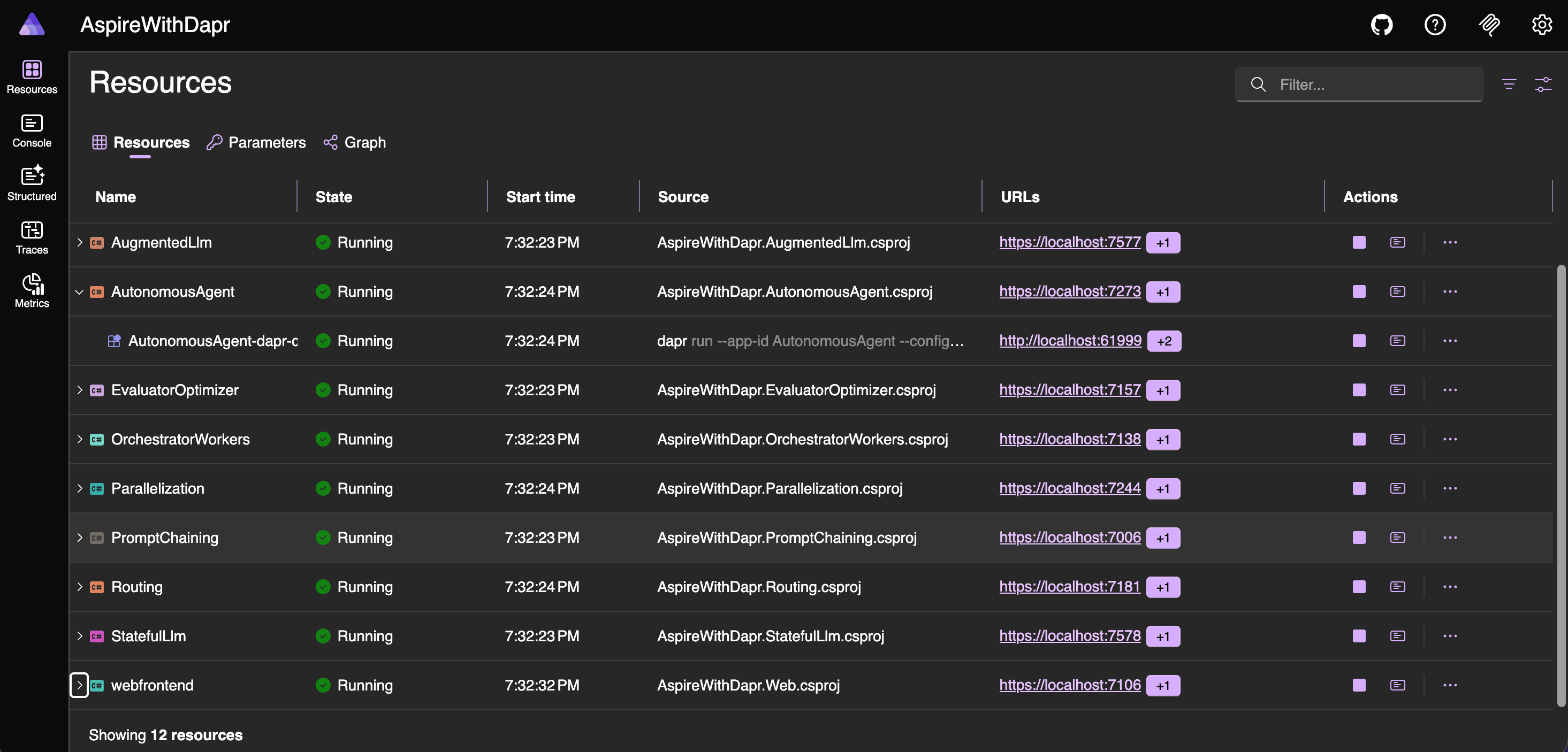
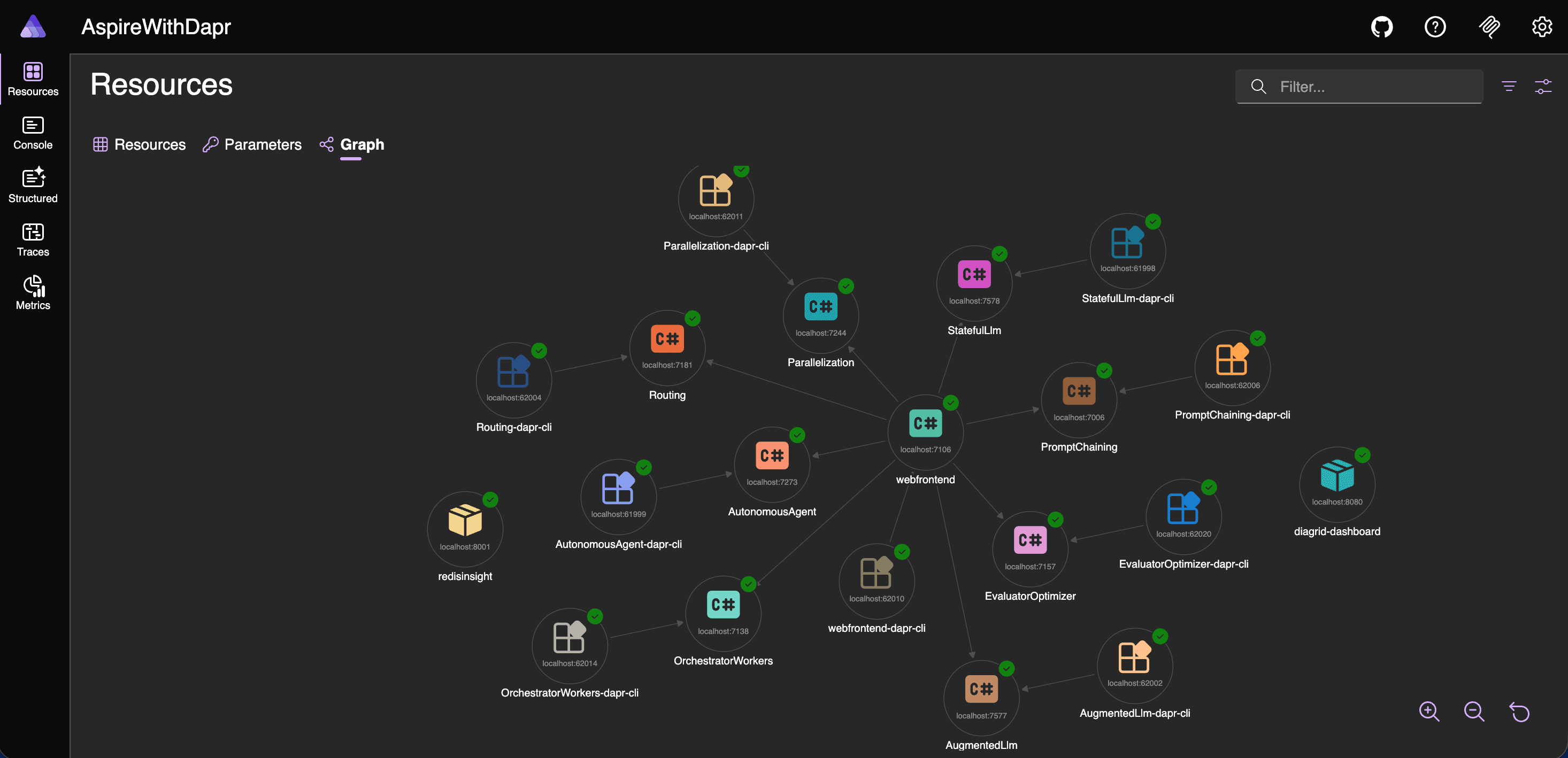
Let’s run the web application
Run the web application from the Aspire Dashboard. Once it launches, select Autonomous Agent (Goal Oriented) as the service type. You can then start a conversation and observe the application’s behavior. Using the Diagrid Dashboard, you can inspect the underlying workflow state and review historical execution data.
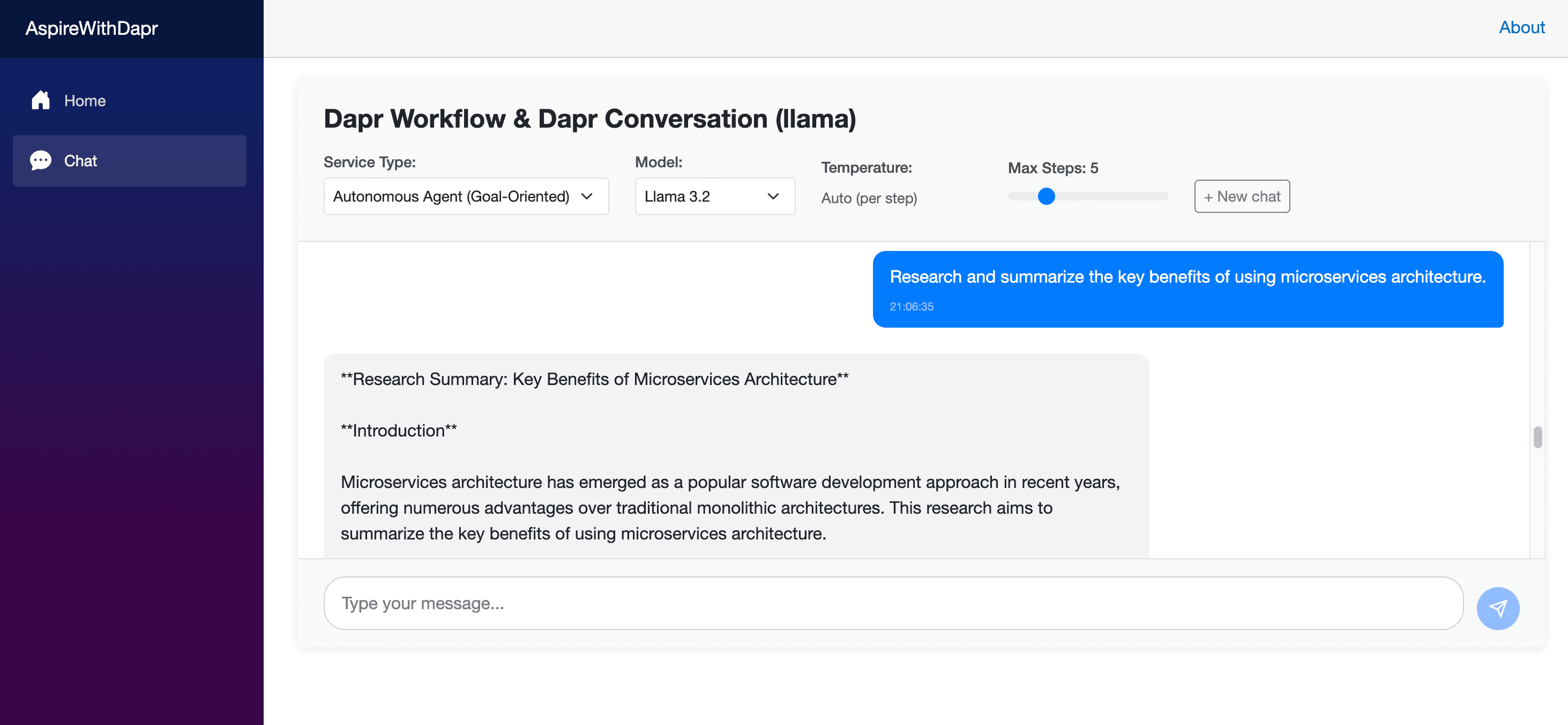
Conclusion
Together, Anthropic’s research, Dapr Workflow, and the Dapr Conversation API provide a strong foundation for building modern, production-ready LLM systems that are both capable and maintainable.
Ultimately, simplicity is a strategic choice. Starting with well-established patterns and evolving the system only as requirements demand helps ensure long-term reliability and clarity.