This blog post explores how to use the Dapr Bindings building block to let an application react to events from external systems and invoke external resources without taking a direct dependency on their client libraries. Dapr separates those two directions into input bindings, which trigger the application when an event occurs, and output bindings, which the application invokes through a consistent API. A single binding component can even support both directions at once via the direction metadata field. You can find the full list of supported binding components in the bindings reference.
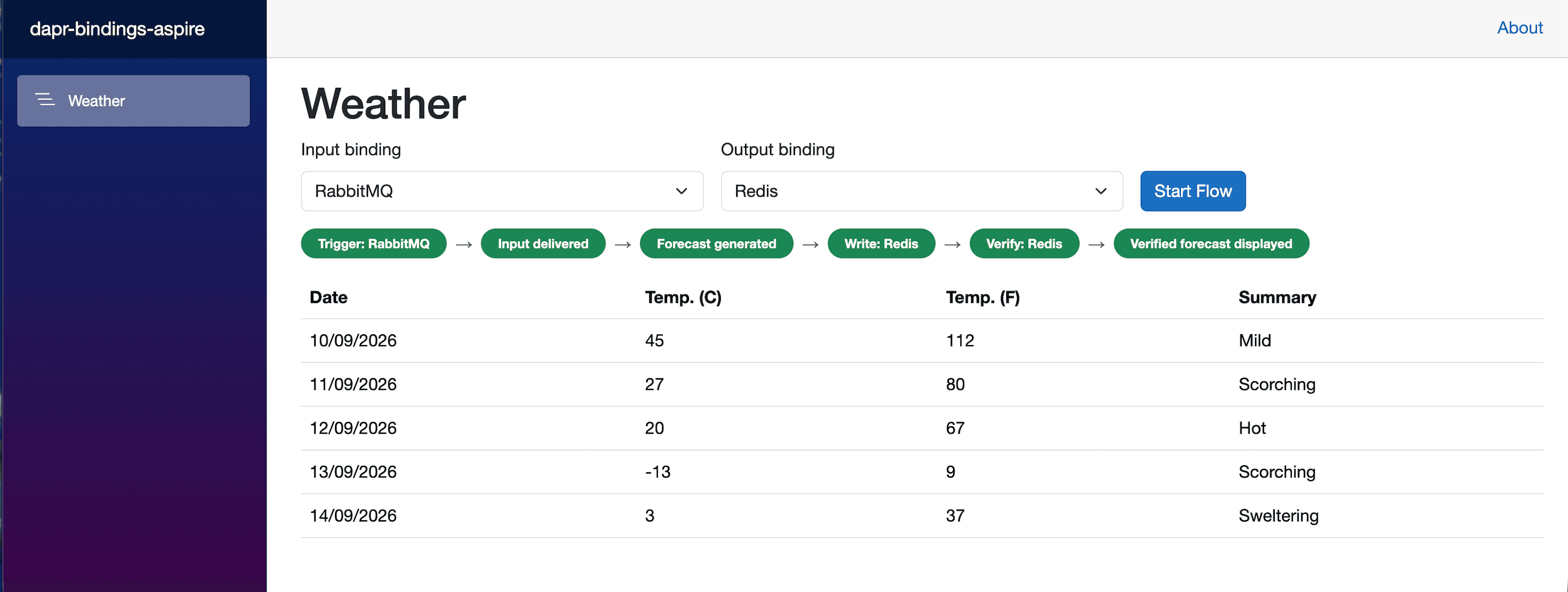
The demo app turns the familiar Weather Forecast example into a selectable binding flow. The user chooses RabbitMQ or Kafka as the input binding, then chooses RabbitMQ, Kafka, or Redis as the output binding. The same application code drives every combination.
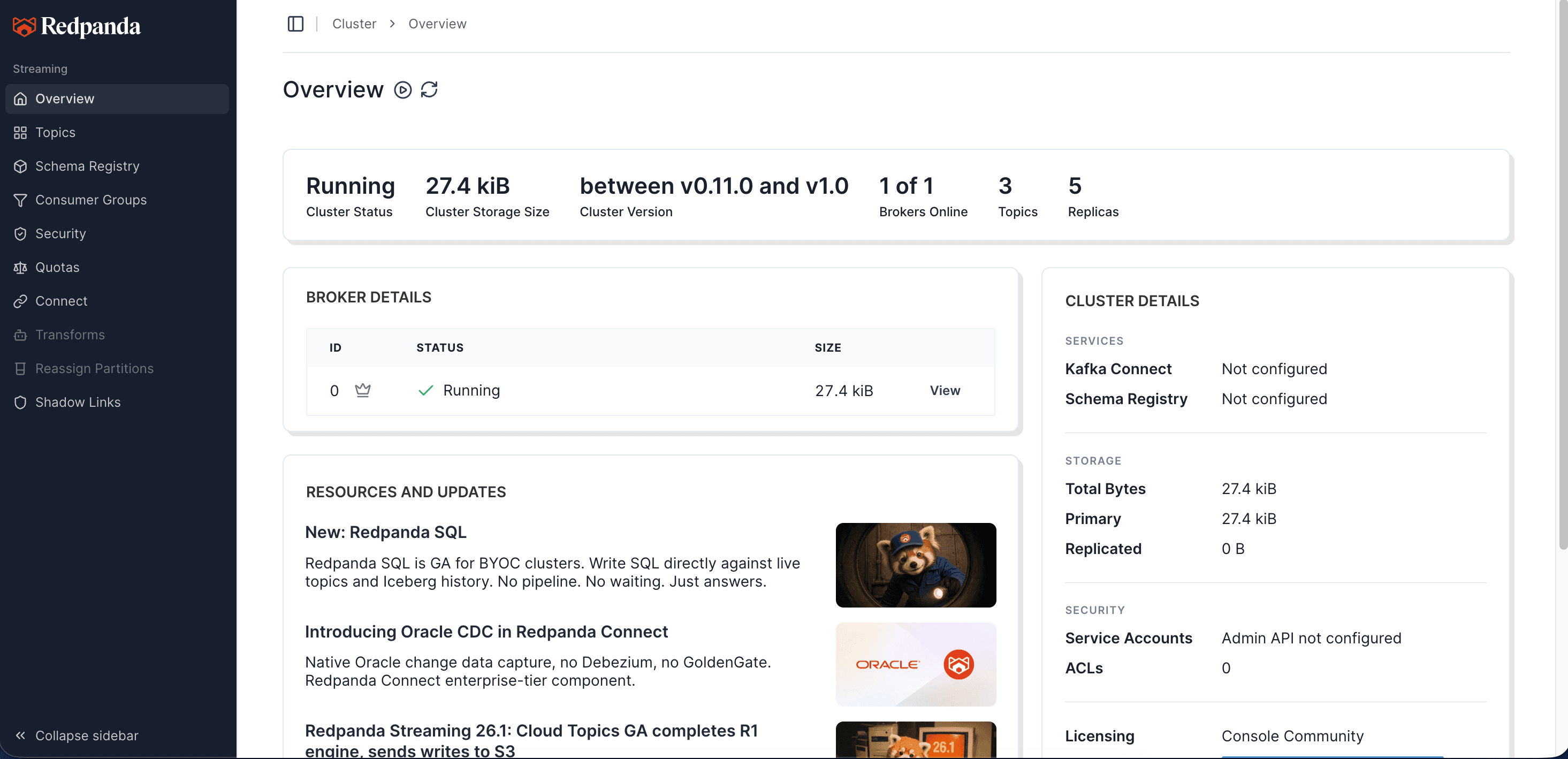
Aspire ties the demo together by orchestrating the application projects, the Dapr sidecar, and the supporting management UIs. The backing RabbitMQ, Kafka, and Redis services stay external, while Aspire gives us one place to start, inspect, and observe the application itself. For the Kafka broker, the demo actually runs Redpanda rather than Apache Kafka itself. Redpanda is a Kafka API-compatible streaming platform, so the Dapr Kafka binding component talks to it without any changes, while giving us a lighter-weight, single-binary broker that's easier to spin up locally through Aspire.
Here's a glimpse of the demo app, built up incrementally throughout this post.
Prerequisites
- Docker Desktop - Docker Desktop provides the local container runtime used by the backing services and management UIs.
- .NET Aspire - Aspire composes, runs, and observes the distributed application from the AppHost.
- Dapr CLI - Dapr CLI installs and manages the local Dapr runtime used by the sidecar.
- RabbitMQ - RabbitMQ supplies one input queue and one output queue for the demo.
- Redpanda - Redpanda provides a Kafka-compatible broker for the Kafka input and output bindings.
- Redis - Redis stores weather forecasts through an output binding.
Demo App
The demo app is based on the Aspire starter template, which includes a frontend (ASP.NET Core Blazor App), a backend (ASP.NET Core Minimal API), ServiceDefaults, and an AppHost project.
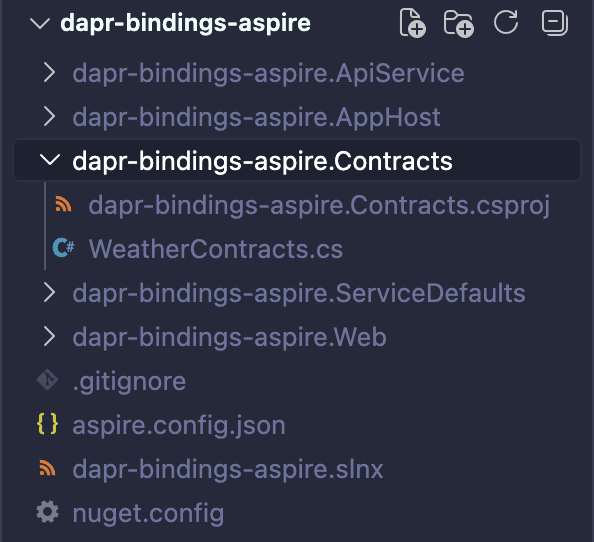
dotnet new aspire-starter --output dapr-bindings-aspireThe solution structure should look similar to the one below.
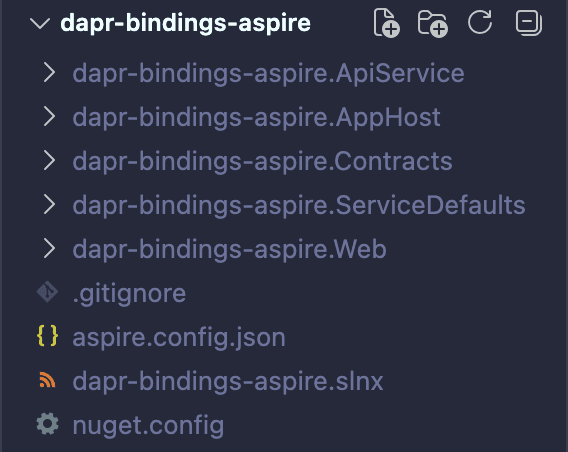
NOTE: A new project, dapr-bindings-aspire-Contracts, has been added to hold DTOs and flow-status constants. It has also been referenced by API and Web.
With the initial structure in place, let's move on to the AppHost.
App Host
Aspire's AppHost is where the distributed application is declared, code-first. In this demo, it starts the API service, its Dapr sidecar, the Blazor frontend, Redpanda Console, and RedisInsight. It also adds a dashboard link for RabbitMQ Management.
Start by adding the CommunityToolkit.Aspire.Hosting.Dapr NuGet package to the AppHost project. It provides extension methods and resource definitions for an Aspire AppHost to configure Dapr resources.
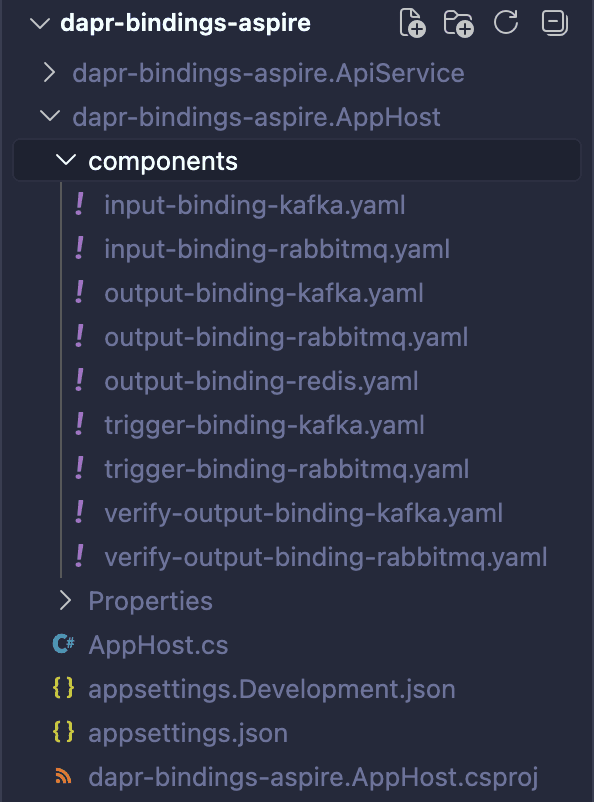
dotnet add package CommunityToolkit.Aspire.Hosting.DaprCreate the folder structure shown below to keep the Dapr component files organized.
components/input-binding-kafka.yaml
Consumes the weather-input Kafka topic as consumer group weather-api and delivers trigger messages to ApiService.
apiVersion: dapr.io/v1alpha1
kind: Component
metadata:
  name: input-binding-kafka
spec:
  type: bindings.kafka
  version: v1
  metadata:
    - name: brokers
      value: localhost:19092
    - name: topics
      value: weather-input
    - name: consumerGroup
      value: weather-api
    - name: authRequired
      value: "false"
    - name: initialOffset
      value: newest
    - name: direction
      value: input
components/input-binding-rabbitmq.yaml
Consumes weather-input-queue from RabbitMQ and delivers trigger messages to ApiService.
apiVersion: dapr.io/v1alpha1
kind: Component
metadata:
  name: input-binding-rabbitmq
spec:
  type: bindings.rabbitmq
  version: v1
  metadata:
    - name: queueName
      value: weather-input-queue
    - name: host
      value: amqp://guest:guest@localhost:5672
    - name: durable
      value: "true"
    - name: deleteWhenUnused
      value: "false"
    - name: prefetchCount
      value: "0"
    - name: direction
      value: input
components/output-binding-kafka.yaml
Writes the completed forecast to Kafka's weather-output topic.
apiVersion: dapr.io/v1alpha1
kind: Component
metadata:
  name: output-binding-kafka
spec:
  type: bindings.kafka
  version: v1
  metadata:
    - name: brokers
      value: localhost:19092
    - name: publishTopic
      value: weather-output
    - name: authRequired
      value: "false"
    - name: direction
      value: output
components/output-binding-rabbitmq.yaml
Writes the completed forecast to RabbitMQ's weather-output-queue.
apiVersion: dapr.io/v1alpha1
kind: Component
metadata:
  name: output-binding-rabbitmq
spec:
  type: bindings.rabbitmq
  version: v1
  metadata:
    - name: queueName
      value: weather-output-queue
    - name: host
      value: amqp://guest:guest@localhost:5672
    - name: durable
      value: "true"
    - name: deleteWhenUnused
      value: "false"
    - name: direction
      value: output
components/output-binding-redis.yaml
Writes a forecast snapshot to Redis; ApiService reads the same key back to verify it.
apiVersion: dapr.io/v1alpha1
kind: Component
metadata:
  name: output-binding-redis
spec:
  type: bindings.redis
  version: v1
  metadata:
    - name: redisHost
      value: localhost:6379
    - name: redisPassword
      value: ""
    - name: enableTLS
      value: "false"
    - name: direction
      value: output
components/trigger-binding-kafka.yaml
Publishes a newly started Kafka flow to weather-input.
apiVersion: dapr.io/v1alpha1
kind: Component
metadata:
  name: trigger-binding-kafka
spec:
  type: bindings.kafka
  version: v1
  metadata:
    - name: brokers
      value: localhost:19092
    - name: publishTopic
      value: weather-input
    - name: authRequired
      value: "false"
    - name: direction
      value: output
components/trigger-binding-rabbitmq.yaml
Publishes a newly started RabbitMQ flow to weather-input-queue.
apiVersion: dapr.io/v1alpha1
kind: Component
metadata:
  name: trigger-binding-rabbitmq
spec:
  type: bindings.rabbitmq
  version: v1
  metadata:
    - name: queueName
      value: weather-input-queue
    - name: host
      value: amqp://guest:guest@localhost:5672
    - name: durable
      value: "true"
    - name: deleteWhenUnused
      value: "false"
    - name: direction
      value: output
components/verify-output-binding-kafka.yaml
Consumes weather-output as consumer group weather-output-verifier and posts the final Kafka message to ApiService for correlation verification.
apiVersion: dapr.io/v1alpha1
kind: Component
metadata:
  name: verify-output-binding-kafka
spec:
  type: bindings.kafka
  version: v1
  metadata:
    - name: brokers
      value: localhost:19092
    - name: topics
      value: weather-output
    - name: consumerGroup
      value: weather-output-verifier
    - name: authRequired
      value: "false"
    - name: initialOffset
      value: newest
    - name: direction
      value: input
components/verify-output-binding-rabbitmq.yaml
Consumes weather-output-queue and posts the final RabbitMQ message to ApiService for correlation verification.
apiVersion: dapr.io/v1alpha1
kind: Component
metadata:
  name: verify-output-binding-rabbitmq
spec:
  type: bindings.rabbitmq
  version: v1
  metadata:
    - name: queueName
      value: weather-output-queue
    - name: host
      value: amqp://guest:guest@localhost:5672
    - name: durable
      value: "true"
    - name: deleteWhenUnused
      value: "false"
    - name: prefetchCount
      value: "0"
    - name: direction
      value: input
AppHost.cs
var builder = DistributedApplication.CreateBuilder(args);

var callbackToken = builder.AddParameter("weather-callback-token",
    new GenerateParameterDefault { MinLength = 32 }, secret: true);

// Dapr components path
var daprComponentsPath = Path.Combine(builder.AppHostDirectory, "components");

// Dashboard link only: the external rabbitmq:4-management container owns ports 5672 and 15672.
// This does not start a broker, create a Management UI, or bind either port.
builder.AddExternalService("rabbitmq-management", "http://localhost:15672");

// Console only; the external broker owns Kafka ports 19092 (Dapr) and 29092 (containers).
builder.AddContainer("redpanda-console", "docker.redpanda.com/redpandadata/console", "v3.10.0")
    .WithEndpoint(targetPort: 8080, scheme: "http", name: "http", isExternal: true)
    .WithEnvironment("KAFKA_BROKERS", "host.docker.internal:29092")
    .WithUrlForEndpoint("http", url =>
    {
        url.Url = "/";
        url.DisplayText = "Redpanda Console";
    });

// RedisInsight UI
builder.AddContainer("redisinsight", "redis/redisinsight", "latest")
    .WithEndpoint(targetPort: 5540, scheme: "http", name: "http", isExternal: true)
    .WithEnvironment("RI_APP_HOST", "0.0.0.0")
    .WithEnvironment("RI_APP_PORT", "5540")
    .WithEnvironment("RI_REDIS_HOST", "host.docker.internal")
    .WithEnvironment("RI_REDIS_PORT", "6379")
    .WithEnvironment("RI_REDIS_ALIAS", "Dapr binding Redis")
    .WithUrlForEndpoint("http", url =>
    {
        url.Url = "/";
        url.DisplayText = "Redis Insight";
    });

// ApiService project with Dapr sidecar
var apiService = builder.AddProject<Projects.dapr_bindings_aspire_ApiService>("apiservice")
    .WithEnvironment("WeatherFlow__CallbackToken", callbackToken)
    .WithHttpHealthCheck("/health")
    .WithDaprSidecar(new CommunityToolkit.Aspire.Hosting.Dapr.DaprSidecarOptions
    {
        ResourcesPaths = [daprComponentsPath]
    })
    .WithUrlForEndpoint("http", url =>
    {
        url.Url = "/";
        url.DisplayText = "API Service";
    })
    .WithUrlForEndpoint("https", url =>
    {
        url.Url = "/";
        url.DisplayText = "API Service";
    });

// Web App project
var webFrontend = builder.AddProject<Projects.dapr_bindings_aspire_Web>("webfrontend")
    .WithEnvironment("WeatherFlow__CallbackToken", callbackToken)
    .WithExternalHttpEndpoints()
    .WithHttpHealthCheck("/health")
    .WithReference(apiService)
    .WaitFor(apiService)
    .WithUrlForEndpoint("http", url =>
    {
        url.Url = "/";
        url.DisplayText = "Web App";
    })
    .WithUrlForEndpoint("https", url =>
    {
        url.Url = "/";
        url.DisplayText = "Web App";
    });

// Callbacks need reverse discovery
apiService.WithReference(webFrontend);

builder.Build().Run();
Here, ResourcesPaths points the sidecar to its component YAML files. Only the API service runs a Dapr sidecar, since it owns the input endpoints and output invocations; the Web App reaches it purely through Aspire service discovery, with no direct Dapr dependency.
Note also what the AppHost leaves out: RabbitMQ and Kafka stay externally managed, and Redis is prepared as part of the dapr init process.
Refer to the command below to prepare RabbitMQ and Kafka:
  docker run -d \
    --name dapr-rabbitmq \
    --hostname dapr-rabbitmq \
    -p 5672:5672 \
    -p 15672:15672 \
    rabbitmq:4-management
docker run -d \
--name dapr-redpanda \
--hostname dapr-redpanda \
-p 19092:19092 \
-p 29092:29092 \
docker.redpanda.com/redpandadata/redpanda:v26.2.2 \
redpanda start \
--mode dev-container \
--smp 1 \
--memory 512M \
--node-id 0 \
--kafka-addr internal://0.0.0.0:9092,external://0.0.0.0:19092,containers://0.0.0.0:29092 \
--advertise-kafka-addr internal://dapr-redpanda:9092,external://localhost:19092,containers://host.docker.internal:29092You can run the following command to check whether both RabbitMQ and Kafka containers are ready.
docker ps --filter name=dapr-rCONTAINER ID IMAGE COMMAND CREATED STATUS PORTS NAMES
9d0361b75952 rabbitmq:4-management "docker-entrypoint.s…" 42 minutes ago Up 42 minutes 0.0.0.0:5672->5672/tcp, [::]:5672->5672/tcp, 0.0.0.0:15672->15672/tcp, [::]:15672->15672/tcp dapr-rabbitmq
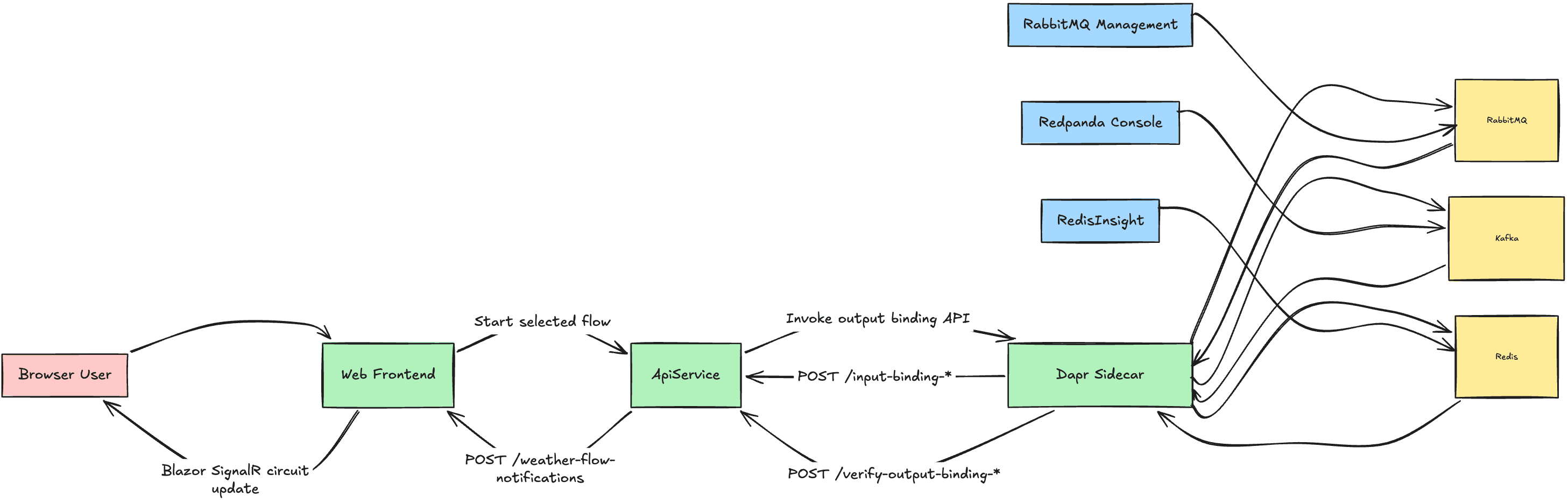
5a123fd3764c docker.redpanda.com/redpandadata/redpanda:v26.2.2 "/entrypoint.sh redp…" 43 minutes ago Up 43 minutes 0.0.0.0:19092->19092/tcp, [::]:19092->19092/tcp, 0.0.0.0:29092->29092/tcp, [::]:29092->29092/tcp dapr-redpandaThe following diagram illustrates the overall application topology.
Contracts
The Contacts project contains the shared DTOs and flow-status constants used by both the API and web projects, keeping the contracts consistent across the application.
WeatherContracts.cs
namespace dapr_bindings_aspire.Contracts;

public sealed record WeatherForecastTriggerRequest(
    int? Days,
    DateOnly? StartDate,
    string? CorrelationId,
    string? OutputBinding,
    string? CallbackUrl);

public sealed record WeatherBindingOption(
    string Id,
    string Label,
    string BindingName);

public sealed record WeatherFlowOptions(
    WeatherBindingOption[] InputBindings,
    WeatherBindingOption[] OutputBindings);

public sealed record WeatherFlowRequest(
    string InputBinding,
    string OutputBinding,
    string? CallbackUrl,
    string? CorrelationId = null);

public sealed record WeatherFlowStartedResponse(
    bool Started,
    string Message,
    string CorrelationId,
    string InputBinding,
    string InputLabel,
    string OutputBinding,
    string OutputLabel);

public sealed record WeatherFlowNotification(
    string CorrelationId,
    string Status,
    string Message,
    WeatherForecastResponse Forecast);

public sealed record WeatherForecast(DateOnly Date, int TemperatureC, string? Summary)
{
    public int TemperatureF => 32 + (int)(TemperatureC / 0.5556);
}

public sealed record WeatherForecastResponse(
    DateTimeOffset? GeneratedAt,
    WeatherForecast[] Forecasts,
    string? CorrelationId = null,
    string? InputBinding = null,
    string? InputLabel = null,
    string? OutputBinding = null,
    string? OutputLabel = null,
    string? OutputStatus = null);

public static class FlowStatus
{
    public const string InputReceived = "input-received";
    public const string ForecastGenerated = "forecast-generated";
    public const string OutputAccepted = "output-accepted";
    public const string Verified = "verified";
    public const string Failed = "failed";
}
API Service
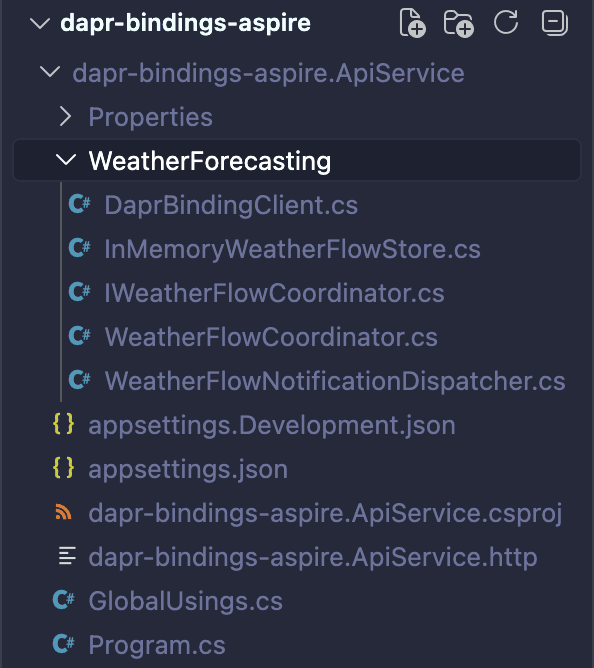
The API project handles weather-forecast requests and coordinates the selected Dapr input and output bindings. It receives events from RabbitMQ or Kafka, invokes the configured output binding, verifies the result, and publishes progress updates for the web app.
Program.cs
using dapr_bindings_aspire.ApiService.WeatherForecasting;
using Microsoft.AspNetCore.Http.HttpResults;

var builder = WebApplication.CreateBuilder(args);

builder.AddServiceDefaults();

builder.Services.AddProblemDetails();

builder.Services.AddOpenApi();

builder.Services.AddHttpClient();
builder.Services.AddHttpClient("weather-notifications")
    .ConfigurePrimaryHttpMessageHandler(() => new HttpClientHandler { AllowAutoRedirect = false });
builder.Services.AddSingleton(TimeProvider.System);
builder.Services.AddSingleton<InMemoryWeatherFlowStore>();
builder.Services.AddSingleton<DaprBindingClient>();
builder.Services.AddSingleton<WeatherFlowNotificationDispatcher>();
builder.Services.AddHostedService(services => services.GetRequiredService<WeatherFlowNotificationDispatcher>());
builder.Services.AddSingleton<IWeatherFlowCoordinator, WeatherFlowCoordinator>();

var app = builder.Build();

app.UseExceptionHandler();

if (app.Environment.IsDevelopment())
{
    app.MapOpenApi();
}

app.MapGet("/", () => "API service is running. Open the Web App to use the bindings demo.");

app.MapGet("/weatherforecast/flows/options", (IWeatherFlowCoordinator weatherFlowCoordinator) =>
    TypedResults.Ok(weatherFlowCoordinator.GetFlowOptions()))
.WithName("GetWeatherFlowOptions")
.WithSummary("Get selectable weather binding flow options.")
.WithDescription("Returns the input and output Dapr binding options exposed by the weather demo.")
.Produces<WeatherFlowOptions>(StatusCodes.Status200OK);

app.MapPost("/weatherforecast/flows/start", async Task<Results<Accepted<WeatherFlowStartedResponse>, ProblemHttpResult>> (
    WeatherFlowRequest request,
    IWeatherFlowCoordinator weatherFlowCoordinator,
    CancellationToken cancellationToken) =>
{
    try
    {
        var result = await weatherFlowCoordinator.StartFlowAsync(request, cancellationToken);
        return TypedResults.Accepted((string?)null, result);
    }
    catch (FlowValidationException ex)
    {
        return TypedResults.Problem(ex.Message, statusCode: StatusCodes.Status400BadRequest);
    }
    catch (FlowCapacityException ex)
    {
        return TypedResults.Problem(ex.Message, statusCode: StatusCodes.Status503ServiceUnavailable);
    }
    catch (HttpRequestException)
    {
        return TypedResults.Problem("The trigger binding is unavailable.", statusCode: StatusCodes.Status502BadGateway);
    }
    catch (Polly.CircuitBreaker.BrokenCircuitException)
    {
        return TypedResults.Problem("The trigger binding is temporarily unavailable.", statusCode: StatusCodes.Status503ServiceUnavailable);
    }
    catch (Polly.Timeout.TimeoutRejectedException)
    {
        return TypedResults.Problem("The trigger binding timed out.", statusCode: StatusCodes.Status504GatewayTimeout);
    }
    catch (OperationCanceledException) when (!cancellationToken.IsCancellationRequested)
    {
        return TypedResults.Problem("The trigger binding timed out.", statusCode: StatusCodes.Status504GatewayTimeout);
    }
})
.WithName("StartWeatherBindingFlow")
.WithSummary("Start a selected Dapr binding flow.")
.WithDescription("Publishes a trigger message to the selected input binding; the Dapr input binding later calls ApiService.")
.Produces<WeatherFlowStartedResponse>(StatusCodes.Status202Accepted)
.ProducesProblem(StatusCodes.Status400BadRequest)
.ProducesProblem(StatusCodes.Status502BadGateway)
.ProducesProblem(StatusCodes.Status503ServiceUnavailable)
.ProducesProblem(StatusCodes.Status504GatewayTimeout);

app.MapPost("/input-binding-rabbitmq", async Task<Ok<WeatherForecastResponse>> (
    HttpRequest request,
    IWeatherFlowCoordinator weatherFlowCoordinator,
    CancellationToken cancellationToken) =>
{
    using var reader = new StreamReader(request.Body);
    var body = await reader.ReadToEndAsync(cancellationToken);
    var forecast = await weatherFlowCoordinator.StoreInputBindingAsync("rabbitmq", body, cancellationToken);
    return TypedResults.Ok(forecast);
})
.WithName("ReceiveRabbitMqWeatherForecast")
.WithSummary("Receive a RabbitMQ input binding event.")
.WithDescription("Dapr calls this endpoint when a message arrives on the input-binding-rabbitmq RabbitMQ binding.")
.Produces<WeatherForecastResponse>(StatusCodes.Status200OK);

app.MapPost("/input-binding-kafka", async Task<Ok<WeatherForecastResponse>> (
    HttpRequest request,
    IWeatherFlowCoordinator weatherFlowCoordinator,
    CancellationToken cancellationToken) =>
{
    using var reader = new StreamReader(request.Body);
    var body = await reader.ReadToEndAsync(cancellationToken);
    var forecast = await weatherFlowCoordinator.StoreInputBindingAsync("kafka", body, cancellationToken);
    return TypedResults.Ok(forecast);
})
.WithName("ReceiveKafkaWeatherForecast")
.WithSummary("Receive a Kafka input binding event.")
.WithDescription("Dapr calls this endpoint when a message arrives on the input-binding-kafka Kafka binding.")
.Produces<WeatherForecastResponse>(StatusCodes.Status200OK);

app.MapPost("/verify-output-binding-rabbitmq", async Task<Ok> (
    HttpRequest request,
    IWeatherFlowCoordinator weatherFlowCoordinator,
    CancellationToken cancellationToken) =>
{
    using var reader = new StreamReader(request.Body);
    await weatherFlowCoordinator.VerifyOutputBindingAsync("rabbitmq", await reader.ReadToEndAsync(cancellationToken), cancellationToken);
    return TypedResults.Ok();
})
.WithName("VerifyRabbitMqWeatherOutput")
.WithSummary("Verify a RabbitMQ output binding delivery.");

app.MapPost("/verify-output-binding-kafka", async Task<Ok> (
    HttpRequest request,
    IWeatherFlowCoordinator weatherFlowCoordinator,
    CancellationToken cancellationToken) =>
{
    using var reader = new StreamReader(request.Body);
    await weatherFlowCoordinator.VerifyOutputBindingAsync("kafka", await reader.ReadToEndAsync(cancellationToken), cancellationToken);
    return TypedResults.Ok();
})
.WithName("VerifyKafkaWeatherOutput")
.WithSummary("Verify a Kafka output binding delivery.");

app.MapDefaultEndpoints();

app.Run();
GlobalUsings.cs
global using dapr_bindings_aspire.Contracts;WeatherForecasting/DaprBindingClient.cs
using System.Net.Http.Json;

namespace dapr_bindings_aspire.ApiService.WeatherForecasting;

public sealed class DaprBindingClient(IHttpClientFactory clients, IConfiguration configuration)
{
    public Task<HttpResponseMessage> InvokeAsync(string bindingName, DaprBindingRequest request, CancellationToken cancellationToken)
    {
        var port = configuration["DAPR_HTTP_PORT"] ?? "3500";
        return clients.CreateClient("dapr").PostAsJsonAsync(
            $"http://127.0.0.1:{port}/v1.0/bindings/{bindingName}", request, cancellationToken);
    }
}

public sealed record DaprBindingRequest(string Operation, object? Data, Dictionary<string, string> Metadata);

public sealed class FlowValidationException(string message) : Exception(message);
public sealed class FlowCapacityException() : Exception("Too many retained flows. Try again later.");
WeatherForecasting/InMemoryWeatherFlowStore.cs
namespace dapr_bindings_aspire.ApiService.WeatherForecasting;

// A bounded, single-process idempotency window. Entries are retained after completion
// so duplicate broker deliveries reuse the same task and generated forecast.
public sealed class InMemoryWeatherFlowStore(TimeProvider clock)
{
    private readonly object gate = new();
    private readonly Dictionary<string, Entry> entries = new(StringComparer.Ordinal);
    public const int Capacity = 1000;
    public static readonly TimeSpan Retention = TimeSpan.FromMinutes(10);

    public Entry Register(string id, string input, string output)
    {
        if (string.IsNullOrWhiteSpace(id) || id.Length > 128)
            throw new FlowValidationException("Correlation ID must contain 1–128 characters.");
        lock (gate)
        {
            RemoveExpired();
            if (entries.TryGetValue(id, out var existing))
            {
                if (existing.Input != input || existing.Output != output)
                    throw new FlowValidationException("Correlation ID is already assigned to another binding selection.");
                return existing;
            }
            if (entries.Count >= Capacity)
                throw new FlowCapacityException();
            var entry = new Entry(input, output, clock.GetUtcNow() + Retention);
            entries.Add(id, entry);
            return entry;
        }
    }

    public Entry? Find(string id)
    {
        lock (gate)
        {
            RemoveExpired();
            return entries.GetValueOrDefault(id);
        }
    }

    public Entry[] Snapshot()
    {
        lock (gate)
        {
            RemoveExpired();
            return entries.Values.ToArray();
        }
    }

    private void RemoveExpired()
    {
        foreach (var id in entries.Where(pair => pair.Value.ExpiresAt <= clock.GetUtcNow()).Select(pair => pair.Key).ToArray())
            entries.Remove(id);
    }

    public sealed class Entry(string input, string output, DateTimeOffset expiresAt)
    {
        public object Gate { get; } = new();
        public string Input { get; } = input;
        public string Output { get; } = output;
        public DateTimeOffset ExpiresAt { get; } = expiresAt;
        public Lazy<Task<WeatherFlowStartedResponse>>? Start { get; set; }
        public Lazy<Task<WeatherForecastResponse>>? Processing { get; set; }
        public WeatherFlowNotification? Completion { get; set; }
        public bool Delivered { get; set; }
        public bool Sending { get; set; }
        public int DeliveryAttempts { get; set; }
    }
}
WeatherForecasting/IWeatherFlowCoordinator.cs
namespace dapr_bindings_aspire.ApiService.WeatherForecasting;

public interface IWeatherFlowCoordinator
{
    WeatherFlowOptions GetFlowOptions();

    Task<WeatherForecastResponse> StoreInputBindingAsync(
        string inputBinding,
        string requestBody,
        CancellationToken cancellationToken);

    Task VerifyOutputBindingAsync(
        string outputBinding,
        string requestBody,
        CancellationToken cancellationToken);

    Task<WeatherFlowStartedResponse> StartFlowAsync(
        WeatherFlowRequest request,
        CancellationToken cancellationToken);

}
WeatherForecasting/WeatherFlowCoordinator.cs
using System.Text.Json;

namespace dapr_bindings_aspire.ApiService.WeatherForecasting;

public sealed class WeatherFlowCoordinator(
    DaprBindingClient dapr,
    InMemoryWeatherFlowStore flows,
    WeatherFlowNotificationDispatcher callbacks,
    ILogger<WeatherFlowCoordinator> logger) : IWeatherFlowCoordinator
{
    private static readonly JsonSerializerOptions JsonOptions = new(JsonSerializerDefaults.Web);

    private static readonly WeatherBindingDefinition[] InputBindings =
    [
        new("rabbitmq", "RabbitMQ", "input-binding-rabbitmq", "trigger-binding-rabbitmq"),
        new("kafka", "Kafka", "input-binding-kafka", "trigger-binding-kafka")
    ];

    private static readonly WeatherBindingDefinition[] OutputBindings =
    [
        new("rabbitmq", "RabbitMQ", "output-binding-rabbitmq", null),
        new("kafka", "Kafka", "output-binding-kafka", null),
        new("redis", "Redis", "output-binding-redis", null)
    ];

    private static readonly string[] Summaries =
    [
        "Freezing",
        "Bracing",
        "Chilly",
        "Cool",
        "Mild",
        "Warm",
        "Balmy",
        "Hot",
        "Sweltering",
        "Scorching"
    ];


    public WeatherFlowOptions GetFlowOptions() =>
        new(
            InputBindings.Select(ToOption).ToArray(),
            OutputBindings.Select(ToOption).ToArray());

    public Task<WeatherForecastResponse> StoreInputBindingAsync(
        string inputBinding,
        string requestBody,
        CancellationToken cancellationToken)
    {
        var input = FindInput(inputBinding);
        var request = ReadTriggerRequest(requestBody);
        var output = FindOutput(request?.OutputBinding ?? "redis");
        callbacks.ValidateCallback(request?.CallbackUrl);
        var correlationId = string.IsNullOrWhiteSpace(request?.CorrelationId) ? Guid.NewGuid().ToString("N") : request.CorrelationId;
        request = request is null
            ? new(null, null, correlationId, output.Id, null)
            : request with { CorrelationId = correlationId };
        var entry = flows.Register(correlationId, input.Id, output.Id);
        Lazy<Task<WeatherForecastResponse>> processing;
        lock (entry.Gate)
        {
            processing = entry.Processing ??= new(() => ProcessInputAsync(request, input, output, cancellationToken));
        }
        return processing.Value;
    }

    private async Task<WeatherForecastResponse> ProcessInputAsync(
        WeatherForecastTriggerRequest request,
        WeatherBindingDefinition input,
        WeatherBindingDefinition output,
        CancellationToken cancellationToken)
    {
        var response = GenerateForecast(request, input, output);

        try
        {
            await callbacks.ProgressAsync(
                response,
                FlowStatus.InputReceived,
                $"Dapr delivered the {input.Label} input event to ApiService.",
                cancellationToken);
            await callbacks.ProgressAsync(
                response,
                FlowStatus.ForecastGenerated,
                $"Weather forecast generated; sending it to {output.Label}.",
                cancellationToken);
            await InvokeSelectedOutputAsync(response, output, cancellationToken);
            await callbacks.ProgressAsync(
                response,
                FlowStatus.OutputAccepted,
                $"{output.Label} accepted the weather forecast.",
                cancellationToken);

            if (output.Id == "redis")
            {
                response = await VerifyRedisOutputAsync(response, cancellationToken);
                await callbacks.CompleteAsync(response, FlowStatus.Verified, cancellationToken);
            }
            else
            {
                response = response with
                {
                    OutputStatus = $"Weather forecast accepted by {output.Label}; waiting for destination verification."
                };
            }
        }
        catch (Exception ex) when (ex is HttpRequestException or OperationCanceledException or InvalidOperationException
            or Polly.Timeout.TimeoutRejectedException or Polly.CircuitBreaker.BrokenCircuitException)
        {
            logger.LogWarning(
                ex,
                "Weather output binding {BindingName} failed for correlation {CorrelationId}.",
                output.BindingName,
                response.CorrelationId);

            response = response with
            {
                OutputStatus = $"{output.Label} output failed: {ex.Message}"
            };
            await callbacks.CompleteAsync(response, FlowStatus.Failed, cancellationToken);
        }

        return response;
    }

    public async Task VerifyOutputBindingAsync(
        string outputBinding,
        string requestBody,
        CancellationToken cancellationToken)
    {
        var output = FindOutput(outputBinding);
        var response = ReadForecastResponse(requestBody);
        if (response?.CorrelationId is null
            || !string.Equals(response.OutputBinding, output.Id, StringComparison.OrdinalIgnoreCase))
        {
            logger.LogWarning("Ignored unverifiable {BindingName} output message.", output.BindingName);
            return;
        }

        if (flows.Find(response.CorrelationId) is not { } entry
            || entry.Output != output.Id || response.InputBinding != entry.Input
            || response.Forecasts is null)
            return;

        response = response with
        {
            OutputStatus = $"Weather forecast verified in {output.Label}."
        };
        await callbacks.CompleteAsync(response, FlowStatus.Verified, cancellationToken);
    }

    public Task<WeatherFlowStartedResponse> StartFlowAsync(
        WeatherFlowRequest request,
        CancellationToken cancellationToken)
    {
        var input = FindInput(request.InputBinding);
        var output = FindOutput(request.OutputBinding);
        var correlationId = string.IsNullOrWhiteSpace(request.CorrelationId)
            ? Guid.NewGuid().ToString("N")
            : request.CorrelationId;
        callbacks.ValidateCallback(request.CallbackUrl);
        var entry = flows.Register(correlationId, input.Id, output.Id);
        Lazy<Task<WeatherFlowStartedResponse>> start;
        lock (entry.Gate)
        {
            start = entry.Start ??= new(() => PublishTriggerAsync(request, input, output, correlationId, cancellationToken));
        }
        return start.Value;
    }

    private async Task<WeatherFlowStartedResponse> PublishTriggerAsync(
        WeatherFlowRequest request, WeatherBindingDefinition input, WeatherBindingDefinition output,
        string correlationId, CancellationToken cancellationToken)
    {
        var trigger = new WeatherForecastTriggerRequest(
            Days: 5,
            StartDate: DateOnly.FromDateTime(DateTime.UtcNow).AddDays(1),
            CorrelationId: correlationId,
            OutputBinding: output.Id,
            CallbackUrl: request.CallbackUrl);

        if (input.TriggerBindingName is null)
        {
            throw new InvalidOperationException($"{input.Label} does not have a trigger binding configured.");
        }

        {
            using var response = await dapr.InvokeAsync(
                input.TriggerBindingName,
                new DaprBindingRequest(
                    Operation: "create",
                    Data: JsonSerializer.Serialize(trigger, JsonOptions),
                    Metadata: []),
                cancellationToken);

            if (!response.IsSuccessStatusCode)
            {
                var details = await response.Content.ReadAsStringAsync(cancellationToken);
                throw new HttpRequestException(
                    $"{input.Label} trigger returned HTTP {(int)response.StatusCode}. {details}");
            }
        }

        return new WeatherFlowStartedResponse(
            true,
            $"Flow started through {input.Label}; waiting for Dapr input binding delivery.",
            correlationId,
            input.Id,
            input.Label,
            output.Id,
            output.Label);
    }

    private async Task InvokeSelectedOutputAsync(
        WeatherForecastResponse forecastResponse,
        WeatherBindingDefinition output,
        CancellationToken cancellationToken)
    {
        var metadata = output.Id == "redis"
            ? new Dictionary<string, string> { ["key"] = GetRedisKey(forecastResponse.CorrelationId) }
            : [];

        using var response = await dapr.InvokeAsync(
            output.BindingName,
            new DaprBindingRequest(
                Operation: "create",
                Data: JsonSerializer.Serialize(forecastResponse, JsonOptions),
                Metadata: metadata),
            cancellationToken);

        if (!response.IsSuccessStatusCode)
        {
            var details = await response.Content.ReadAsStringAsync(cancellationToken);
            throw new InvalidOperationException(
                $"{output.Label} returned HTTP {(int)response.StatusCode}. {details}");
        }

    }

    private async Task<WeatherForecastResponse> VerifyRedisOutputAsync(
        WeatherForecastResponse expected,
        CancellationToken cancellationToken)
    {
        using var response = await dapr.InvokeAsync(
            "output-binding-redis",
            new DaprBindingRequest(
                Operation: "get",
                Data: null,
                Metadata: new Dictionary<string, string> { ["key"] = GetRedisKey(expected.CorrelationId) }),
            cancellationToken);

        if (!response.IsSuccessStatusCode)
        {
            var details = await response.Content.ReadAsStringAsync(cancellationToken);
            throw new InvalidOperationException(
                $"Redis verification failed with HTTP {(int)response.StatusCode}. {details}");
        }

        var stored = ReadForecastResponse(await response.Content.ReadAsStringAsync(cancellationToken));
        if (stored?.Forecasts is null || stored.OutputBinding != "redis"
            || !string.Equals(stored.CorrelationId, expected.CorrelationId, StringComparison.Ordinal))
        {
            throw new InvalidOperationException("Redis verification did not return the forecast written for this flow.");
        }

        return stored with
        {
            OutputStatus = "Weather forecast verified in Redis."
        };
    }

    private WeatherForecastResponse GenerateForecast(
        WeatherForecastTriggerRequest? request,
        WeatherBindingDefinition input,
        WeatherBindingDefinition output)
    {
        var days = Math.Clamp(request?.Days ?? 5, 1, 10);
        var startDate = request?.StartDate ?? DateOnly.FromDateTime(DateTime.UtcNow).AddDays(1);
        var forecasts = Enumerable.Range(0, days)
            .Select(index => new WeatherForecast(
                startDate.AddDays(index),
                Random.Shared.Next(-20, 55),
                Summaries[Random.Shared.Next(Summaries.Length)]))
            .ToArray();

        return new WeatherForecastResponse(
            DateTimeOffset.UtcNow,
            forecasts,
            string.IsNullOrWhiteSpace(request?.CorrelationId) ? Guid.NewGuid().ToString("N") : request.CorrelationId,
            input.Id,
            input.Label,
            output.Id,
            output.Label);
    }

    private static WeatherForecastTriggerRequest? ReadTriggerRequest(string requestBody)
    {
        if (string.IsNullOrWhiteSpace(requestBody))
        {
            return null;
        }

        try
        {
            using var document = JsonDocument.Parse(requestBody);
            var root = document.RootElement;

            if (root.ValueKind == JsonValueKind.Object && root.TryGetProperty("data", out var data))
            {
                return ReadTriggerRequest(data);
            }

            return ReadTriggerRequest(root);
        }
        catch (JsonException)
        {
            return null;
        }
    }

    private static WeatherForecastTriggerRequest? ReadTriggerRequest(JsonElement element)
    {
        if (element.ValueKind == JsonValueKind.String)
        {
            return ReadTriggerRequest(element.GetString() ?? string.Empty);
        }

        return element.Deserialize<WeatherForecastTriggerRequest>(JsonOptions);
    }

    private static WeatherForecastResponse? ReadForecastResponse(string content)
    {
        if (string.IsNullOrWhiteSpace(content))
        {
            return null;
        }

        try
        {
            using var document = JsonDocument.Parse(content);
            return ReadForecastResponse(document.RootElement);
        }
        catch (JsonException)
        {
            return null;
        }
    }

    private static WeatherForecastResponse? ReadForecastResponse(JsonElement element)
    {
        if (element.ValueKind == JsonValueKind.Object && element.TryGetProperty("data", out var data))
        {
            return ReadForecastResponse(data);
        }

        if (element.ValueKind == JsonValueKind.String)
        {
            var value = element.GetString();
            if (string.IsNullOrWhiteSpace(value))
            {
                return null;
            }

            return ReadForecastResponse(value);
        }

        return element.Deserialize<WeatherForecastResponse>(JsonOptions);
    }

    private static string GetRedisKey(string? correlationId) =>
        $"weatherforecast:{correlationId ?? throw new InvalidOperationException("A correlation ID is required for Redis verification.")}";

    private static WeatherBindingOption ToOption(WeatherBindingDefinition definition) =>
        new(definition.Id, definition.Label, definition.BindingName);

    private static WeatherBindingDefinition FindInput(string id) =>
        InputBindings.FirstOrDefault(binding => string.Equals(binding.Id, id, StringComparison.OrdinalIgnoreCase))
        ?? throw new FlowValidationException($"Unknown input binding '{id}'.");

    private static WeatherBindingDefinition FindOutput(string id) =>
        OutputBindings.FirstOrDefault(binding => string.Equals(binding.Id, id, StringComparison.OrdinalIgnoreCase))
        ?? throw new FlowValidationException($"Unknown output binding '{id}'.");

    private sealed record WeatherBindingDefinition(
        string Id,
        string Label,
        string BindingName,
        string? TriggerBindingName);
}
WeatherForecasting/WeatherFlowNotificationDispatcher.cs
using System.Net.Http.Json;

namespace dapr_bindings_aspire.ApiService.WeatherForecasting;

public sealed class WeatherFlowNotificationDispatcher(
    IHttpClientFactory clients,
    IConfiguration configuration,
    InMemoryWeatherFlowStore registry,
    ILogger<WeatherFlowNotificationDispatcher> logger) : BackgroundService
{
    public const string DefaultUrl = "https+http://webfrontend/weather-flow-notifications";
    public const int MaxAttempts = 10;
    private string CallbackUrl => configuration["WeatherFlow:CallbackUrl"] ?? DefaultUrl;

    public void ValidateCallback(string? requestedUrl)
    {
        if (!string.IsNullOrWhiteSpace(requestedUrl) && !string.Equals(requestedUrl, CallbackUrl, StringComparison.Ordinal))
            throw new FlowValidationException("Callback URL must match the configured Web notification endpoint.");
    }

    public Task ProgressAsync(WeatherForecastResponse forecast, string status, string message, CancellationToken cancellationToken) =>
        SendAsync(new(forecast.CorrelationId!, status, message, forecast), cancellationToken);

    public async Task CompleteAsync(WeatherForecastResponse forecast, string status, CancellationToken cancellationToken)
    {
        if (forecast.CorrelationId is null || registry.Find(forecast.CorrelationId) is not { } entry)
            return;
        lock (entry.Gate)
        {
            entry.Completion ??= new(forecast.CorrelationId, status, forecast.OutputStatus ?? "Flow ended.", forecast);
        }
        logger.LogInformation("Flow {CorrelationId} reached {Status} for {OutputBinding}.",
            forecast.CorrelationId, status, forecast.OutputBinding);
        await DeliverAsync(entry, cancellationToken);
    }

    public async Task RetryPendingAsync(CancellationToken cancellationToken)
    {
        await Parallel.ForEachAsync(registry.Snapshot(), new ParallelOptions
        {
            MaxDegreeOfParallelism = 4,
            CancellationToken = cancellationToken
        }, async (entry, token) => await DeliverAsync(entry, token));
    }

    private async Task DeliverAsync(InMemoryWeatherFlowStore.Entry entry, CancellationToken cancellationToken)
    {
        WeatherFlowNotification notification;
        lock (entry.Gate)
        {
            if (entry.Completion is null || entry.Delivered || entry.Sending || entry.DeliveryAttempts >= MaxAttempts)
                return;
            notification = entry.Completion;
            entry.Sending = true;
            entry.DeliveryAttempts++;
        }
        try
        {
            var delivered = await SendAsync(notification, cancellationToken);
            lock (entry.Gate)
                entry.Delivered = delivered;
            if (delivered)
                logger.LogInformation("Completion callback delivered for {CorrelationId} with {Status}.",
                    notification.CorrelationId, notification.Status);
            else if (entry.DeliveryAttempts >= MaxAttempts)
                logger.LogWarning("Completion callback exhausted {Attempts} attempts for {CorrelationId}.",
                    MaxAttempts, notification.CorrelationId);
        }
        finally
        {
            lock (entry.Gate)
                entry.Sending = false;
        }
    }

    private async Task<bool> SendAsync(WeatherFlowNotification notification, CancellationToken cancellationToken)
    {
        var token = configuration["WeatherFlow:CallbackToken"];
        if (string.IsNullOrWhiteSpace(token))
        {
            logger.LogWarning("Callback token is not configured; notification for {CorrelationId} was not sent.", notification.CorrelationId);
            return false;
        }
        using var timeout = CancellationTokenSource.CreateLinkedTokenSource(cancellationToken);
        timeout.CancelAfter(TimeSpan.FromSeconds(2));
        try
        {
            using var request = new HttpRequestMessage(HttpMethod.Post, CallbackUrl)
            {
                Content = JsonContent.Create(notification)
            };
            request.Headers.Add("X-Weather-Callback-Token", token);
            using var response = await clients.CreateClient("weather-notifications").SendAsync(request, timeout.Token);
            if (response.IsSuccessStatusCode)
                return true;
            logger.LogWarning("Callback returned {StatusCode} for {CorrelationId}.", (int)response.StatusCode, notification.CorrelationId);
        }
        catch (Exception ex) when (ex is HttpRequestException or OperationCanceledException
            or Polly.Timeout.TimeoutRejectedException or Polly.CircuitBreaker.BrokenCircuitException)
        {
            logger.LogWarning(ex, "Callback delivery failed for {CorrelationId}.", notification.CorrelationId);
        }
        return false;
    }

    protected override async Task ExecuteAsync(CancellationToken stoppingToken)
    {
        using var timer = new PeriodicTimer(TimeSpan.FromSeconds(2));
        try
        {
            while (await timer.WaitForNextTickAsync(stoppingToken))
                await RetryPendingAsync(stoppingToken);
        }
        catch (OperationCanceledException) when (stoppingToken.IsCancellationRequested) { }
    }
}
Service Defaults
There's no change in the ServiceDefaults project. It remains as it was generated by the template.
Web App
To keep this post focused on Dapr Bindings, I've omitted the Web App code snippets. The app lets user selects bindings, correlates progress notifications for each flow, waits for verification, and displays only verified output. All binding behavior remains in the API service and Dapr component definitions. That said, if you'd like access to the code, feel free to get in touch.
Running the App
With almost everything in place, let's run the application.
aspire runOpen the Aspire dashboard, select the webfrontend resource, and navigate to the Weather page. Choose an input binding, choose an output binding, then select Start Flow.
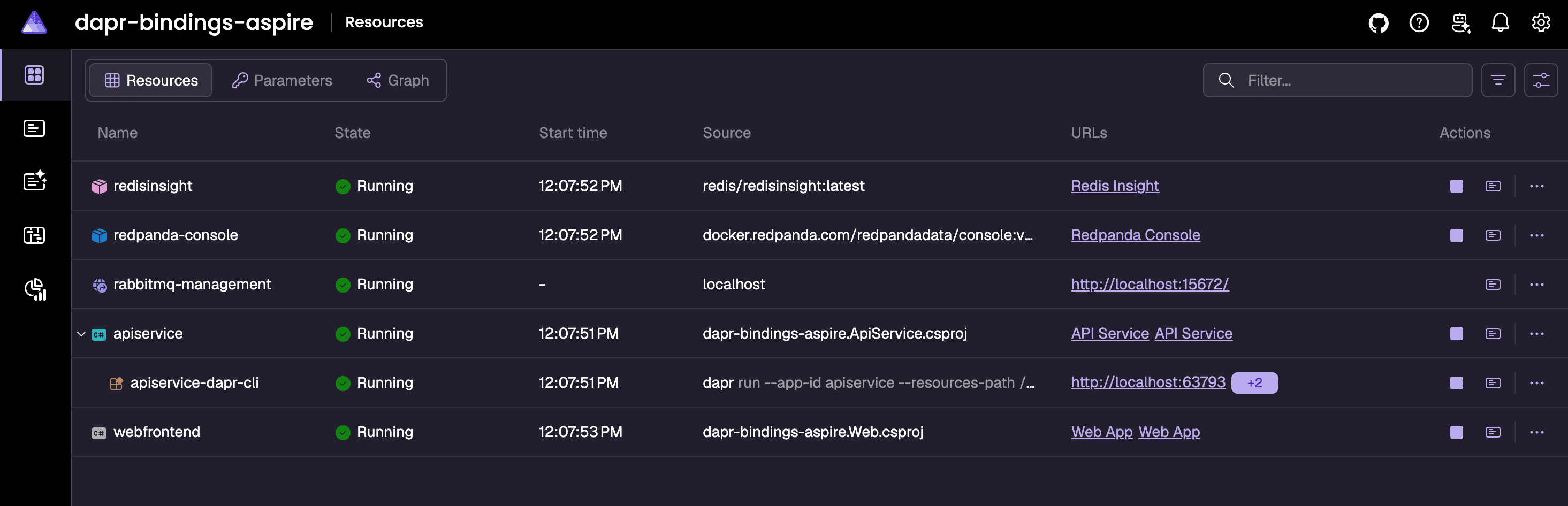
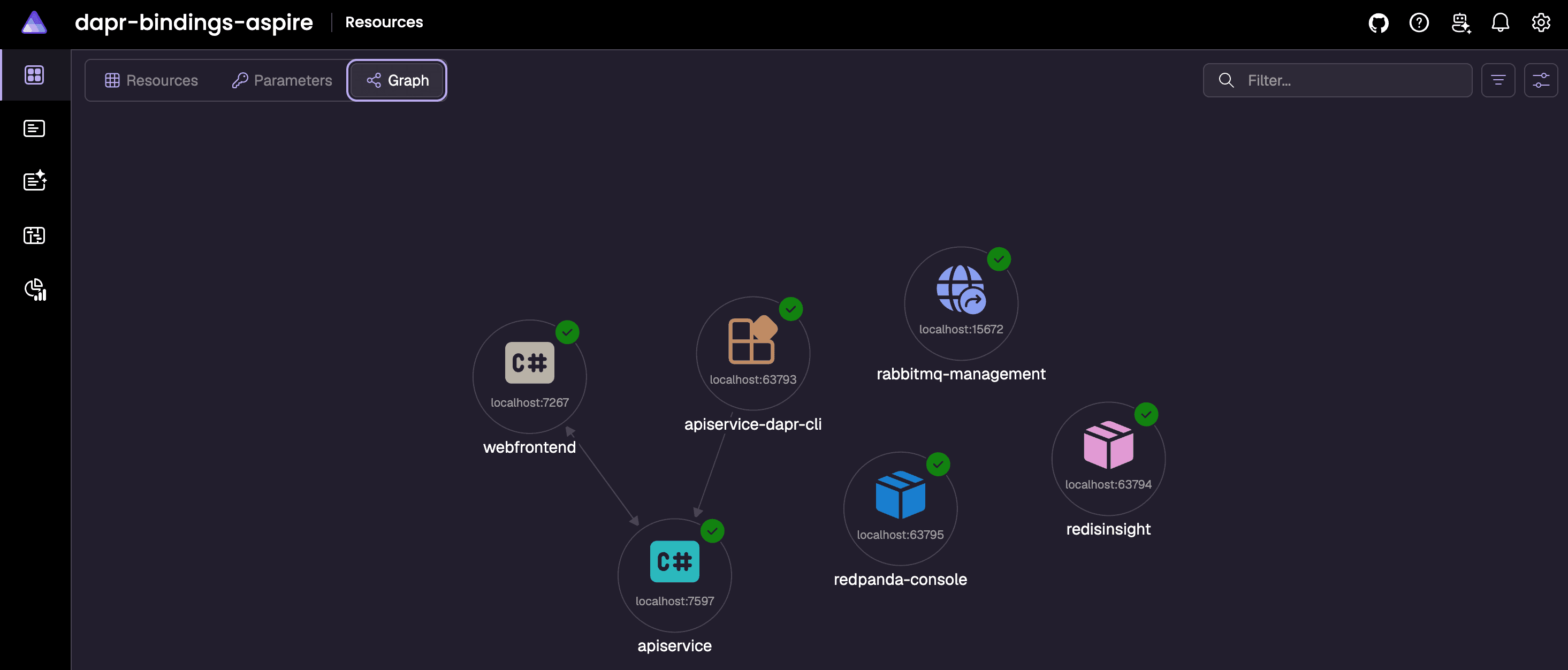
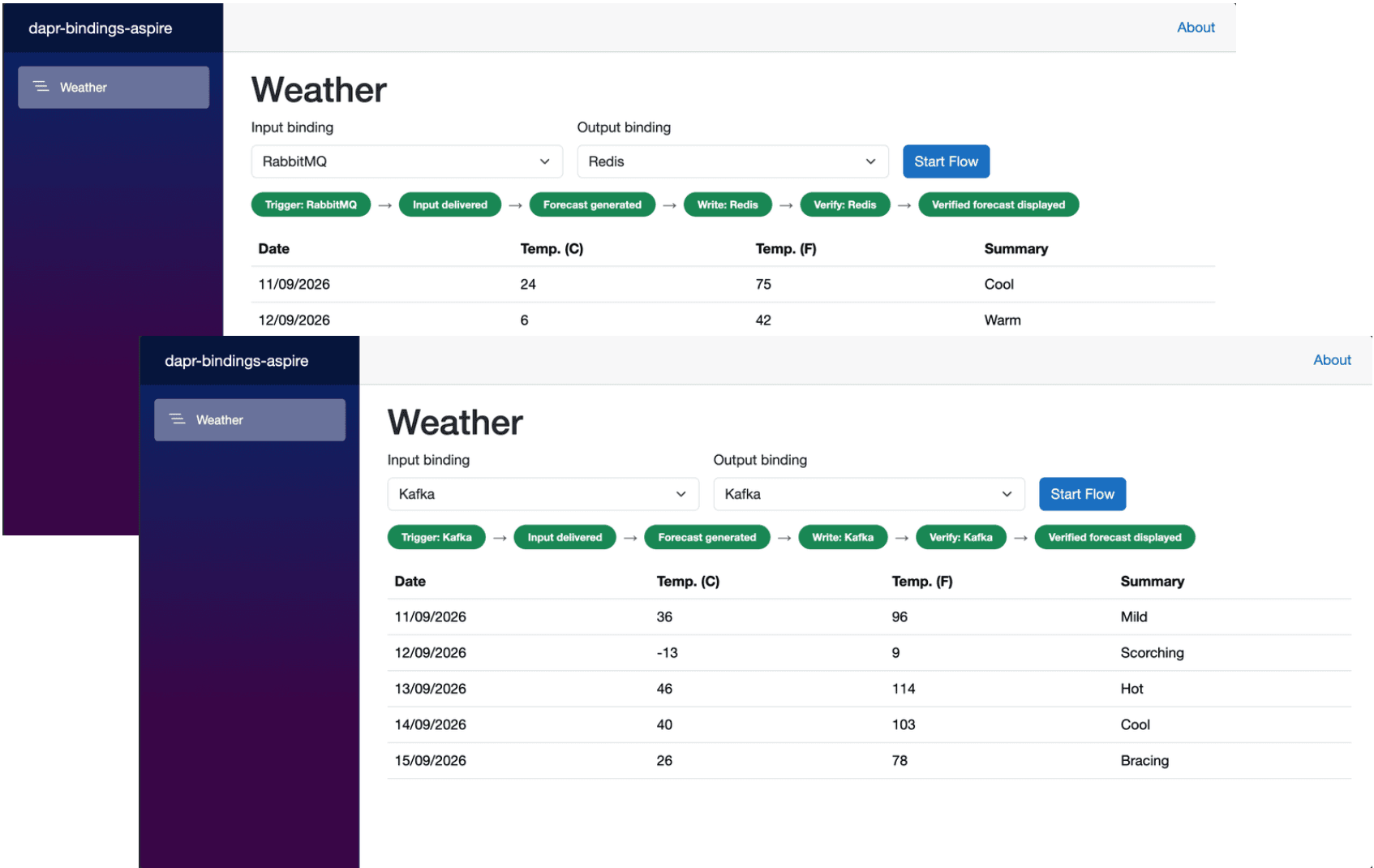
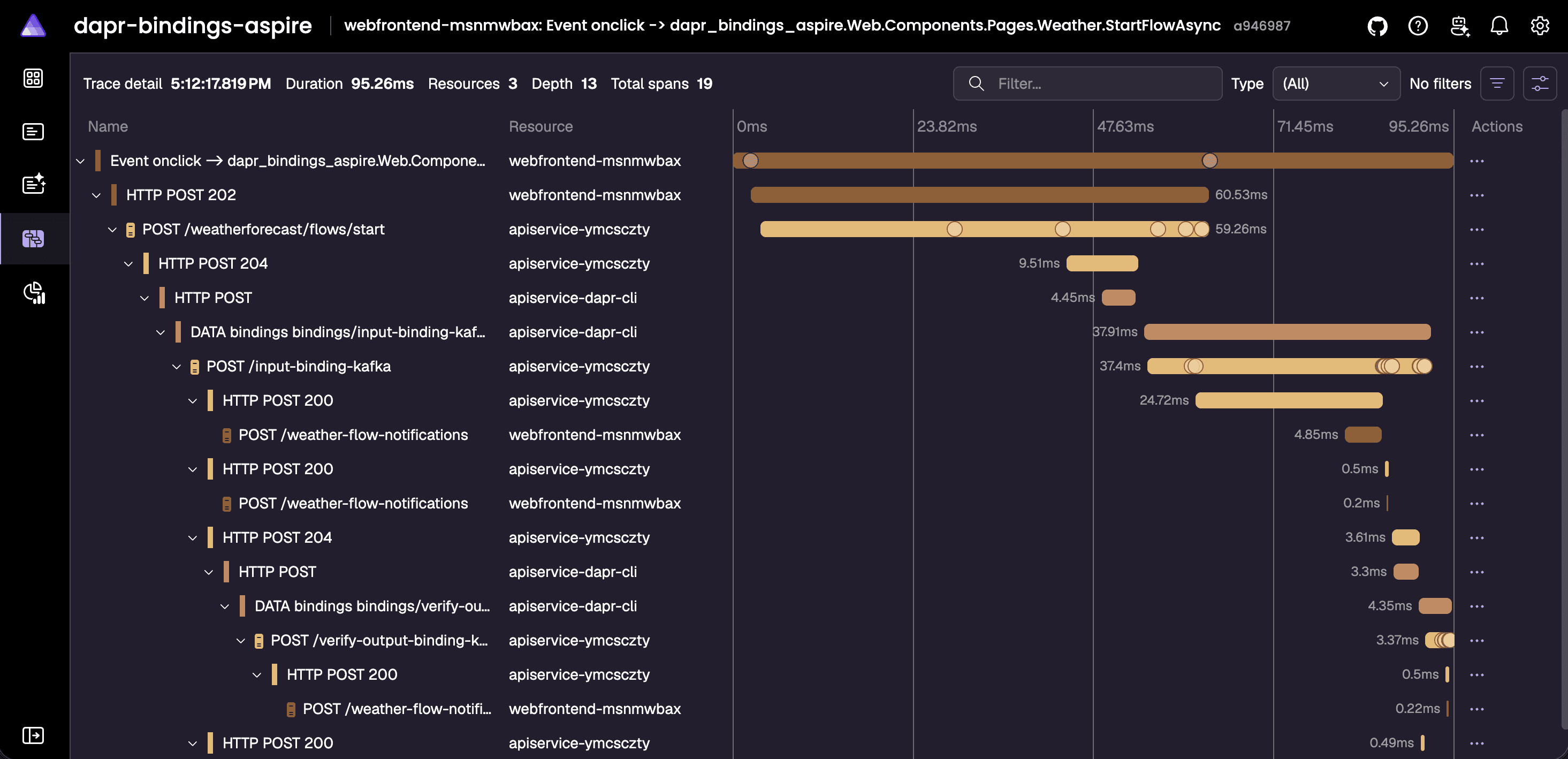
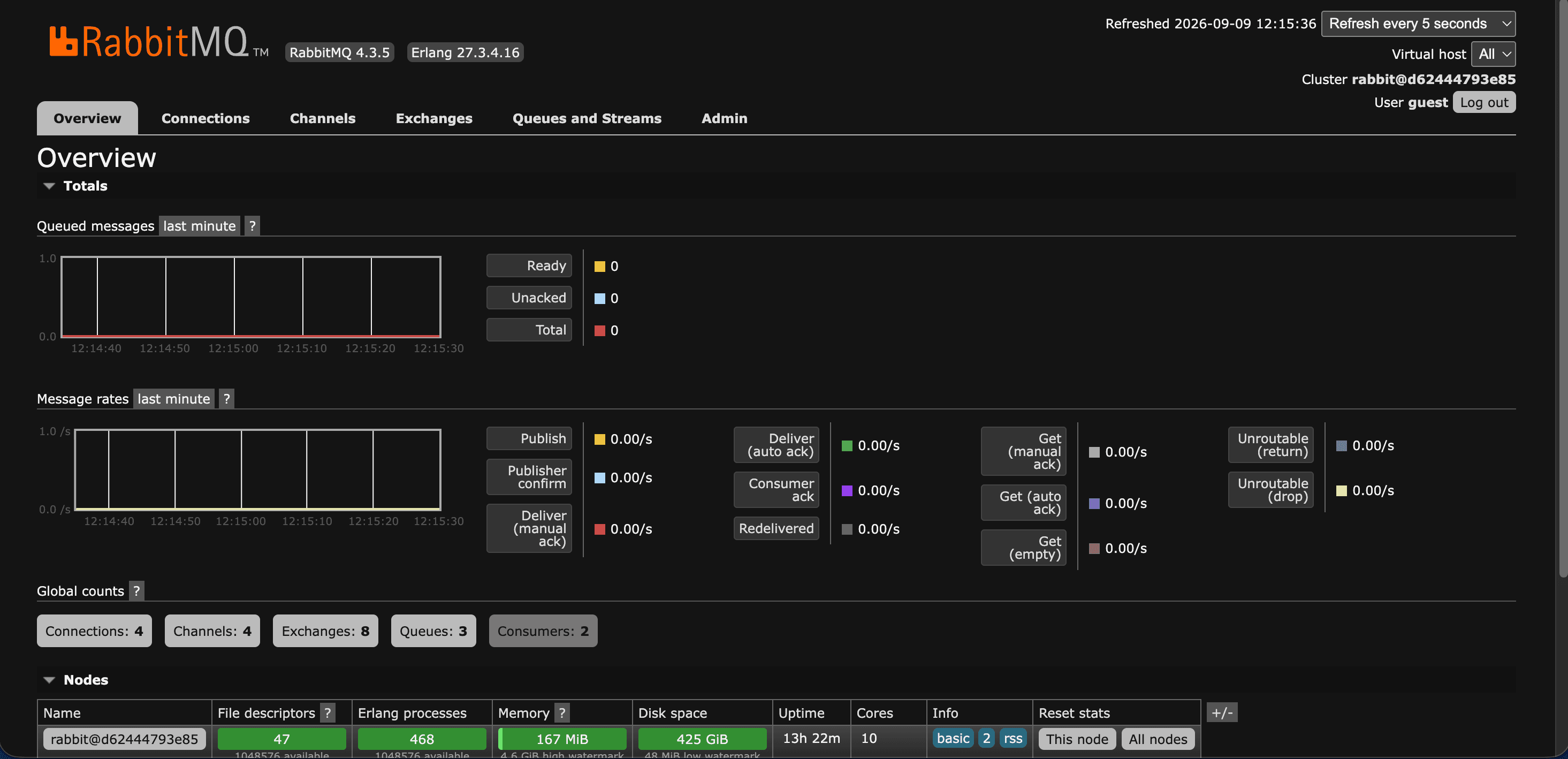
You can also open the management UIs for RabbitMQ, Redpanda Console, and Redis Insight from the Aspire dashboard to inspect the external services.
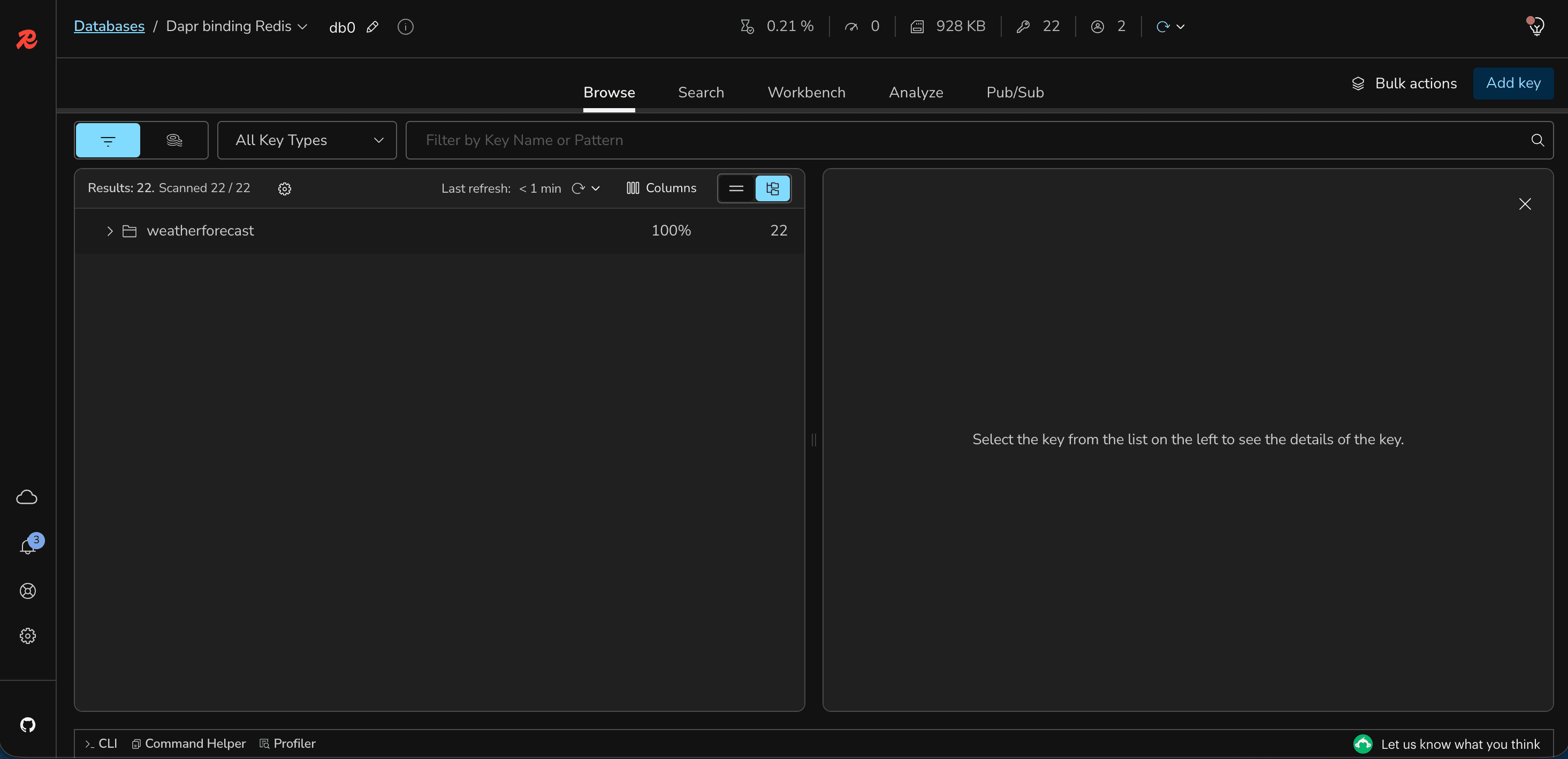
Try all six input/output combinations to see how each flow moves a forecast from its selected input binding to its selected output destination.
Conclusion
This demo highlights how Dapr Bindings provide a consistent way to connect applications with external systems such as RabbitMQ, Kafka, and Redis. Instead of adding and maintaining a separate client library for every provider, the API service uses Dapr’s binding API to send data through a single, consistent contract.
The provider-specific details, such as connection settings, queues, topics, and Redis keys stay in the Dapr component definitions. This keeps the application code focused on the weather-forecast workflow while allowing infrastructure choices to change independently.
With Dapr Bindings, input events can trigger the API through standard application endpoints, and output bindings can deliver results to different destinations without changing the business logic. Combined with Aspire’s orchestration and observability, the complete flow remains easy to run, inspect, and understand.